

Skip to content

RBA Card Surcharge Ban 2026: What It Means for Your Practice

From 1 October 2026, the way Australian businesses accept card payments is changing, and healthcare practices are no exception. 

As part of the Reserve Bank of Australia’s (RBA) biggest payments overhaul in two decades, card surcharging will no longer be permitted, meaning practices won’t be able to add a separate fee when a patient chooses to pay by card.

The cost of accepting card payments isn’t disappearing, though. Payment providers will keep charging businesses to process transactions, so if your practice currently surcharges, now is the time to understand what the change means for your fees, your systems and your patients.

Why the RBA is scrapping surcharging

Surcharging was introduced more than two decades ago, when cash was still the norm, to make the extra cost of paying by card visible so customers could choose a cheaper option. That logic doesn’t hold up today: card payments are now the default for most Australians, including patients at healthcare practices. The RBA has concluded that surcharging no longer steers people toward cheaper payment choices and mostly just adds confusion at the point of payment, so it’s being removed.

What's changing from 1 October 2026

The surcharge ban applies to payments made using eftpos, Mastercard and Visa. American Express has also announced it will remove surcharging from the same date.

Your payment provider will continue to charge a processing fee on every card transaction regardless. That means most practices will need to think about how these costs fit into their overall pricing, rather than passing them on at the point of sale.

Key takeaways

Card surcharging on eftpos, Mastercard, Visa (and Amex, voluntarily) ends on 1 October 2026.

Processing fees still apply; they just can't be passed on as a separate surcharge.

The interchange fee cap is also dropping (roughly 0.8% to 0.3%), which may modestly lower costs, though savings aren't guaranteed to be passed on.

Review your fee structure, payment settings and patient-facing materials before the deadline.

MediRecords/Stripe customers who don't act will have surcharging switched off automatically from 1 October.

Discounts for specific payment methods are still allowed, provided they're genuinely structured and communicated as discounts.

What the surcharge ban means for healthcare practices

It’s an opportunity to review how your practice manages payment costs more broadly. Before 1 October 2026, here’s what’s worth reviewing:

Check your surcharge settings

Find out whether your practice currently applies a card surcharge, and where.

Review your card processing fees

Understand exactly what you currently pay your payment provider to process card transactions.

Review your fee structure

Consider whether your current fees still work for your practice once card processing costs can no longer be passed on as a surcharge.

Update patient-facing information

Check your website, booking systems and other patient materials for references to card surcharges that will need to be removed or updated.

There’s no requirement to increase your fees. Every practice’s costs are different, so it’s worth deciding what approach makes sense for yours.

If you do decide to build card processing costs into your fees, the simplest approach is usually to fold it into your regular annual fee review, factoring in your typical card-to-cash payment split. When communicating any increase, a simple message about your annual review is usually enough; there’s no need to mention card processing costs specifically.

Understanding card processing costs

Previously, practices could recover some or all of their processing fee through a surcharge. From 1 October 2026, that option disappears, so the cost needs to be built into your overall pricing strategy instead.

This is partly offset by another change in the same reform: the RBA is lowering the cap on interchange fees (the portion of a transaction fee that goes to the patient’s bank), from roughly 0.8% to 0.3% on standard credit cards. Stripe has also announced lower domestic pricing from the same date. In theory these should reduce processing costs over time, but providers aren’t obligated to pass savings on in full, so it’s worth treating any reduction as a bonus rather than something to plan around.

Using Stripe with MediRecords?
Here's what to do

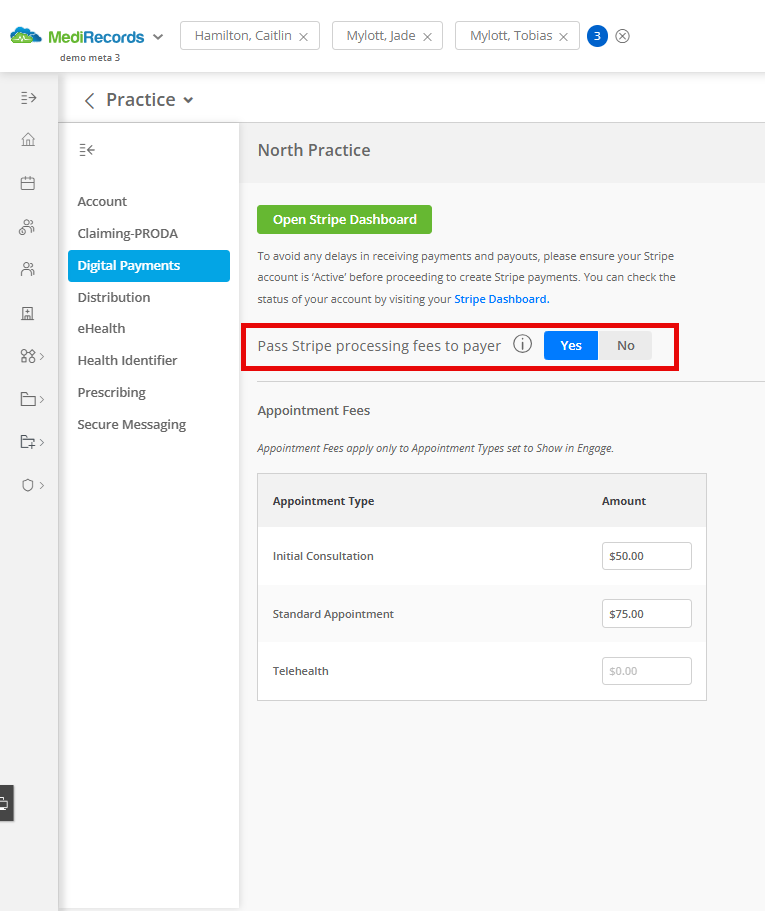
If your practice processes payments through Stripe via MediRecords and currently applies a card surcharge, you’ll need to update your settings before 1 October 2026.

1. Turn off your surcharge

Go to Practice and User Configurations > Digital Payments and set the Surcharge toggle to No.

2. Review your fee structure

Consider whether your practice fees need adjusting to account for card processing costs that can no longer be surcharged.

What if you don’t update your settings? MediRecords will automatically switch off surcharging for Stripe customers from 1 October 2026 and remove the surcharge option entirely. Stripe processing fees will still apply to your practice regardless.

Other payment changes worth considering

The surcharge ban only targets fees added specifically because a patient chooses to pay by card. Other ways of structuring fees and payments aren’t affected in the same way.

Discounts

The new rules don’t prevent practices from offering a discount for a particular payment method, for example, a lower fee for patients who pay by direct deposit. If your practice currently varies its prices depending on how a patient pays, it’s worth reviewing that structure before October to make sure it’s presented and communicated as a genuine discount, not a disguised card surcharge.

Online and telehealth payments

The ban applies to card payments made online just as much as in person, including booking deposits, outstanding account payments and telehealth consultations. Check how surcharges are currently applied across these touchpoints and make sure your settings are ready.

Frequently Asked Questions

When does the card surcharge ban start in Australia?

From 1 October 2026, card surcharging will no longer be permitted in Australia for eftpos, Mastercard and Visa payments. American Express has also announced it will remove surcharging from the same date.

Yes. Payment providers will continue to charge businesses a processing fee on every card transaction; only the ability to pass that fee on to the customer as a separate surcharge is being removed.

Partly. As part of the same reform, the RBA is lowering the cap on interchange fees from roughly 0.8% to 0.3% on standard credit cards, and Stripe has announced lower domestic pricing from 1 October 2026. Any savings aren’t guaranteed to be passed on in full, so it’s worth treating this as a possible bonus rather than something to plan around.

Yes. It applies to card payments made online in the same way as those made in person, including payment links, booking deposits, outstanding account payments and telehealth consultations.

If patients have no out-of-pocket cost, surcharging generally hasn’t been relevant to you. This mostly affects practices charging gap or private fees where a surcharge is currently applied at the point of payment.

Check whether your practice currently applies a card surcharge, review what you pay in processing fees, and decide whether your fee structure needs adjusting once surcharging is no longer an option. It’s also worth updating any patient-facing references to surcharges on your website or booking materials.

If your practice surcharges through Stripe via MediRecords, turn off the surcharge toggle under Practice and User Configurations > Digital Payments before 1 October 2026. If you don’t, MediRecords will switch it off automatically from that date, though Stripe processing fees will still apply.

Considering a move to MediRecords?

Choose your current system and enter your details into the form below. We’ll show your full migration breakdown, and if you’re ready to proceed, our team will be in touch with your timeframe.

Can't see your system? It can usually still move across. Reach out to our team to organise a sample data review.