Why the Patient Record Needs to Become a Platform


by Matthew Galetto, CEO & Founder
We’ve spent more than a decade building what I believe is the only truly cloud-native GP practice management system in Australia.
So when a customer recently described the PMS, and by implication MediRecords, as the “bread and butter” of the practice, something that’s simply expected, part of the furniture and not particularly high value, I had to sit with that for a while.
The comparison was made in contrast to all the new shiny and exciting AI software emerging across healthcare. How is it that a PMS, so critical to the clinical and operational running of a practice, isn’t seen with the same value as an AI scribe?
Then again, I should know better. Medical Director was once given away for free and later offered at a nominal subscription fee, largely funded by the pharmaceutical industry.
The more I thought about it, the more I realised the customer was probably right. Appointments, billing, clinical notes, prescribing, documents, messaging. These things matter enormously. They’re fundamental to running a healthcare organisation. But in 2026, they’re expected. They’re the floor, not the ceiling.
The organisations creating the most value today are asking a different question. Not where the record lives, but what they can build on top of it.
The world has already moved on
In the United States, the ONC Cures Act mandated secure, standards-based APIs, and CMS followed with interoperability and patient access policies. In the UK, NHS England’s GP Connect lets software such as the NHS App surface structured GP record data and repeat prescribing workflows directly to patients through a national digital front door.
Australia is heading in the same direction, and the policy settings are largely there. AU FHIR Core, My Health Record’s FHIR guidance, and a growing body of interoperability work all point toward the same future. The challenge is that we’ve been moving far more slowly than we should.
I’ve attended enough healthcare conferences recently to know that the conversation here is still more talk than action when it comes to genuine interoperability. AI has, in many ways, completely taken over the discussion. That’s understandable, but I sometimes wonder whether we’ve allowed interoperability to become an opportunity lost. The reality is that we need both. The technology exists today, the standards exist today, and patients should already be benefiting.
The context problem we don't talk about enough
The AI conversation in healthcare often gets stuck on the wrong question. People ask whether AI works. They debate the accuracy of ambient scribes, the efficiency gains of voice assistants, hallucinations, false positives, and whether the technology is ready.
Those are reasonable questions, but I think they miss the deeper issue, which is that AI is only as useful as the context it can access.
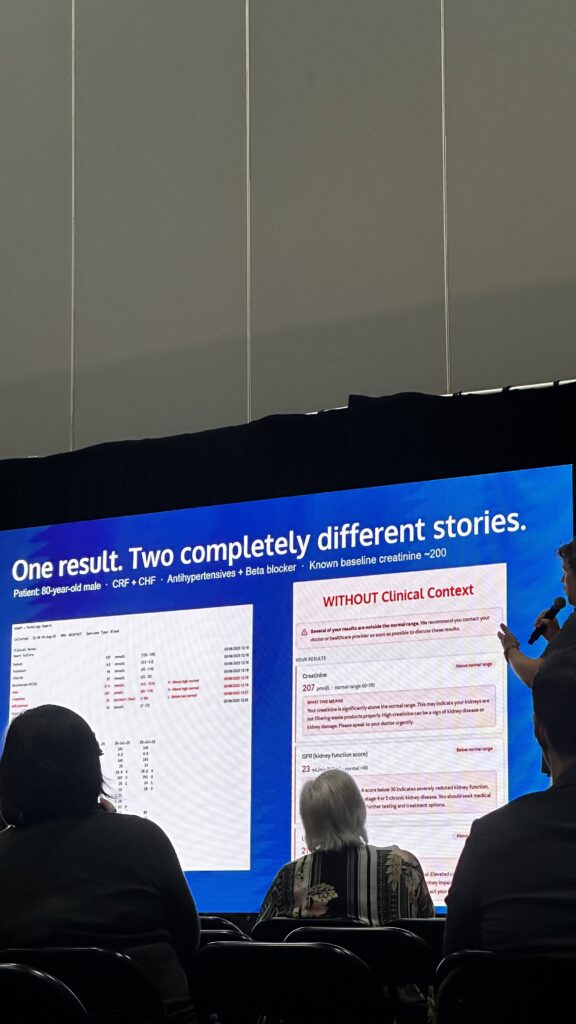
Consider a patient we presented at the Digital Health Festival earlier this year. An 80-year-old male with chronic renal failure, congestive heart failure, hypertension, osteoarthritis, and hypercholesterolaemia. He was taking five medications, including furosemide and bisoprolol. His baseline creatinine was 200 and his GFR was 24.
Now imagine his latest pathology result arrives and he photographs it with his phone before asking an AI to explain it. Without context, the outcome is predictable. The numbers look abnormal, the AI flags concern, and the patient becomes worried. But for this patient, that’s actually his normal. Those results reflect a chronic condition that has been stable for years, not a new clinical event.
What this means for MediRecords
This is the lens I’ve increasingly been applying to what we’re building, and the honest truth is I don’t really see MediRecords as a PMS anymore. I see it as a patient system of record that we and others can build on. That distinction matters because one approach stores information while the other helps customers, partners, clinicians, patients, and AI tools do something useful with it.
In practice, that means investing heavily in FHIR resources to support richer interoperability. It means SMART App Launch, so third-party applications can open already knowing the patient, the encounter, and the surrounding clinical context. It means webhooks, so customer systems can react when an appointment is created, a result arrives, or a consultation note is saved, instead of continuously polling for changes. It means analytics platforms like Clarity sitting close to the record and close to governance, rather than being bolted on later as an afterthought. Most importantly, it means creating an environment where innovation can happen safely, securely, and within clinical workflow.
We’ve already seen what this looks like in practice: FHIR-connected ePrescribing at Northern Health, the HepLink hepatitis C program delivering end-to-end digital pathways, telehealth, patient engagement, and AI Scribe. These aren’t proofs of concept. They’re examples of what becomes possible when the patient record is treated as a platform rather than simply a repository.
The question for the industry
The next generation of healthcare platforms won’t win because they store more data. They’ll win because they let customers do more with the data they already have, securely, within workflow, and at scale. The digital front door, ambient AI, connected care pathways, embedded insights. Whether these capabilities are built directly into a platform or delivered by partners matters less than many people think. What matters is having a platform underneath that makes them possible.
The PMS will always matter. It remains the operational backbone of a healthcare organisation. But I don’t think the future belongs to systems that simply store records. I think it belongs to platforms that make those records useful. That’s the direction we’re taking at MediRecords, and I believe it’s what Australian healthcare needs.
Preview the platform for yourself, and discover what's possible.
For an obligation-free MediRecords demo, simply reach out to our friendly team via the form below.
