Why the Patient Record Needs to Become a Platform

Why the Patient Record Needs to Become a Platform


by Matthew Galetto, CEO & Founder

We’ve spent more than a decade building what I believe is the only truly cloud-native GP practice management system in Australia.

So when a customer recently described the PMS, and by implication MediRecords, as the “bread and butter” of the practice, something that’s simply expected, part of the furniture and not particularly high value, I had to sit with that for a while.

The comparison was made in contrast to all the new shiny and exciting AI software emerging across healthcare. How is it that a PMS, so critical to the clinical and operational running of a practice, isn’t seen with the same value as an AI scribe?

Then again, I should know better. Medical Director was once given away for free and later offered at a nominal subscription fee, largely funded by the pharmaceutical industry.

The more I thought about it, the more I realised the customer was probably right. Appointments, billing, clinical notes, prescribing, documents, messaging. These things matter enormously. They’re fundamental to running a healthcare organisation. But in 2026, they’re expected. They’re the floor, not the ceiling.

The organisations creating the most value today are asking a different question. Not where the record lives, but what they can build on top of it.

The world has already moved on

In the United States, the ONC Cures Act mandated secure, standards-based APIs, and CMS followed with interoperability and patient access policies. In the UK, NHS England’s GP Connect lets software such as the NHS App surface structured GP record data and repeat prescribing workflows directly to patients through a national digital front door.

Australia is heading in the same direction, and the policy settings are largely there. AU FHIR Core, My Health Record’s FHIR guidance, and a growing body of interoperability work all point toward the same future. The challenge is that we’ve been moving far more slowly than we should.

I’ve attended enough healthcare conferences recently to know that the conversation here is still more talk than action when it comes to genuine interoperability. AI has, in many ways, completely taken over the discussion. That’s understandable, but I sometimes wonder whether we’ve allowed interoperability to become an opportunity lost. The reality is that we need both. The technology exists today, the standards exist today, and patients should already be benefiting.

The context problem we don't talk about enough

The AI conversation in healthcare often gets stuck on the wrong question. People ask whether AI works. They debate the accuracy of ambient scribes, the efficiency gains of voice assistants, hallucinations, false positives, and whether the technology is ready.

Those are reasonable questions, but I think they miss the deeper issue, which is that AI is only as useful as the context it can access.

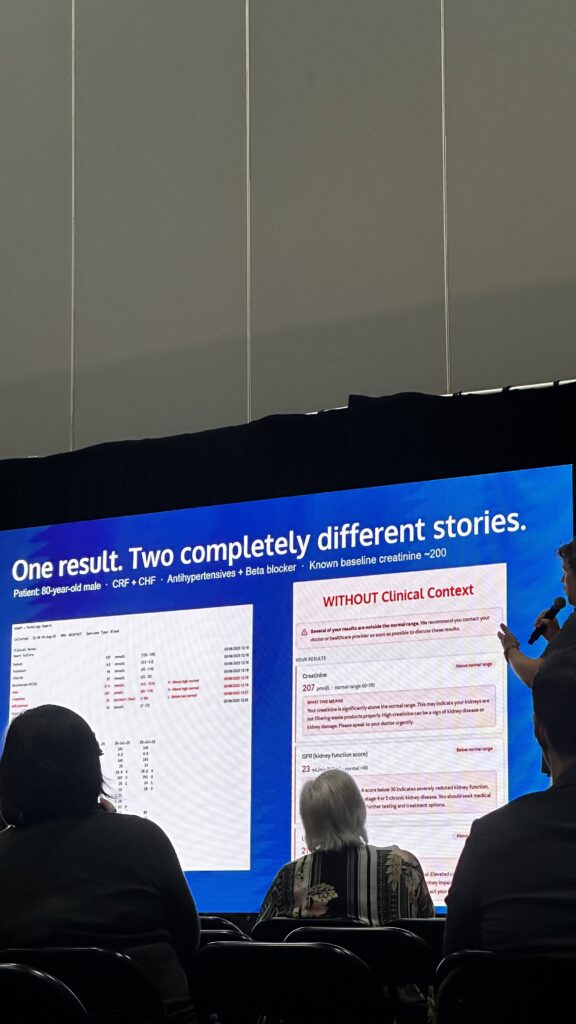
Consider a patient we presented at the Digital Health Festival earlier this year. An 80-year-old male with chronic renal failure, congestive heart failure, hypertension, osteoarthritis, and hypercholesterolaemia. He was taking five medications, including furosemide and bisoprolol. His baseline creatinine was 200 and his GFR was 24.

Now imagine his latest pathology result arrives and he photographs it with his phone before asking an AI to explain it. Without context, the outcome is predictable. The numbers look abnormal, the AI flags concern, and the patient becomes worried. But for this patient, that’s actually his normal. Those results reflect a chronic condition that has been stable for years, not a new clinical event.
What this means for MediRecords

This is the lens I’ve increasingly been applying to what we’re building, and the honest truth is I don’t really see MediRecords as a PMS anymore. I see it as a patient system of record that we and others can build on. That distinction matters because one approach stores information while the other helps customers, partners, clinicians, patients, and AI tools do something useful with it.

In practice, that means investing heavily in FHIR resources to support richer interoperability. It means SMART App Launch, so third-party applications can open already knowing the patient, the encounter, and the surrounding clinical context. It means webhooks, so customer systems can react when an appointment is created, a result arrives, or a consultation note is saved, instead of continuously polling for changes. It means analytics platforms like Clarity sitting close to the record and close to governance, rather than being bolted on later as an afterthought. Most importantly, it means creating an environment where innovation can happen safely, securely, and within clinical workflow.

We’ve already seen what this looks like in practice: FHIR-connected ePrescribing at Northern Health, the HepLink hepatitis C program delivering end-to-end digital pathways, telehealth, patient engagement, and AI Scribe. These aren’t proofs of concept. They’re examples of what becomes possible when the patient record is treated as a platform rather than simply a repository.

The question for the industry

The next generation of healthcare platforms won’t win because they store more data. They’ll win because they let customers do more with the data they already have, securely, within workflow, and at scale. The digital front door, ambient AI, connected care pathways, embedded insights. Whether these capabilities are built directly into a platform or delivered by partners matters less than many people think. What matters is having a platform underneath that makes them possible.

The PMS will always matter. It remains the operational backbone of a healthcare organisation. But I don’t think the future belongs to systems that simply store records. I think it belongs to platforms that make those records useful. That’s the direction we’re taking at MediRecords, and I believe it’s what Australian healthcare needs.

Preview the platform for yourself, and discover what's possible.

For an obligation-free MediRecords demo, simply reach out to our friendly team via the form below. 

MediRecords Completes Queensland Health Implementation In Record Time

MediRecords Completes Queensland Health Implementation In Record Time

In April 2018, Queensland Health selected MediRecords (www.medirecords.com) as its core practice management enterprise solution (PMES) to be used by Hospital and Health Services (HHSs) across Queensland. MediRecords replaced practiX in the private practice operations of Queensland Health, a system that had been in use for over 25 years.

MediRecords is now fully operational in all 13 participating HHSs with the largest of these, Metro South and Metro North going live in April 2019. MediRecords is the first clinical and administrative cloud-based software as a service (SaaS) application serving thousands of subscribers operating within Queensland Health. Implemented on a dedicated platform, MediRecords has successfully been deployed within a 10-month time frame.
On the company’s success, CEO and Founder of MediRecords Matthew Galetto said: “I am delighted with the success of this project which has exceeded our expectations in terms of the scale, speed of implementation and most importantly the acceptance of change by the HHSs end-users. It has been a pleasure to see how constructively and collaboratively the Queensland Health project team and the MediRecords team have worked together. We look forward to a long and strong working relationship.”
In addition to supporting smaller clinics, MediRecords supports larger enterprises managing high volume transactions across hundreds of clinics for thousands of subscribers all from within a single instance of the software. MediRecords supports multiple claiming services covering standard outpatient submissions for GP’s and Specialists alongside a full Eclipse claiming integration. This allows the application to support complex billing for Diagnostic Imaging, Radiation Oncology, Anaesthetic services and all Therapeutic Surgical Procedures. The MediRecords claiming dashboard simplifies submissions, automates receipting and reconciliation, reduces rejections and is supplemented by a detailed financial reporting platform.
The implementation of the MediRecords market leading clinical module used by GP’s and Specialists nationally, and currently in use in several private practice HHS clinics, will be expanded to other HHSs during 2019. MediRecords replaces paper-based record keeping systems with a full longitudinal patient electronic record including consultation note taking and prescribing.
Harnessing the strong synergies with Queensland Health to transform healthcare through digital innovations and technologies, MediRecords will again be sponsoring the eHealth EXPO on 6 June in Brisbane as exclusive partner for the Healthcare of the Future breakout session.

About MediRecords

MediRecords offers the next generation of clinical and practice management software that is transforming the delivery of healthcare servicing in Australia. Connecting health professionals and patients with a suite of integrated products, MediRecords improves patient care while reducing associated costs of outdated technology. Developed from the ground up to harness the power of the cloud, MediRecords is available as an SaaS solution for SMB’s or as a dedicated platform service for larger corporates and institutions.
MediRecords has built an enterprise-calibre platform based on Australian eHealth standards delivering healthcare securely in the cloud. Corporates, government and other institutions can configure and customise the MediRecords Platform to support their PMS and EMR requirements without the overheads of building and maintaining costly application infrastructure. It’s an efficient way for business leaders to build a customised software solution to suit their growing organisation.

More information

Matthew Galetto – Chief Executive Officer

P 0407 374 910

E [email protected]

W www.medirecords.com

Looking to stay updated with the latest from MediRecords?

Sign up to the newsletter

    The hidden cost of maintaining a practice server

    The hidden cost of maintaining a practice server.


    Across our country thousands of practices, including GP’s, specialist and allied health, own and maintain a practice server. The practice server is the powerhouse of the clinic, the primary function of which, is to host the clinical and practice management software. Other critical functions include the hosting of a myriad of add-ons and plugins that connect to, and extract from, the practice management software.


    As a secondary function, the practice server often operates as a file server to store business documents or often as a file repository for incoming faxes. It can also have accounting software installed or be used as an email service for programmes such as Microsoft Exchange.


    There is no doubt that the practice server is a critical piece of infrastructure and central to the successful operations of a clinic.


    So how much does it cost to own and operate a practice server that is so critical to your business? Is there a way to reduce the operating costs? Are there alternative solutions that not only cost less but also reduce the risk of having to maintain a practice server? These are important fundamental questions that all practice owners must ask themselves both when setting up a new practice or  when operating an existing practice.


    Let’s look at costs first! It is mind-blowing!


    The objective is to calculate the total cost of purchasing, operating and maintaining a practice server exclusive of all other peripherals like printers, routers and user computers located at reception desks or doctors rooms. This way we can accurately calculate the cost of ownership and make a valid comparison between on-premise machinery versus a cloud service.


    Table 1 summarises the estimated costs of buying, owning and operating a practice server for a GP clinic with 5 doctors and 4 administration staff applying best practice processes to ensure the business runs without disruption.


    Table 1: Practice Server Costs


    In-House Costs

    Year 1 Year 2+

    Equipment

    Hardware

    Server x 2

    $14,000 $3,500

    Rack

    $2,000 $500

    Backups

    $4,000 $1,000

    Power

    $1,000 $250

    Hardware setup, networking & server backups and testing

    $5,000 $1,250

    Clinical software installation & configuration

    $5,000 $1,250

    Sub total

    $31,000 $7,750

    Licencing

    Licencing

    5 doctors & 4 support. FTE $1000 pa per FTE

    $9,000 $9,000

    Office 365

    5 doctors & 4 support. Office 365 with Storage @ $12pm

    $1,296 $1,296

    Sub Total

    $10,296 $10,296

    Operating Costs

    Server

    1700W at $ 0.37running 24/7 (2 x 850W server) running @ 1/2 power

    $2,643 $2,643

    Computer Room

    Assuming a nominal 2% floor coverage @ $100k per year

    $1,000 $1,000

    Backup Equipment

    800W at $ 0.37running 24/7 running @ 1/2 power

    $1,321 $1,321

    A/C 9m3 room

    24/7 running costs at $0.50 per hour

    $4,464 $4,464

    Sub Total

    $9,428 $9,428

    Monitoring and Management

    Server Management

    $1000 per month

    $12,000 $12,000

    Sub Total

    $12,000 $12,000

    Total

    $62,724 $39,474


    Capital costs for year 1 exceed $30k. In combination with initial software licensing (including practice management software and MS Office 365), electricity costs and consulting fees to both setup and manage your infrastructure, takes the total year 1 expenditure to $62,724


    Ongoing annual costs are estimated at $39,474 per year. Over a five-year period, the total cost of ownership is estimated to be $220,620


    Cloud Service Costs


    Calculating the total cost of ownership for cloud services is easy. There is no need for a dedicated practice server to host the clinical and practice management software, and the only requirement is to include licensing and initial software configuration costs.

    Of course, as previously stated, the practice server is often used for other purposes, the most common being a file server for the practice, where documents are saved. To compare like for like, subscriptions to MS Office 365 for all staff are also included. MS Office 365 is a cloud offered service providing access to MS Word, Excel, Email and most importantly OneDrive. OneDrive is a dedicated cloud based file service hosted in Australia when linked to an Australian entity. This guarantees that any clinical documents are saved on OneDrive securely and in Australia. Practices can use OneDrive to file and backup business documents and faxes. Table 2 summarises the estimated costs of cloud services.


    Table 2. Cloud Services Costs


    MediRecords Year 1 Year 2+

    SetUp Fees

    Medicare, Training, Letter Templates, MHR, Messaging $2,750 $0

    Data Migration

    $1,500 $0

    Licencing

    5 doctors & 4 support, 4 Integrated, 2 Clinical, 3 Practice

    $7,560 $7,560

    Office 365

    5 doctors & 4 support. Office 365 with Storage @ $12pm

    $1,296 $1,296

    Sub Total

    $13,106 $8,856


    Including setup fees, data migration and licensing of both MediRecords and MS Office 365 the total year one estimated cost is $13,106. Ongoing annual costs are estimated as $8,856


    Conclusion – The results Speak For Themselves


    Comparing like for like costs between an in-house practice server vs cloud services, excluding all other peripherals like printers and users computers, significant savings can be made.


    In year one alone the costs saving is estimated as $49,618  Ongoing annual cost savings are estimated as $30,618 and over a five year period the total estimated savings are a staggering $172,290


    To put this saving in perspective, and assuming 20 consults per day with an average billing rate of $70 per consult, this would translate to an extra 5 days holiday for each of the 5 doctors doctors each year.


    There is no doubt that significant savings can be made by moving the entire practice to the cloud, the numbers speak for themselves. However that’s not the only reason it’s a smart move. Cloud services providers offer backups and redundancy. Knowing that your information is being backed up, secure and available provides peace of mind to the practice owner – how do you put a price on that!