Too many apps on the dancefloor: digital continuity, governance and productivity 101

Two doctors discuss a patient's file over a tablet device.

Too many apps on the dancefloor: digital continuity, governance and productivity 101

Two doctors discuss a patient's file over a tablet device.

Do we try to sew together a mass of emerging apps to connect and refer up and downstream, or use agile platforms that can connect it all in one system?

Matthew Galetto - Founder and CEO MediRecords

This article was originally published by Health Services Daily on 11 November 2025

The federal government has drawn a line in the sand: since October 2025, pathology providers must upload reports to My Health Record by default, with diagnostic imaging following in February 2026. Medicare benefits are only payable when organisations comply.

That’s just the beginning.

The government is explicitly exploring ways to expand default sharing beyond pathology and diagnostic imaging to other types of key health information, including discharge summaries, specialist letters, and care plans.

It’s not a question of if GP consultations, specialist visits, and allied health services will face the same requirements. It’s when.

 And it’s not just about uploading data. Since 2023, clinical software that connects to My Health Record has been required to meet mandatory security conformance standards.

While the government ultimately stopped short of mandating full Essential Eight compliance (recognising that very few systems would have met the threshold), the direction is clear: minimum cybersecurity standards are coming as a prerequisite for exchanging information with government services, including Medicare.

If your systems can’t demonstrate baseline security resilience, you won’t be connecting to national infrastructure much longer.

A screenshot of the Sales Audit screen within the MediRecords software.

For organisations managing both internal health services and external community referral networks, this integration challenge isn’t theoretical. It’s the difference between being able to answer an auditor’s questions and hoping they don’t dig too deep and it’s a massive potential pivot to or away from productivity.

When audits expose the integration gap

The Australian National Audit Office’s recent audit of Defence health services put numbers to what many already suspected: poor integration between clinical and financial systems made it impossible to reliably track what services were delivered, by whom, or whether claims matched care.

Defence is far from unique.

The same pattern shows up across corporate health services, corrections health, employee assistance programs, and anywhere else an internal health service refers patients to external community providers.

What the audit exposed was that when you refer internally and deliver externally without a unified system, you lose the thread. You can’t track the referral pathway. You can’t validate service delivery. You can’t reconcile the claim back to the original clinical decision.

A specialist and surgeon discuss the details of a patient's referral over a clipboard.

When the referral chain breaks

A patient visits an internal health service. The GP refers to a community specialist. The specialist orders pathology and refers to allied health. Someone else handles the follow-up. Each provider bills separately, through separate systems.

By the time finance tries to reconcile it all, tracking the chain of referrals feels more like forensic investigation than accounting. Clinically coded data lives in one system. Community provider billing happens in another. Medicare bulk bills go through one channel, private providers through another, and DVA or other contracted arrangements follow their own logic entirely.

When something doesn’t add up (and it often doesn’t), you’re left hunting through emails, spreadsheets, and disparate databases trying to reverse-engineer what actually happened.

 For organisations with duty-of-care obligations, where you’re responsible for health outcomes even when care is delivered externally, that lack of visibility is a significant governance failure. But it’s one we’ve largely lived with because our systems haven’t been sophisticated enough to cope with the problem.

However, now that we can contemplate a system that doesn’t just connect these elements but in doing so also creates an audit trail, it’s not just governance people should be thinking about. It’s productivity.

How much money and workforce productivity will start to emerge in our healthcare system when we start properly joining up all the elements of referral, clinical record, booking and invoicing, in real time?

We are literally talking in the billions. Yet it’s something people haven’t largely even contemplated in the current digital transformation of our healthcare system … yet.

How it should work

If your internal health service already uses a platform that manages referrals, clinical documentation, billing, and compliance, extending that same platform to community providers creates an unbroken chain of accountability from initial consultation to final payment.

Internal service creates a referral. The system captures the clinical justification, authorised services, and any service limits. The community provider receives the referral, accesses the same system, sees the referral context, and documents their service delivery. Service is coded and billed. The system automatically validates that the service matches the referral authorisation. Finance reconciles in real-time. Because everything lives in one system, there’s nothing to reconcile manually.

Every action connects to the one before it. The audit trail is automatic. The organisation maintains visibility and governance over care delivered externally, without sacrificing provider autonomy.

But the system pay-off is in productivity of the provider and the patient. Literally millions of hours not wasted in trying to connect the dots on payments, invoicing and bookings.

The pay-off is for everyone but providers will need to be able to extend the system they use internally to their external provider network.

Some systems today are starting to claim they can do this. But most only offer elements of solving the problem.

A cloud-based e-referral system, for instance, is neat but it can’t seamlessly integrate to bookings and invoicing in a line to create a single audit trail and set of invoices. These are nice-to-have new elements but they are essentially modern versions of the old SMD systems.

Solving the referral-to-community problem

Forgive me here but I’m going to talk about the one system I’m involved with, MediRecords. I’m doing this because I know it so well, it provides a great example of what is achievable if you are able to extend your system seamlessly to external provider networks and, well, I’m selling it, obviously.

Surprisingly, given the seismic productivity gains on offer for both patients and providers, systems like MediRecords – essentially an FHIR-enabled cloud-based EMR with lots of good APIs – are, so far, few and far between in Australia.

For a long time the government has not really incentivised cloud-based connectivity in Australia with the result that many old server-bound integrations have been able persist a long time in the system.

Other cloud-based systems like MediRecords with longitudinal system connectivity capability do exist, but I’ll let you do that research.

What’s important is these new core cloud systems are agile in their ability to connect and share data in real time with other systems, which is auditable and which, because of the flexibility of connection, provides the ability for all elements of a single patient transaction to be captured and processed.

Where MediRecords is already deployed as the core system for internal health services, extending it to community providers means those providers gain access to the same platform, but with appropriate scope limits and data access controls.

A community GP sees only their own patients and referrals, but the referring organisation maintains oversight across the entire care pathway.

The platform handles referral management with structured referrals including clinical context, service authorisation, and validity periods. It manages multidisciplinary workflows with different claiming rules for GPs, specialists, allied health, pathology, and imaging. Real-time compliance happens automatically, validating services against referral authorisations and payor rules. And every referral, service, and claim comes with audit trails that prove clinical appropriateness.

For enterprise and community networks managing dozens of sites and hundreds of external providers, dashboards show where referrals are flowing, where services are getting stuck, and where revenue patterns don’t match clinical expectations.

Meeting regulatory standards

MediRecords supports FHIR and OntoServer standards, integrates with national infrastructure via secure messaging, and stores the structured data required for My Health Record uploads.

Under the hood, MediRecords is built with double-entry accounting, a general ledger, and full journal management. This provides the financial backbone that government finance departments and enterprise systems require.

The Department of Health, Disability and Ageing’s Compliance Strategy 2025-30 makes it clear: data integrity includes cybersecurity.

MediRecords’ cloud-native architecture aligns clinical and financial assurance with enterprise-grade security. For organisations evaluating community provider networks, that means one less integration risk and one less compliance gap.

The trade-off: Integration v independence

When you’re managing thousands of services, including external referrals across hundreds of providers, manual review is almost impossible.

Some advanced providers, MediRecords being one of them, are exploring how artificial intelligence can automatically identify, link, and map services to item codes, validate claims against payor rules (whether government, insurer, or contract-based) and flag services that don’t match referral authorisations.

That means fewer manual audits, faster reconciliation, and better confidence that community providers are claiming appropriately. The result is a platform that doesn’t just capture data. It learns from patterns and helps organisations maintain governance without drowning in manual review.

What comes next

Health reform is heading in one direction: integration, data sharing, accountability and significant productivity gains, particularly in the area of workforce.

Organisations responsible for health outcomes are being asked to demonstrate traceability even when care is delivered externally and solve their productivity and workforce issues. That’s now just not feasible with legacy systems: when internal services and external providers use completely different platforms.

The path forward isn’t more integration layers, one-off cloud-based connection applications or complex data feeds. It’s system continuity.

Using the same platform internally and externally, so that clinical accountability, financial governance, and regulatory compliance flow naturally across organisational boundaries.

For organisations already using MediRecords internally, extending it to community providers isn’t just the path of least resistance. It’s the path of greatest assurance and productivity.

Connected care, credible claims, real compliance and generationally impactful productivity gains.

That’s what modern health governance and productivity looks like when care crosses organisational lines, which more and more these days it must if we are to manage a system rapidly moving to team based chronic care management.

Is cloud technology the new necessity for innovation and productivity in digital health?

Is cloud technology the new necessity for innovation and productivity in digital health?

Is cloud technology the new necessity for innovation and productivity in digital health?

What a difference the cloud makes - why GPs need to look up when seeking software
Matthew Galetto - Founder and CEO MediRecords

Ask anyone working in digital health today, particularly those investing or looking for solutions to support new models of care, and they’ll tell you: all innovation is happening in the cloud. From startups launching AI diagnostic tools, coding agents, and voice assistants for booking and admin, to government projects aimed at connecting national health systems, everything modern is being built on cloud infrastructure.

Cloud is no longer a technology trend. It is the new normal.

At MediRecords, we see this shift as driven by more than convenience or cost-cutting. It is structural, it is inevitable, and it is being driven by real demand and expectations from service providers, clinicians, and most importantly, patients. In 2025, cloud-based technology has become the clearest signal of innovation in healthcare and the most practical way to achieve the productivity gains the system so urgently needs.

Whether you are a startup, a health service, or a government agency, cloud is no longer a nice-to-have. It is the bare minimum, and every new dollar of investment is chasing it.

Why cloud matters in digital health

The cloud is not just another way to host software. It is a different way to build, deliver, and keep improving it. Here’s why cloud-native solutions are leading the way:

  • Real interoperability: National health infrastructure is API-based, and that is where the future is heading. My Health Record, IHI, Provider Connect Australia, and the Service Locator are all part of an API ecosystem. Cloud-native systems are built to plug into these environments seamlessly, supporting information sharing at the point of care with the reliability and resilience of cloud hosting.
  • AI enablement: From clinical decision support to smart assistants and summarisation tools, AI runs best where it was designed to, on the cloud. Cloud makes AI scalable, secure, and accessible without the need for costly hardware. At the Medical Software Industry Association (MSIA) forum in July, AI was called out as both an opportunity and a risk. AI scribes, triage tools and predictive analytics are recognised as critical enablers of safety and efficiency, but there are also new cyber threats, with attackers using generative tools to launch sophisticated campaigns. Cloud platforms offer the enterprise-grade security, zero-trust frameworks and rapid patching that healthcare now requires.
  • Data-driven care: Cloud platforms unlock live analytics and reporting that go far beyond static PDFs or siloed spreadsheets. Think population health insights, service delivery metrics, and predictive alerts, available in real time.
  • Lower overheads: No servers to manage and no on-site maintenance. Cloud reduces the total cost of ownership while accelerating change. Less drag, more delivery.
  • Always up to date: Continuous upgrades mean your platform improves every few weeks, not every few years. That is the speed clinicians and patients expect today.
  • Productivity through scale and innovation: Cloud is not just about what is possible today, it is about what becomes possible tomorrow. From smarter workflows and automation to seamless integrations and flexible deployment models, cloud platforms open new ways of working. Providers can scale efficiently, deploy services faster, and deliver care in ways that traditional systems cannot support.

Cloud as the productivity engine

The recent MSIA conference sharpened this focus. Digital health reform is no longer about modernisation for its own sake; it is about driving system-wide productivity. Rising demand, workforce shortages and growing administrative burden mean the health system must deliver more with less.

Cloud-native platforms, built on FHIR standards and national interoperability, enable real-time data sharing, automation and AI in ways that reduce duplication, shorten wait times, and free up clinicians for patient care.

Seen this way, cloud is more than a proxy for innovation. It is the engine of productivity. In health, innovation and productivity are inseparable. Innovation that does not deliver productivity will not scale, and productivity gains without innovation will stall.

Government signals: Cloud as a strategic pillar

The federal government’s Sharing by Default Act 2025 is a milestone, requiring pathology and diagnostic imaging results to flow automatically into My Health Record. The upcoming National Digital Medicines Strategy (2025–2030) will go further, embedding interoperable, cloud-enabled medicines management into the foundations of the system.

Policy language now makes it clear: “information sharing by default, near real time, at the point of care” is the goal. That is only achievable with cloud-native systems that speak fluent API.

Procurement patterns are already shifting. It is increasingly difficult to win a government contract or even make it to tender without being cloud-enabled.

Clinicians are also driving this change. Next-generation doctors are digital natives. They expect intuitive, mobile-responsive, fast-evolving tools that feel more like Spotify or Canva than clunky desktop software. Patients expect the same: digital front doors, secure portals to access personal information, cost transparency, and notifications that help them manage their care.

Investment dollars also tell the story. Every new venture-backed digital health company in Australia is building for the cloud. There is simply no appetite to fund new on-premise apps.

Finally, security is no longer a barrier to cloud, it is a benefit. Cloud platforms provide enterprise-grade security, encrypted communications, and high availability that far exceed what most local deployments can offer. In today’s environment, cloud has become the safer, more resilient choice.

Evidence that digital maturity and connected systems delivers results

The evidence for digital transformation in Australia is compelling.

  • Queensland’s transition to integrated digital hospitals achieved a 40% reduction in medication incidents and a 70% reduction in prescribing errors. 
  • Digital-first cardiac rehabilitation programs have demonstrated up to 71% reductions in readmission bed days, proving that connected care can improve outcomes and reduce costs
  • Studies of digital maturity in Queensland health services show that higher-maturity, interoperable systems are associated with better patient experience, improved staff satisfaction, and perceptions of safer care. 

Cloud as the path to digital maturity

These improvements arise from digital maturity, not hosting models alone. But cloud is increasingly the only realistic way to achieve and sustain that maturity at scale. Recent Australian examples demonstrate the benefits. NSW Health’s migration of clinical applications to AWS Cloud improved application performance, halved the time to deploy new environments, and freed clinicians from manual IT work. A trans-Tasman review of 66 cloud-enabled healthcare use cases found consistent gains in productivity, patient access, and system equity. And in community pharmacy, electronic prescribing and digital medication records, often delivered via cloud platforms, have streamlined workflows and improved medication safety.

Cloud does not just enable new technology; it provides the structural resilience, interoperability, and scalability that allow digital systems to deliver measurable improvements in outcomes and efficiency.

MediRecords: A case study in cloud-driven innovation

MediRecords was built in the cloud from day one, not retrofitted or migrated. That foundation lets us partner with the most forward-thinking health programs, providers, and digital vendors across the country.

We are already helping modern care models take shape:

  • Telehealth providers using MediRecords to deliver digital-first consultations without legacy drag.
  • AI partners are integrating with our APIs to provide summarisation, smart triage, and workflow automation.
  • Analytics through our soon-to-be-released Clarity module, giving providers real-time insights into service usage, clinician performance, and patient outcomes.

We connect natively with Australia’s API-based government digital infrastructure, ensuring our customers can operate seamlessly across national systems. Our containerised implementation of OntoServer (CSIRO’s terminology server) provides scalable clinical decision support and structured interoperability as a managed service.

Just as importantly, our open APIs empower healthcare organisations to shape their own digital future by connecting enterprise systems, building digital front doors for patients, and innovating beyond the clinic walls.

Conclusion: The cloud test

If you are evaluating a new digital health solution, whether it’s practice management, patient engagement, analytics or anything related, ask this first: is it cloud-native?

If not, it is already out of step with:

  • Where government policy is going
  • Where clinicians and patients expect to be
  • Where investment dollars are flowing

In 2025, cloud is not just infrastructure. It is the benchmark for innovation and productivity in digital health.

In healthcare, innovation that does not deliver productivity is unsustainable. Productivity gains without innovation pathways, quickly erode. Cloud is where the two converge, and where the future of healthcare is being built.

References

  1. Queensland Health. Digital Hospital Benefits Realisation Report. Cited in MSIA, 2021.
  2. Neubeck L, et al. Digital cardiac rehabilitation: systematic review and meta-analysis. Eur J Prev Cardiol. 2020.
  3. Woodruffe S, et al.  Effects of a digitally enabled cardiac rehabilitation intervention on risk factors, recurrent hospitalization and mortality: a randomized controlled trial. European Heart Journal – Digital Health. 2025
  4. Adler-Milstein J, et al. Evaluating Digital Health Capability at Scale Using the Digital Health Indicator. Appl Clin Inform. 2021.
  5. Thiru K, et al. Perceived Impact of Digital Health Maturity on Patient and Staff Experience in Queensland. Int J Med Inform. 2023.
  6. eHealth NSW. Case Study: Clinical Applications Migrated to AWS Cloud. 2022.
  7. AWS Institute. Benefits of Cloud-Enabled Healthcare in Australia & New Zealand. 2022.
  8. Hussain R, et al. Electronic health records and e-prescribing in Australian community pharmacies. Int J Med Inform. 2024.

Feeling the heat at
Burning GP


Feeling the heat at Burning GP

MediRecords joined the sun-starved throng flocking to the Tweed for the Wild Health Burning GP conference last week.

Here are 10 takeaways from two days of robust and enlightening conversations.

1. GPs are divided on the impact of Urgent Care Centres (UCC)

Are nascent UCCs an attempt to woo voters in outer suburban marginal seats, a means to divert a few people from crowded hospital emergency departments… or an example of government spending that would be better invested in primary care? The Royal Australian College of General Practitioners (RACGP) past president Adj Prof Karen Price also pondered whether UCCs are turning away “non-urgent” patients and referring them back to their family GPs.

2. There’s a great divide between GPs and hospitals

Healthdirect Australia is trialling a way to send NSW hospital discharge summaries to GPs and patients and Queensland discharge summaries are uploaded to The Viewer … but the data disconnect between primary and tertiary care remains vast*.

Associate Professor Alam Yoosuff, the Rural Doctors Association NSW vice president, said GPs were often left in the dark about hospital outcomes for their patients.

“We don’t always know if person has died, been discharged, or been sent home with only six (tablets)… We know the system is not right. It may be better than other countries, but we know it should be even better, given what (governments) are spending.” 

– Associate Professor Alam Yoosuff, the Rural Doctors Association NSW vice president

Judging by the overall vibe at Burning GP, GPs feel much of the government cash spent on shiny new hospitals could be better spent on disease prevention led by community-based primary care practitioners.

3. Workforce scaling

The RACGP warned Australia has a “whole of health” workforce crisis, exacerbated by insufficient medical students coming through, so we’re going to have to import doctors, nurses and specialists from overseas. (The ever-resilient Health Department Assistant Secretary Medicare Benefits and Digital Health, Mr Daniel McCabe, said he preferred “critical juncture” to crisis, triggering a running joke for the entire conference.)

Grampians Health Chief Strategy & Regions Officer Dr Robert Grenfell said the shortage of GPs in western Victoria was so acute he was planning based on having none. He said: “If we have (GPs) I will use them” but it was now prudent to make alternative plans.

4. Medicare misery is multiplying

Several conference panels highlighted the challenges of determining the correct, optimally reimbursed Medicare item codes for complex consultations. Mr McCabe conceded all billable items are due for review, with an aspirational goal of improving access to healthcare for people who can least afford it.

5. Telehealth – supplementary or threat?

If young and tech-savvy consumers keep opting for online access to quick prescriptions, medical certificates and more, community GPs will be left with older, sicker, more complex clients, including those with mental ill health. Whitebridge Medical Centre owner Dr Max Mollenkopf said GPs needed to understand why consumers are switching to digital health companies such as Eucalyptus and adapt fast. He said, “Our old patients who love us will die off and all the young ones will be (Eucalyptus patients) unless we do something different.”

6. The numbers speak for themselves

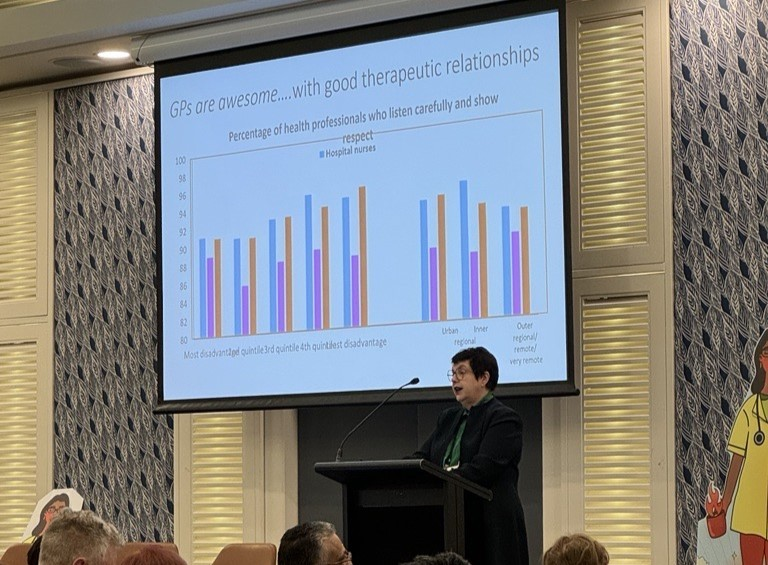
The Australian National University Associate Professor (and GP) Louise Stone highlighted a 42% pay gap between men and women GPs. She said this was compounded by women GPs shouldering a majority of longer, underfunded consultations with complex patients, (who may have been released from hospital prematurely to reduce bed blockages).

7. But metrics may deceive

Associate Professor Stone cautioned that ‘evidence-based solutions’ in healthcare may not be what they seem. Analysis had shown the typical participant in clinical trials is a privileged white male, the researcher is likely to be a white urban male and even the average lab rat is a white furred male. This means clinical metrics may not be representative … and AI tools risk exaggerating biased data even further.

Evrima Technologies CEO and Founder Charlotte Bradshaw said that 80% of clinical trials are delayed in Australia because eligible people can’t be found and paired with researchers.

8. The My Health Record (MHR) will grow exponentially

Mr McCabe confirmed legislation is imminent to mandate sharing diagnostic imaging and pathology with the MHR. The government will also “push very hard” for every medication event – prescribing and dispensing – to be uploaded. The CSIRO-led Sparked community will need to lead the software industry to a FHIR (Fast Healthcare Interoperability Resources) standard to achieve this. Mr McCabe said Australian healthcare was hamstrung by “a lot of technology built in the 1990s that is not fit for purpose”. The recent MediSecure data breach showed, “We need to make sure we set the bar a lot higher than it is today”.

9. Technology knowledge is variable

When you’re a time poor GP, technology is rarely top of mind. You just want it to work. GPs still need reassurance from healthcare influencers that cloud technology is as safe (or safer) than server-driven desktop tech and that switching brings cost and time savings on hardware, hosting, back-ups, security, software patches, electricity and more. As one GP said to us, “You mean I can sack my IT guy?”

As for innovations such as Artificial Intelligence (AI), there’s a sense that while there are time, safety, revenue and efficiency gains to be made, the early adopters and innovators will be waiting a while for their conservative colleagues to join them.

10. Summing up

Based on our conversations and observations at Burning GP, community general practitioners feel underfunded, overworked, undervalued, and under siege from telehealth providers and pharmacists. They’re a resilient mob though, and still passionately defending their role as number one for longitudinal patient care.

*MediRecords new Admissions module means we can provide a longitudinal record connecting primary and tertiary care in one secure, cloud-hosted software system. We can send Discharge Summaries from our Admissions module and store them against the central patient file. Please reach out to us at [email protected] if you’re trying to solve these types of connectivity problems!

Australian Healthcare Providers to Automatically Share Data with My Health Record Within a Year
 

Australian healthcare providers to automatically share data with My Health Record within a year

New rules mandating healthcare providers share information to My Health Record by default are expected next year.


In a five-year strategy and roadmap released last week, the Australian Digital Health Agency (ADHA) detailed “priority initiatives that will contribute to delivering the strategy’s vision of an inclusive, sustainable and healthier future for all Australians through a connected and digitally enabled health system”. 

The ADHA is charged with accelerating the adoption and use of digital services and technologies across the Australian health system, and this report identifies four change enablers. Among these is regulatory and policy change 

 Dovetailing with the federal government’s Digital Health Blueprint 2023 – 2033 , the other enablers are: 

  • Secure, fit-for-purpose and connected digital solutions 
  • Digitally ready and enabled health workforce 
  • Informed consumers and carers with strong digital health literacy 

 Consumers and clinicians can look forward to health-information exchange and real-time access to data when the National Digital Health Strategy 2023-28 is fully implemented. 

Secure, connected, interoperable digital solutions are key to accelerate the adoption and use of digital services and technologies across the Australian health ecosystem, according to the new strategy. 

The ADHA is a corporate Commonwealth entity supported by all Australian governments to cultivate the adoption and use of digital services and technologies in health.

MediRecords Founder and Chief Executive Officer Matthew Galetto said, “We welcome this report and stand ready to collaborate as industry partners.”

“In particular, we welcome the government’s regulatory efforts aimed at enabling efficient health data exchange to support accessible, person-centered care for patients.”

“At MediRecords, we are fully prepared to embrace and support the government’s vision that mandates “real-time information exchange at the point of care”. Our cloud-based solutions are equipped with Application Programming Interfaces (APIs) and Fast Healthcare Interoperability Resources (FHIR) by design, ensuring seamless connectivity within the broader healthcare ecosystem.”

“We’ve already observed a growing trend among healthcare service providers who are eager to future-proof their operations by adopting the next generation of clinical solutions. This proactive approach not only aligns with our capabilities but also underscores our commitment to advancing healthcare through innovative technology.”


Looking to stay updated with the latest from MediRecords?

Sign up to the newsletter

    Big-spending Federal Budget tackles bulk billing crisis 
     

    Big-spending Federal Budget tackles
    bulk billing crisis

    Doctors and healthcare consumers are the winners in the 2023-2024 federal Budget.

    The Albanese Government’s first Budget emphasised the importance of secure, safe and efficient digital sharing of health information — albeit without mandating standards for achieving this.

    A total commitment of $101 billion in health spending will include an upgrade to My Health Record, and $3.5 billion in bulk billing incentives for common GP consultations, including telehealth and videoconference, making care more affordable.

    More than 300 common PBS medicines will be made more affordable, with Australians able to buy two months’ worth of medicine for the price of a single (one month) prescription.

    MyMedicare — a new voluntary scheme in which patients enrol with a MyMedicare general practice — will support longer GP telehealth consultations, with reduced administration for practices, at a cost of nearly $6million to the government. There’s also more than $200 million allocated under this same scheme to provide new funding packages for general practices to provide comprehensive care to patients who are frequent hospital users ($98.9m); and for Australians in residential aged care ($112.0m). 

    The key budget measures for healthcare include:
    • $3.5 billion in bulk billing incentives enabling more telehealth and video conference consultations, and free appointments for children aged under 11, pensioners and Commonwealth Concession Card holders.
    • $358.5 million for 8 additional Medicare Urgent Care Clinics to reduce pressure on hospital emergency departments
    • $98.2 million for larger Medicare rebates for long healthcare appointments, aimed at enhancing care for people with chronic diseases and mental illness.
    • $445.1 million to encourage general practices to hire multidisciplinary teams to provide team-based primary care.
    • $951.2 million to overhaul the My Health Record
    • $46.8 million for Medicare rebates for care provided by nurse practitioners, including prescriptions of PBS medications
    • $1.2 billion for community pharmacies to administer free vaccinations and support treatments for opioid addictions.
    Looking to stay updated with the latest from MediRecords?

    Sign up to the newsletter