Pulse Check: Seeking singles: One town, one record of care

Pulse Check: Seeking singles: One town, one record of care

Tim Pegler - Author, Journalist and Senior Business Development Manager at MediRecords

Imagine you’re a metropolitan GP working a couple of medical jobs to pay the mortgage and school fees, while toying with the idea of a tree change. 

You see a role advertised in a rural practice, sweetened by government incentives to ease the costs of transition. 

You make sure there’s good internet so your partner can work remotely and negotiate the kids down to one pony as their transfer fee. 

Then you move the family to a town of 10,000 people, only 90 minutes from the capital city you used to call home. 

It’s not Hicksville. The busy practice you join is shared with two other GPs. There’s a local hospital with Urgent Care Centre (UCC) and annexed residential aged care facilities (RACF), along with a separate, privately run RACF. The town has two other small GP practices, several allied health providers, two dental practices, a local ambulance, and three pharmacies.

Your new duties include a share of all the after-hours work with the other GPs in town. 

The local hospital and UCC has no staff doctors, so you conduct ward rounds for your admitted patients, before and after clinic appointments. You attend at the RACFs when requested by nursing staff. 

If a patient requires surgery, or more complex care than the rural hospital can handle, an ambulance transports them to a provincial city hospital 45 minutes away. Sometimes you need to travel to follow-up patients there too. 

The workload is intense, but the variety and intellectual challenge of rural medicine provide great job satisfaction. It is the technology that nearly kills you. 

Fragmented tech

Your new practice uses server-based technology, with no remote access. 

The local hospital and UCC have limited digitisation – basic patient contact details with scanned PDF documents attached, along with rooms full of paper files. 

The public and private RACFs use outdated, different software. 

The provincial city hospital has an enterprise Patient Administration System (PAS) and electronic medical record (EMR) – albeit without an eprescribing module due to budget restrictions. 

Your allied health colleagues use a smorgasbord of software products, as do the other local GPs, although one getting close to retirement keeps all his patient records in manila folders in a locked cabinet. 

Fax machines are still widely used to exchange information. 

You lose valuable time every day, searching for information, logging into multiple systems, often re-entering data you have typed in previously but can’t easily cross check. 

You ask yourself why there isn’t one software system capable of handling healthcare for the entire town. 

One record, many uses

The good news is that there is. In recent years MediRecords has evolved into an electronic health record and medical practice management system that can be used across outpatient and inpatient settings. It can be accessed anywhere Internet is available and is designed for use by multidisciplinary teams. It shares data securely with hospital patient administration systems (PAS) and electronic medical record (EMR) products. 

MediRecords’ deployment with the Australian Defence Force (ADF) is a case in point for entire ‘town’ usage. The national ADF deployment involves more than 2000 clinical users, comprising allied health professionals, nurses, GPs and specialists. The ADF manages 200 inpatient beds at military bases, so an inpatient module has been created with medication management, charting, progress notes, handovers, pre-admission and discharge workflows. 

The ADF single record of care means a doctor can see records for any inpatient admission adjacent to the individual’s full outpatient history, without having to login to anything else. An ‘admission’ can be to a ward, or to virtual care in the patient’s own bed. 

The MediRecords Engage patient portal will provide a highly mobile workforce of an estimated 85,000 ADF personnel access to their medication lists and prescriptions, reports, letters and appointment bookings, via their personal devices. 

MediRecords’ best-in-class interoperability is also enabling secure data sharing with dental, telehealth, pharmacy, and hospital systems for ADF. 

Zooming out

Getting every health professional in a large rural town onto one software system is perhaps a pipe dream, given each will have their own tech preferences and business needs. 

But the further you travel from metropolitan cities, the more plausible the concept. In remote Australia small hospitals often still use paper records. The number of local GPs may be one — or none. Nursing and support staff rule the world, assisted by FIFO locums, telehealth, air ambulances, and long drives to neighbouring towns. 

Imagine the immediate benefits of one health record system for a community, auto-saving data to the cloud, with back-ups, software updates, security and hosting all managed by MediRecords. One data set makes clinical coding and reporting simpler and cleaner. Cloud access means care teams can work from anywhere; Hospital in the Home and rehabilitation teams can update the longitudinal health record in real time. 

MediRecords has numerous clients delivering care to RACFs and is actively exploring how to share medication histories with software used in these facilities to increase resident safety. 

Instead of fax machines, information can emailed to MediRecords AI-powered Evolve Direct tool for easier management of inbound letters, reports, referrals and results. 

One town, one health record. It’s a long shot but not impossible. 

Link of the Month

For those who followed the recent US Midterm elections, it’s interesting to see elected Democrat physicians (11) are likely to outnumber Republican (9) medicos for the first time in decades. This comes as the USA loses its measles-free status for the first time since 2000.  

It’s an interesting era in US healthcare, with current Health and Human Services Secretary Robert F Kennedy Jnr  on the record stating AI can give “a second opinion that is much better informed than any doctor in the country,” and has the power to “free us from medical tyranny.”  

Related reading:

A clinician’s MediRecords odyssey: unveiling efficient, mobile aged care medicine

A clinician's MediRecords odyssey: unveiling efficient, mobile aged care medicine

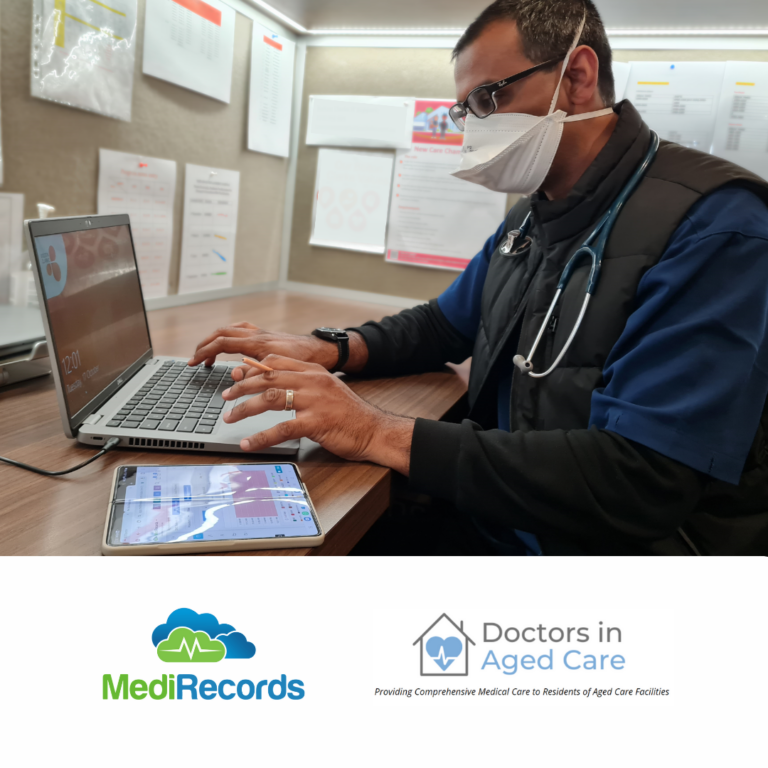
Here’s the latest in our series on how people use MediRecords. In this Q & A, Dr Gaveen Jayarajan explains why he made the switch to the cloud and MediRecords to power his Doctors in Aged Care mobile medical practice.

Tell us a bit about your practice.

I operate the Doctors in Aged Care mobile GP service that visits residents at several Residential Aged Care Facilities (RACFs) throughout metropolitan Melbourne. Our service exclusively does RACF work and is fully mobile and virtual; we see residents in their homes every week. We are committed to excellence in medical care of the elderly using innovative, non-traditional/hybrid approaches to healthcare service delivery.

Associated with our medical practice, I have built the Doctors in Aged Care (DiAC) Facebook group, which is a community of over 2300 doctors Australia-wide.

Please contrast MediRecords with the system you used prior to using MediRecords.

I had used all the common GP clinical and practice management systems working as a GP in medical centres for the previous eight years. Usually clinics would use two different programs, one for clinical use and one for practice management (i.e., appointments/billing/claiming/reporting). When I started working full-time in aged care, I used a popular GP clinical software system which was server-based. This worked okay in a medical centre but was not well suited to mobile work visiting RACFs.

As a doctor working in a challenging and inefficient setting, I urgently needed a reliable and stable solution. Hence my move to a cloud-based alternative, MediRecords.

My initial apprehension with using a cloud system was what happens if internet speed and connection were unreliable? To my surprise this was a non-issue. Using mobile broadband devices, which now give NBN-type speeds in some locations, internet speed was not an issue. I could also use my mobile phone as a Hotspot if needed.

MediRecords is an all-in-one, integrated clinical and practice management system. So, from a single browser window I could access the clinical functions I needed as well as seamlessly view my appointment book, create new appointments, perform billings, view current Medicare claims in progress, and generate reports for total invoices/billings over any time period.

The third change was no longer having to engage and deal with a third-party IT service provider. Now all of this was handled in the background automatically; updates are   installed remotely with no disruption or major technical issues.

How does MediRecords enhance your efficiency?

I use the MediRecords appointment book as a key tool to manage my workload, maximise efficiency and provide proactive rather than reactive care.

Every time a phone, email or fax request is received to review a patient, the patient’s name is entered into the appointment book for the next weekly visit day (or on the day of request if urgent) with an appointment type depending on the nature of the issue. It could be a “Regular” appointment or classified as for example, “Urgent’’, “Vaccine”, “Wound Review”, “Post-fall Review”, “Health Assessment”, “Phone Consultation”, etc. MediRecords allows multiple appointment types and durations to be created. Every time a patient is seen, a follow-up appointment is also made at an appropriate interval. When done for every patient, I can see with reasonable accuracy what my workload will be like. Unplanned extra patients, or “walk-ins”, can be added to the daily schedule depending on demand that day.

We further enhance our scheduled care by using the recalls or “Clinical Actions” function. For every new patient we have recalls for core things relating to Medicare item numbers and due dates, e.g., Health Assessments, Residential Medication Management Reviews and Care Plan Contributions.

Also useful for efficiency is the Tagging feature. I use Tags, along with another existing MediRecords feature of doing multiple patient invoices at once, to reduce the time taken to process daily billings to under five minutes.

Another recent improvement has come with my API integration of MediRecords with Snapforms. Using Snapforms I created a “New Patient Details Form”. Now when a RACF asks me to take on a new patient, I email them a cloud-based form with a URL link. They complete all new patient details, attach a recent patient health summary or hospital discharge summary and a current medication list. After they hit submit, something magical happens! A new patient file is created in MediRecords with the key demographic data already populated, and a PDF copy of the form and any uploaded health summary or discharge summary and medication lists stored in the Correspondence IN tab in the patient file.

I use MediRecords on multiple devices including my Surface Laptop, Samsung Galaxy tablet and Samsung Z-Fold 5 mobile phone.

How does MediRecords enhance patient care?

MediRecords allows me to operate with the lowest and leanest cost base and make it financially viable and sustainable for the long-term. It enables me to maintain safe and high standards of care that are consistent, repeatable and maximise quality of life for patients.


What are your tips for people considering changing to MediRecords?

Have a clear idea and rationale for why you want to move to the cloud.

It can’t just be about saving money on software subscription costs or on upgrading or buying a new server. Independent GPs working at your practice will not be interested in this. Show them a way forward with a big picture view of how moving to the cloud can change the way they deliver healthcare, creating benefits they are not currently experiencing. Avoid trying to replicate like-for-like every feature of server-based software.

What are you looking forward to with MediRecords in the future?

The efficiencies we have been able to achieve by using cloud-based software have been done with an intense focus on optimising processes and managing costs – and without Artificial Intelligence (AI). We look forward to incorporating AI to further drive efficiency and improve patient care standards by automating more administrative processes and providing advanced clinical decision support and insights.

If you’d like to showcase innovative ways you use MediRecords in healthcare, please reach out to us via [email protected].

Dr Gaveen Jayarajan is an investor and member of the MediRecords Medical Advisory Board.  

Read more about Doctors in Aged Care on their website.  

Looking to stay updated with the latest from MediRecords?

Sign up to the newsletter

    MediRecords partners with Clinivid to provide secure communications between multidisciplinary care teams.

    MediRecords partners with Clinivid to provide secure communications between multidisciplinary care teams.

    Matthew Galetto MediRecords banner

    Matthew Galetto

    MediRecords, the market leading cloud based clinical & practice management solution, and Clinivid a cloud-based clinical communication platform, have joined forces to provide a secure alternative for multidisciplinary care teams to communicate, share advice and files for improved holistic patient care.
    Matthew Galetto, CEO of MediRecords, says: “Our partnership with Clinivid allows health providers using MediRecords to easily share clinical information, including images, in a mobile environment and to include external members of a care team through easy and direct messaging. It supports our goal to give our users access to the best-in-market solutions, with the flexibility to choose the right tools to support their workflow. Most importantly, clinical information flows seamlessly back into MediRecords to complete the patient longitudinal record and clinical workflow. ”
    Dr Katja Beitat, CEO of Clinivid, adds ”This partnership highlights the power of cloud-based clinical solutions that make multidisciplinary care instant and easy. Patient information is secure at all times. With automatic creation of a medical record, everyone saves a lot of time.”
    MediRecords is expecting its users with high levels of mobility and multidisciplinary care to take up the joint solution. Clinivid secure messaging is applicable for care teams in hospitals, chronic disease management, mental health care and for virtual patient handovers.

    About MediRecords

    MediRecords is Australia’s leading cloud-based clinical and practice management solution used by Specialists, GP’s and Allied Health Professionals across Australia. MediRecords is transforming the delivery of healthcare servicing in Australia. Connecting health professionals and patients with a suite of integrated products, MediRecords improves patient care while reducing associated costs of outdated technology. Developed from the ground up to harness the power of the cloud, MediRecords is available as a SaaS solution for SMB’s or as a dedicated platform service for larger corporates and institutions.

    About Clinivid

    Clinivid is an Australian based company enabling safe and mobile clinical information sharing across the whole health care sector. Fitting seamlessly into existing workflows in practices and hospitals, we improve the way clinicians connect, communicate and collaborate to increase efficiency, minimise risks and help provide better patient care. Clinivid offers secure mobile messaging and clinical meetings.

    To learn more or get involved email [email protected] or call 1300 103 903.

    Media Contacts:

    Michael Alldrick
    Matthew Galetto MediRecords banner

    Matthew Galetto

    Looking to stay updated with the latest from MediRecords?

    Sign up to the newsletter