Too many apps on the dancefloor: digital continuity, governance and productivity 101

Two doctors discuss a patient's file over a tablet device.

Too many apps on the dancefloor: digital continuity, governance and productivity 101

Two doctors discuss a patient's file over a tablet device.

Do we try to sew together a mass of emerging apps to connect and refer up and downstream, or use agile platforms that can connect it all in one system?

Matthew Galetto - Founder and CEO MediRecords

This article was originally published by Health Services Daily on 11 November 2025

The federal government has drawn a line in the sand: since October 2025, pathology providers must upload reports to My Health Record by default, with diagnostic imaging following in February 2026. Medicare benefits are only payable when organisations comply.

That’s just the beginning.

The government is explicitly exploring ways to expand default sharing beyond pathology and diagnostic imaging to other types of key health information, including discharge summaries, specialist letters, and care plans.

It’s not a question of if GP consultations, specialist visits, and allied health services will face the same requirements. It’s when.

 And it’s not just about uploading data. Since 2023, clinical software that connects to My Health Record has been required to meet mandatory security conformance standards.

While the government ultimately stopped short of mandating full Essential Eight compliance (recognising that very few systems would have met the threshold), the direction is clear: minimum cybersecurity standards are coming as a prerequisite for exchanging information with government services, including Medicare.

If your systems can’t demonstrate baseline security resilience, you won’t be connecting to national infrastructure much longer.

A screenshot of the Sales Audit screen within the MediRecords software.

For organisations managing both internal health services and external community referral networks, this integration challenge isn’t theoretical. It’s the difference between being able to answer an auditor’s questions and hoping they don’t dig too deep and it’s a massive potential pivot to or away from productivity.

When audits expose the integration gap

The Australian National Audit Office’s recent audit of Defence health services put numbers to what many already suspected: poor integration between clinical and financial systems made it impossible to reliably track what services were delivered, by whom, or whether claims matched care.

Defence is far from unique.

The same pattern shows up across corporate health services, corrections health, employee assistance programs, and anywhere else an internal health service refers patients to external community providers.

What the audit exposed was that when you refer internally and deliver externally without a unified system, you lose the thread. You can’t track the referral pathway. You can’t validate service delivery. You can’t reconcile the claim back to the original clinical decision.

A specialist and surgeon discuss the details of a patient's referral over a clipboard.

When the referral chain breaks

A patient visits an internal health service. The GP refers to a community specialist. The specialist orders pathology and refers to allied health. Someone else handles the follow-up. Each provider bills separately, through separate systems.

By the time finance tries to reconcile it all, tracking the chain of referrals feels more like forensic investigation than accounting. Clinically coded data lives in one system. Community provider billing happens in another. Medicare bulk bills go through one channel, private providers through another, and DVA or other contracted arrangements follow their own logic entirely.

When something doesn’t add up (and it often doesn’t), you’re left hunting through emails, spreadsheets, and disparate databases trying to reverse-engineer what actually happened.

 For organisations with duty-of-care obligations, where you’re responsible for health outcomes even when care is delivered externally, that lack of visibility is a significant governance failure. But it’s one we’ve largely lived with because our systems haven’t been sophisticated enough to cope with the problem.

However, now that we can contemplate a system that doesn’t just connect these elements but in doing so also creates an audit trail, it’s not just governance people should be thinking about. It’s productivity.

How much money and workforce productivity will start to emerge in our healthcare system when we start properly joining up all the elements of referral, clinical record, booking and invoicing, in real time?

We are literally talking in the billions. Yet it’s something people haven’t largely even contemplated in the current digital transformation of our healthcare system … yet.

How it should work

If your internal health service already uses a platform that manages referrals, clinical documentation, billing, and compliance, extending that same platform to community providers creates an unbroken chain of accountability from initial consultation to final payment.

Internal service creates a referral. The system captures the clinical justification, authorised services, and any service limits. The community provider receives the referral, accesses the same system, sees the referral context, and documents their service delivery. Service is coded and billed. The system automatically validates that the service matches the referral authorisation. Finance reconciles in real-time. Because everything lives in one system, there’s nothing to reconcile manually.

Every action connects to the one before it. The audit trail is automatic. The organisation maintains visibility and governance over care delivered externally, without sacrificing provider autonomy.

But the system pay-off is in productivity of the provider and the patient. Literally millions of hours not wasted in trying to connect the dots on payments, invoicing and bookings.

The pay-off is for everyone but providers will need to be able to extend the system they use internally to their external provider network.

Some systems today are starting to claim they can do this. But most only offer elements of solving the problem.

A cloud-based e-referral system, for instance, is neat but it can’t seamlessly integrate to bookings and invoicing in a line to create a single audit trail and set of invoices. These are nice-to-have new elements but they are essentially modern versions of the old SMD systems.

Solving the referral-to-community problem

Forgive me here but I’m going to talk about the one system I’m involved with, MediRecords. I’m doing this because I know it so well, it provides a great example of what is achievable if you are able to extend your system seamlessly to external provider networks and, well, I’m selling it, obviously.

Surprisingly, given the seismic productivity gains on offer for both patients and providers, systems like MediRecords – essentially an FHIR-enabled cloud-based EMR with lots of good APIs – are, so far, few and far between in Australia.

For a long time the government has not really incentivised cloud-based connectivity in Australia with the result that many old server-bound integrations have been able persist a long time in the system.

Other cloud-based systems like MediRecords with longitudinal system connectivity capability do exist, but I’ll let you do that research.

What’s important is these new core cloud systems are agile in their ability to connect and share data in real time with other systems, which is auditable and which, because of the flexibility of connection, provides the ability for all elements of a single patient transaction to be captured and processed.

Where MediRecords is already deployed as the core system for internal health services, extending it to community providers means those providers gain access to the same platform, but with appropriate scope limits and data access controls.

A community GP sees only their own patients and referrals, but the referring organisation maintains oversight across the entire care pathway.

The platform handles referral management with structured referrals including clinical context, service authorisation, and validity periods. It manages multidisciplinary workflows with different claiming rules for GPs, specialists, allied health, pathology, and imaging. Real-time compliance happens automatically, validating services against referral authorisations and payor rules. And every referral, service, and claim comes with audit trails that prove clinical appropriateness.

For enterprise and community networks managing dozens of sites and hundreds of external providers, dashboards show where referrals are flowing, where services are getting stuck, and where revenue patterns don’t match clinical expectations.

Meeting regulatory standards

MediRecords supports FHIR and OntoServer standards, integrates with national infrastructure via secure messaging, and stores the structured data required for My Health Record uploads.

Under the hood, MediRecords is built with double-entry accounting, a general ledger, and full journal management. This provides the financial backbone that government finance departments and enterprise systems require.

The Department of Health, Disability and Ageing’s Compliance Strategy 2025-30 makes it clear: data integrity includes cybersecurity.

MediRecords’ cloud-native architecture aligns clinical and financial assurance with enterprise-grade security. For organisations evaluating community provider networks, that means one less integration risk and one less compliance gap.

The trade-off: Integration v independence

When you’re managing thousands of services, including external referrals across hundreds of providers, manual review is almost impossible.

Some advanced providers, MediRecords being one of them, are exploring how artificial intelligence can automatically identify, link, and map services to item codes, validate claims against payor rules (whether government, insurer, or contract-based) and flag services that don’t match referral authorisations.

That means fewer manual audits, faster reconciliation, and better confidence that community providers are claiming appropriately. The result is a platform that doesn’t just capture data. It learns from patterns and helps organisations maintain governance without drowning in manual review.

What comes next

Health reform is heading in one direction: integration, data sharing, accountability and significant productivity gains, particularly in the area of workforce.

Organisations responsible for health outcomes are being asked to demonstrate traceability even when care is delivered externally and solve their productivity and workforce issues. That’s now just not feasible with legacy systems: when internal services and external providers use completely different platforms.

The path forward isn’t more integration layers, one-off cloud-based connection applications or complex data feeds. It’s system continuity.

Using the same platform internally and externally, so that clinical accountability, financial governance, and regulatory compliance flow naturally across organisational boundaries.

For organisations already using MediRecords internally, extending it to community providers isn’t just the path of least resistance. It’s the path of greatest assurance and productivity.

Connected care, credible claims, real compliance and generationally impactful productivity gains.

That’s what modern health governance and productivity looks like when care crosses organisational lines, which more and more these days it must if we are to manage a system rapidly moving to team based chronic care management.

Is cloud technology the new necessity for innovation and productivity in digital health?

Is cloud technology the new necessity for innovation and productivity in digital health?

Is cloud technology the new necessity for innovation and productivity in digital health?

What a difference the cloud makes - why GPs need to look up when seeking software
Matthew Galetto - Founder and CEO MediRecords

Ask anyone working in digital health today, particularly those investing or looking for solutions to support new models of care, and they’ll tell you: all innovation is happening in the cloud. From startups launching AI diagnostic tools, coding agents, and voice assistants for booking and admin, to government projects aimed at connecting national health systems, everything modern is being built on cloud infrastructure.

Cloud is no longer a technology trend. It is the new normal.

At MediRecords, we see this shift as driven by more than convenience or cost-cutting. It is structural, it is inevitable, and it is being driven by real demand and expectations from service providers, clinicians, and most importantly, patients. In 2025, cloud-based technology has become the clearest signal of innovation in healthcare and the most practical way to achieve the productivity gains the system so urgently needs.

Whether you are a startup, a health service, or a government agency, cloud is no longer a nice-to-have. It is the bare minimum, and every new dollar of investment is chasing it.

Why cloud matters in digital health

The cloud is not just another way to host software. It is a different way to build, deliver, and keep improving it. Here’s why cloud-native solutions are leading the way:

  • Real interoperability: National health infrastructure is API-based, and that is where the future is heading. My Health Record, IHI, Provider Connect Australia, and the Service Locator are all part of an API ecosystem. Cloud-native systems are built to plug into these environments seamlessly, supporting information sharing at the point of care with the reliability and resilience of cloud hosting.
  • AI enablement: From clinical decision support to smart assistants and summarisation tools, AI runs best where it was designed to, on the cloud. Cloud makes AI scalable, secure, and accessible without the need for costly hardware. At the Medical Software Industry Association (MSIA) forum in July, AI was called out as both an opportunity and a risk. AI scribes, triage tools and predictive analytics are recognised as critical enablers of safety and efficiency, but there are also new cyber threats, with attackers using generative tools to launch sophisticated campaigns. Cloud platforms offer the enterprise-grade security, zero-trust frameworks and rapid patching that healthcare now requires.
  • Data-driven care: Cloud platforms unlock live analytics and reporting that go far beyond static PDFs or siloed spreadsheets. Think population health insights, service delivery metrics, and predictive alerts, available in real time.
  • Lower overheads: No servers to manage and no on-site maintenance. Cloud reduces the total cost of ownership while accelerating change. Less drag, more delivery.
  • Always up to date: Continuous upgrades mean your platform improves every few weeks, not every few years. That is the speed clinicians and patients expect today.
  • Productivity through scale and innovation: Cloud is not just about what is possible today, it is about what becomes possible tomorrow. From smarter workflows and automation to seamless integrations and flexible deployment models, cloud platforms open new ways of working. Providers can scale efficiently, deploy services faster, and deliver care in ways that traditional systems cannot support.

Cloud as the productivity engine

The recent MSIA conference sharpened this focus. Digital health reform is no longer about modernisation for its own sake; it is about driving system-wide productivity. Rising demand, workforce shortages and growing administrative burden mean the health system must deliver more with less.

Cloud-native platforms, built on FHIR standards and national interoperability, enable real-time data sharing, automation and AI in ways that reduce duplication, shorten wait times, and free up clinicians for patient care.

Seen this way, cloud is more than a proxy for innovation. It is the engine of productivity. In health, innovation and productivity are inseparable. Innovation that does not deliver productivity will not scale, and productivity gains without innovation will stall.

Government signals: Cloud as a strategic pillar

The federal government’s Sharing by Default Act 2025 is a milestone, requiring pathology and diagnostic imaging results to flow automatically into My Health Record. The upcoming National Digital Medicines Strategy (2025–2030) will go further, embedding interoperable, cloud-enabled medicines management into the foundations of the system.

Policy language now makes it clear: “information sharing by default, near real time, at the point of care” is the goal. That is only achievable with cloud-native systems that speak fluent API.

Procurement patterns are already shifting. It is increasingly difficult to win a government contract or even make it to tender without being cloud-enabled.

Clinicians are also driving this change. Next-generation doctors are digital natives. They expect intuitive, mobile-responsive, fast-evolving tools that feel more like Spotify or Canva than clunky desktop software. Patients expect the same: digital front doors, secure portals to access personal information, cost transparency, and notifications that help them manage their care.

Investment dollars also tell the story. Every new venture-backed digital health company in Australia is building for the cloud. There is simply no appetite to fund new on-premise apps.

Finally, security is no longer a barrier to cloud, it is a benefit. Cloud platforms provide enterprise-grade security, encrypted communications, and high availability that far exceed what most local deployments can offer. In today’s environment, cloud has become the safer, more resilient choice.

Evidence that digital maturity and connected systems delivers results

The evidence for digital transformation in Australia is compelling.

  • Queensland’s transition to integrated digital hospitals achieved a 40% reduction in medication incidents and a 70% reduction in prescribing errors. 
  • Digital-first cardiac rehabilitation programs have demonstrated up to 71% reductions in readmission bed days, proving that connected care can improve outcomes and reduce costs
  • Studies of digital maturity in Queensland health services show that higher-maturity, interoperable systems are associated with better patient experience, improved staff satisfaction, and perceptions of safer care. 

Cloud as the path to digital maturity

These improvements arise from digital maturity, not hosting models alone. But cloud is increasingly the only realistic way to achieve and sustain that maturity at scale. Recent Australian examples demonstrate the benefits. NSW Health’s migration of clinical applications to AWS Cloud improved application performance, halved the time to deploy new environments, and freed clinicians from manual IT work. A trans-Tasman review of 66 cloud-enabled healthcare use cases found consistent gains in productivity, patient access, and system equity. And in community pharmacy, electronic prescribing and digital medication records, often delivered via cloud platforms, have streamlined workflows and improved medication safety.

Cloud does not just enable new technology; it provides the structural resilience, interoperability, and scalability that allow digital systems to deliver measurable improvements in outcomes and efficiency.

MediRecords: A case study in cloud-driven innovation

MediRecords was built in the cloud from day one, not retrofitted or migrated. That foundation lets us partner with the most forward-thinking health programs, providers, and digital vendors across the country.

We are already helping modern care models take shape:

  • Telehealth providers using MediRecords to deliver digital-first consultations without legacy drag.
  • AI partners are integrating with our APIs to provide summarisation, smart triage, and workflow automation.
  • Analytics through our soon-to-be-released Clarity module, giving providers real-time insights into service usage, clinician performance, and patient outcomes.

We connect natively with Australia’s API-based government digital infrastructure, ensuring our customers can operate seamlessly across national systems. Our containerised implementation of OntoServer (CSIRO’s terminology server) provides scalable clinical decision support and structured interoperability as a managed service.

Just as importantly, our open APIs empower healthcare organisations to shape their own digital future by connecting enterprise systems, building digital front doors for patients, and innovating beyond the clinic walls.

Conclusion: The cloud test

If you are evaluating a new digital health solution, whether it’s practice management, patient engagement, analytics or anything related, ask this first: is it cloud-native?

If not, it is already out of step with:

  • Where government policy is going
  • Where clinicians and patients expect to be
  • Where investment dollars are flowing

In 2025, cloud is not just infrastructure. It is the benchmark for innovation and productivity in digital health.

In healthcare, innovation that does not deliver productivity is unsustainable. Productivity gains without innovation pathways, quickly erode. Cloud is where the two converge, and where the future of healthcare is being built.

References

  1. Queensland Health. Digital Hospital Benefits Realisation Report. Cited in MSIA, 2021.
  2. Neubeck L, et al. Digital cardiac rehabilitation: systematic review and meta-analysis. Eur J Prev Cardiol. 2020.
  3. Woodruffe S, et al.  Effects of a digitally enabled cardiac rehabilitation intervention on risk factors, recurrent hospitalization and mortality: a randomized controlled trial. European Heart Journal – Digital Health. 2025
  4. Adler-Milstein J, et al. Evaluating Digital Health Capability at Scale Using the Digital Health Indicator. Appl Clin Inform. 2021.
  5. Thiru K, et al. Perceived Impact of Digital Health Maturity on Patient and Staff Experience in Queensland. Int J Med Inform. 2023.
  6. eHealth NSW. Case Study: Clinical Applications Migrated to AWS Cloud. 2022.
  7. AWS Institute. Benefits of Cloud-Enabled Healthcare in Australia & New Zealand. 2022.
  8. Hussain R, et al. Electronic health records and e-prescribing in Australian community pharmacies. Int J Med Inform. 2024.

What a difference the cloud makes – why GPs need to look up when seeking software

What a difference the cloud makes - why GPs need to look up when seeking software

This article was originally published by The Medical Republic and can be viewed in its original format here.


Matthew Galetto - Founder and CEO of MediRecords

 At the recent Wild Health Summit – Towards One Health System, MediRecords hosted a breakfast panel called, “What a Difference the Cloud Makes.” It was a chance to have a real conversation about where general practice IT is headed, and where it should be. 

One of our panellists, Peter O’Halloran, Chief Digital Officer at the Australian Digital Health Agency, was asked a simple question: 

“If you were setting up a general practice today, would you go cloud or on-premise?” 

His answer was unequivocal. Cloud technology is essential. 


The RACGP’s cloud guidance feels out of step 

That’s why it’s a bit jarring to read the RACGP’s own guidelines on cloud computing, which still lean heavily towards on-premise systems and paint the cloud as risky. 

From where we sit, as a healthcare cloud provider working with GPs every day, this doesn’t reflect reality. 

The idea that practices are better off managing their own servers, software, patches, backups, and security just doesn’t stack up in 2025. Most clinics don’t have dedicated IT staff, and even if they do, securing on-prem systems to the same standard as cloud platforms is near impossible. 

Cloud providers like MediRecords deliver: 

  • Continuous updates and security patches, 
  • Encryption by default (at rest and in transit), 
  • Secure, redundant backups, 
  • Access controls, audit logs, and role-based permissions, 
  • Always-on monitoring by specialised teams. 

These aren’t “nice-to-haves”. They’re standard and they’re built in. 

Cloud systems remove the need for older remote access tools like Citrix or RDP, making it easier for teams to connect and get work done. This simpler setup means faster performance, especially with tasks like printing, which are often slow or unreliable on Citrix and RDP due to delays and compatibility issues, with fewer security layers to manage. 


Meanwhile, the government Is Moving Full Steam Ahead on Cloud 

The disconnect is this: the Australian Government has made it clear that the future of digital health is cloud-first, secure, and interoperable. That’s not just a goal, it’s national policy. From the National Digital Health Strategy to ADHA’s recent messaging, it’s crystal clear. 

When asked about security, Mr O’Halloran said cloud technology companies are best equipped to provide these protections. 

Cyber-criminals are highly organised and sophisticated and well advanced of most Australian businesses, he said. 

“You’ve got no hope of trying to keep up to date and keep ahead of the bad guys,” he said. “Putting (your data) in the cloud, if you do it a safe way, it doesn’t guarantee you’re safe, but it gives you a heck of lot more chance.” 

He said the days of running server-based systems are over; “it’s simply not safe”. 

What about costs? 

Costs of switching to cloud technology can be largely offset by reductions in hardware and utility costs but Mr O’Halloran applied a different lens. “Quite frankly, in most cases, the cost of not (transitioning to the cloud) is far worse when something goes wrong.” 

Dated advice 

When we asked the RACGP to consider updating their guidance that cloud technology may introduce “increased potential for data breaches”, we were told they’re happy with the current version. That’s disappointing, not for us as a vendor, but for the GPs who rely on accurate, forward-looking advice from their peak body. 

Time to call it like it is 

The truth is, we’re well past the point where this should be up for debate. Cloud isn’t a risk, it’s the solution to the risks we’ve seen time and time again with outdated, localised infrastructure. 

It’s safer. It’s more scalable. It is more user friendly for your workforce and supports better patient outcomes. And it’s what the rest of the health system is already moving towards. 

We owe it to our clinicians, and our patients, to move the conversation forward. 


About the author: 

Matt Galetto is the founder and CEO of MediRecords, Australia’s first true cloud practice management system and electronic health record. Matt has extensive experience in data analytics, healthcare, banking and hospitality technology. 

 This article was written by MediRecords CEO & Founder Matthew Galetto, and originally published by The Medical Republic. The original article can be viewed here.

7 reasons to rethink technology decisions
 

7 reasons to rethink technology decisions

Tim Pegler

Tim Pegler

My household recently purchased an electric vehicle (EV) – a complete backflip on what we had intended. So, what happened to change our decision?

When it comes to choosing a car, I’m more worrier than warrior. Going electric seemed a bridge too far. Vehicle ‘range anxiety’, trip planning and recharging hassles were big barriers for me to overcome before getting on board EV technology. I’m also brand loyal and very hard to shift.

We were so close to buying a hybrid vehicle. We drove it and loved it. So, what changed? Here are seven factors that influenced our household decision:

1. Conversations with trusted users, ranging from brave and wacky early adopters to recent converts, changed our lens. Discussing pros, cons and compromises with actual users, backed by extensive reading and watching product reviews from balanced, independent sources, was influential.

2. Smart and safe tech: A significant injury has changed our household and how we experience accessibility, mobility and usability. The safety features bundle in the selected vehicle appears to be a usability gamechanger. 

 3. Change management considerations: Many of us are time poor, set in our ways, and disinclined to change. I pessimistically overestimated the change process. But, as one existing user pointed out, “Tim, you already plug in devices every evening so what difference will another make?” To advice from a childhood bakery, I had to ‘Look at the doughnut and not the hole’. 

4. Soft sales technique: The salesperson answered our questions about product features, implementation and onboarding, respected our pre-research, didn’t argue against our confessed biases, and let the product sell itself in an unaccompanied test drive. At no point did we feel pressured or pursued. 

5. Alternatives have not advanced – enough: We tried the latest version of our incumbent vehicle. It was familiar and convenient, and we wanted it to win. There were noticeable improvements but going hybrid felt half-cooked. There would be fuel economy gains but we’d still be paying for servicing old tech, oil and petrol, and not eliminating emissions.     

6. Price: No product is perfect, so we looked at the big picture. In a tabular comparison of safety, product features, economy, run costs and price, we had a clear winner, much to our surprise. Cost comprises more than ticket price.

7. Sustainability: Our home largely runs on solar energy and we’re fortunate to be able to act on environmental concerns and minimise our consumption footprint. We watch the news and are acutely aware people like us have a responsibility to walk the walk, not just talk the talk

As someone with a technology sales role, I have been thinking about how I learn from this consumer experience and apply it to my work in 2025. 

I’ve seen the LinkedIn posts from tech buyers bemoaning people connecting, then pitching and spamming them ad nauseum. Fair enough. Cold calls are like lotto tickets; not many win.  

So in the aim of not hitting your inbox uninvited, here’s how I think my family’s car buying conversion aligns with MediRecords cloud technology: 

1.Trusted.  I encourage would-be buyers to check who has trusted MediRecords with their health records and practice management information. We’re trusted by the Defence Force and other major government clients. Just as importantly, we have loyal clients ranging from sole practitioners to mixed multidisciplinary clinics to large telehealth businesses. You’ll find them on LinkedIn, our website and elsewhere. 

2. Safe. MediRecords’ cloud technology is ISO 27001 and 9001 certified and HIPAA compliant for privacy, security and data safety. We are continually working to improve usability; there’s a big list of user-requested enhancements and innovations going live over the next few weeks. 

One of the key reasons doctors switch to our software is accessibility. You can securely access MediRecords anywhere, without struggling with remote desktop login systems. Cloud tech means no more IT drudgery scheduling updates and backups. And we’re leaders in interoperability — smart ways to exchange data safely. 

3. Outstanding change management. Our team is experienced in change management, with data migration experts and an excellent onboarding and training crew. But the real magic happens when the buyer is as excited as we are about doing business on next generation cloud technology, and the possibilities this creates. Change management is a partnership. 

4. Customer-centred. Our team do not engage in pressure selling. Like the EV dealer, we believe in our product. Our role is to understand your workplace needs and bugbears and then explore together how we can help make your work life easier. 

5. New tech. Traditional server technology still dominates the Australian medical software market, but some vendors are using hybrid technology to bridge the gap to cloud data. If you want the benefits of true cloud connectivity, it’s not the time to go halfway. Governments are on the record stating healthcare data needs to be accessible 24-7; cloud technology needs to be the present, not just the future. 

6. Priced to save you money. MediRecords pricing is competitive but even more so when you look at the big picture. The ability to slash spending on server technology and associated office and electricity costs, along with IT consultants who take you offline for countless software patches and security updates and bill you for storing massive backup files… there are big savings to be made here. 

7. Sustainable. There’s mounting evidence that cloud technology is more sustainable than server tech, thanks to reductions in hardware and energy requirements, and centralisation of data centres and security resources.*  

Like many other consumers, I don’t want to be harassed by sellers. I appreciate good information and timely, accurate responses to questions. I like to stay aware of technological developments so I can work with the best fit solution for the betterment of my family, colleagues, and planet. Selling in this environment is the challenge for sales professionals in 2025. 

My team is committed to goodwill, integrity and a willingness to walk away. We will approach you if we think we can help. If we can’t, thanks for your time and please let us know if things change. 

And yes, I’m self-aware. I’m now an ex-journalist, salesperson who drives an EV. No more dinner party invitations for me. 

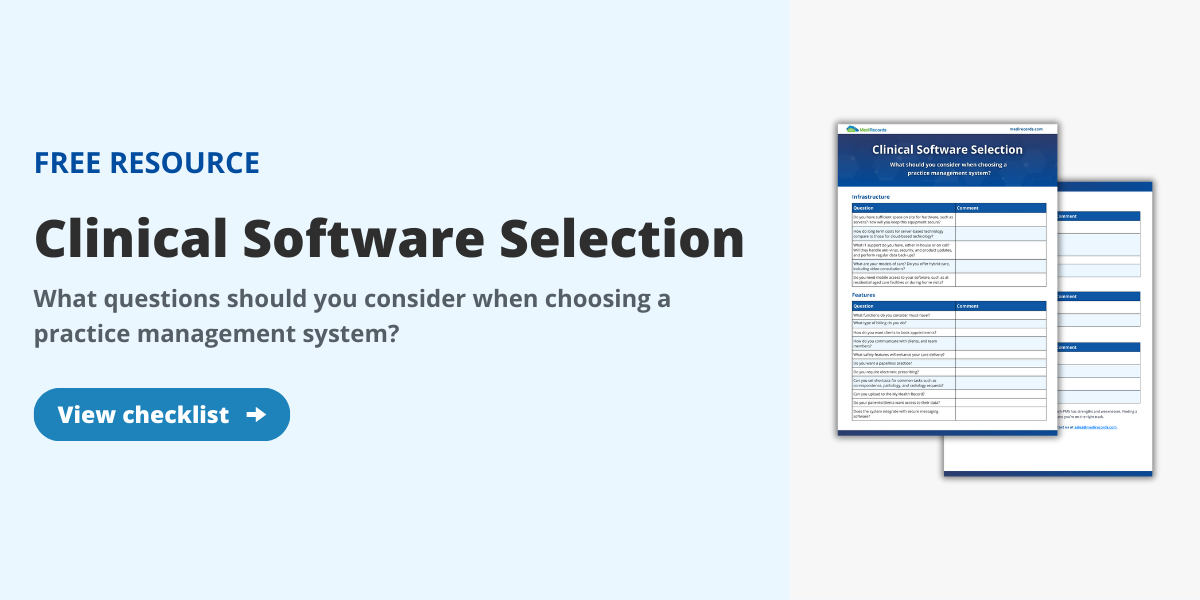
What to consider when selecting a practice management system?

What to consider when selecting a practice management system?

Looking for a new system to manage your practice, clinical notes, and patient records? What should you be looking for in a software solution?  

Delve into the following factors to consider when seeking a healthcare practice management system. These insights come from conversations with our customers, decades in digital health, and personal experience as healthcare consumers.

1. System architecture

When navigating PMS options, one of the first crucial decisions is whether to opt for a server-based or cloud-based system. Evaluate the long-term costs, encompassing initial setup, subscriptions, IT support, and maintenance. It’s important to tailor your choice to your practice’s model of care, whether it’s virtual care/telehealth, bricks-and-mortar, or a hybrid approach.

Read our article, “Eight Reasons to Embrace Cloud Technology in Healthcare” to learn how cloud technology can help in substantial cost savings, potentially saving your practice $600k in 10 years.

2. Feature requirements

To maximise the efficiency of your healthcare delivery, it’s essential to define specific feature requirements tailored to your practice. From appointment booking to electronic health records and billing, identify key elements such as ePrescribing, Medicare billing & claiming, online booking, My Health Record integration, secure messaging, patient portal functionality, investigation requests, and robust reporting capabilities.

3. Training and support

A successful integration of a PMS into your healthcare setting relies heavily on the training and support provided by the vendor. It’s important to enquire about the level of training and ongoing support offered by the PMS vendor, and to assess the available support mechanisms for addressing any day-to-day operational issues.

4. Evaluate other key aspects –

Other important factors to consider include the following:

  • Ease of use: Ensure the system is user-friendly, promoting an efficient workflow within your team.
  • Mobile accessibility: Verify if the PMS allows remote access, facilitating flexibility and on-the-go management.
  • Interoperability: Confirm the system seamlessly integrates with other healthcare systems, promoting efficient information exchange.
  • Security and compliance: Ensure the PMS adheres to necessary regulations to safeguard patient data, maintaining the highest standards of security.

The truth is every practice has slightly different needs and workflows so no practice/patient management system will be a perfect fit. Each will have strengths and weaknesses and potentially require compromise to accommodate your team’s unique requirements. Finding a flexible, robust system that can tick most of the boxes, now and tomorrow, suggests you’re on the right track.

Contact our Sales team today to discuss how MediRecords cloud-based software can help you. 

Looking to stay updated with the latest from MediRecords?

Sign up to the newsletter

    Keeping it real: Artificial Intelligence to dominate digital health-tech in 2024

    Keeping it real: Artificial Intelligence to dominate digital health-tech in 2024

    Twelve months ago, MediRecords made eight predictions about health-tech trends to watch in 2023. While we weren’t too far off the mark, it’s fair to say some of these emerging trends are still, well, trending. Nonetheless, as we welcome 2024, it’s time to look forward again.


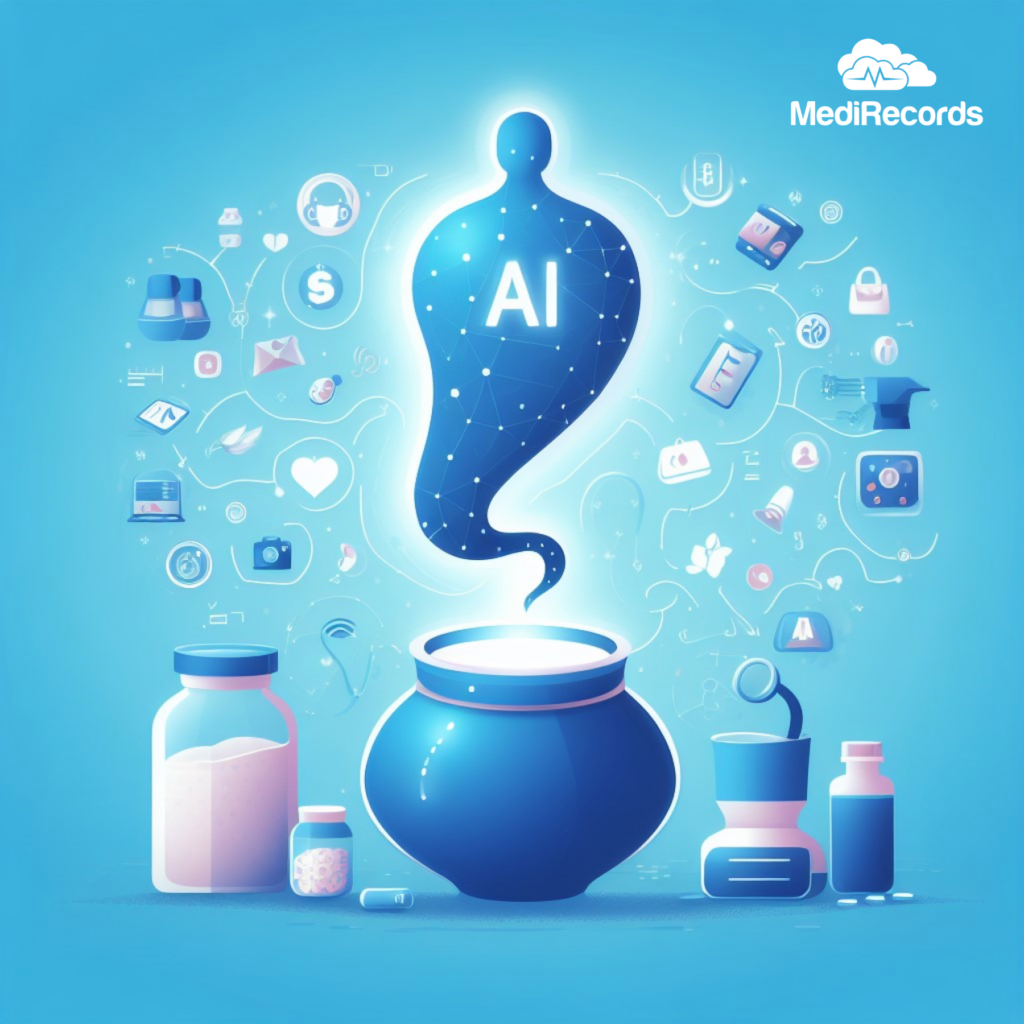
    Any health-tech pundit will have two words for you in 2024: Artificial Intelligence. This is because the AI genie is out of the bottle. The race is on to use this nascent technology in healthcare so that it is safe, secure, accurate, and unbiased. Here are some of the ways AI is being deployed — or will be:

    Smart notes: Using AI assistants to translate consultations into clinical notes should mean less administration and more time for person-centred care. This doesn’t mean the AI is diagnostic, just smart enough to summarise a conversation into pertinent points, after listening to a telehealth or in-person appointment

    Data-driven decisions: No two patients are exactly the same but algorithms can detect patterns across thousands of previous cases and predict the statistically most likely path forward. This will be the basis for health coaching, chronic disease and other illness management programs, hopefully providing timely information at ‘teachable’ moments that can alter and optimise patient outcomes.

    Handy insights: Your handheld device or wearable is likely to know things about you before anyone else. How hard you tap the screen, your vocabulary, tone of voice, gait, facial expression, skin tone, heart rate, respiration, perspiration and oxygen saturation are signposts to your mental and physical health. Combining these data points will enable earlier interventions. Imagine how powerful this could be for triggering a call to a clinician or counsellor when a patient needs help or reminding someone to take their medication.

    Getting under your skin: A drop of blood, a lick of saliva and other bodily fluid samples can help you find long lost relatives but also medications that work better for you and foods that make the orchestra in your gut microbiome play in tune. Consumer kits for quicker insights into fertility, fitness, faeces and more, will become readily available.

    Coming to your sensors: Data will be harvested from sources including your phone camera, your clothing (See This AI-Powered Sock Could Revolutionize the Care of People With Dementia | Tech Times) and even your toilet (See This Futuristic Toilet Sensor Reads Your Pee to Measure Health – CNET). If it can be measured, it will be.

    Next available: As competition for healthcare-consumer dollars increases, buyer power is boosted. Consumers will expect Uber-style technology to find the next available appointment and have their results and medications delivered, pronto. If funding and regulatory hurdles can be leaped, healthcare could potentially be delivered globally.

    Ch-ch-ch-changes

    Speaking of regulations, there’s much anticipation associated with the Federal Government’s recently released Digital Health Blueprint for the next decade; see:

    The Digital Health Blueprint and Action Plan 2023–2033 | Australian Government Department of Health and Aged Care). A key commitment is that personal health data is available and interoperable – in other words useable — wherever you need care. MediRecords is actively involved in the Sparked community developing core national standards for FHIR (Fast Healthcare Interoperability Resources). We look forward to Federal incentives for adherence to new industry-wide data models so that healthcare organisations can seamlessly share information.

    Looking within

    The acclaimed US science-fiction author Ray Bradbury had the following to say about predicting the future: “Predicting the future is much too easy… You look at the people around you, the street you stand on, the visible air you breathe, and predict more of the same. To hell with more. I want better.”

    This sentiment is central to MediRecords’ digital health wish list for 2024. We understand the job is never finished. Health tech can never stop striving to do things better, smarter and safer. MediRecords is building next-generation, cloud-connected healthcare. We can confidently predict we’ll be sharing major new product enhancements in coming months.

    About MediRecords

    MediRecords is Australia’s leading cloud electronic health record and patient management system. MediRecords is used by clinicians providing outpatient and inpatient care in community health, Defence, hospitals, emergency medicine, industry, universities, and telemedicine.

    References

    “Tremendous emerging demand”: The security and data challenge in Australian healthcare – Cloud – Digital – Security – CRN Australia

    AI May Be on Its Way to Your Doctor’s Office, But It’s Not Ready to See Patients – KFF Health News

    Amazon Health Launches New Initiative To Address Chronic Conditions (forbes.com)

    Cardiology has embraced AI more than most other specialties (cardiovascularbusiness.com)

    Health technology in 2024: Projections for AI, digital health, and more (chiefhealthcareexecutive.com)

    Use Technology to Support Your Clinicians | HealthLeaders Media

    Why Providence had to ‘blow up’ the old way of providing care with virtual nursing (beckershospitalreview.com)

    https://www.healthcareitnews.com/news/addiction-recovery-provider-sees-success-ai-enabled-telehealth-meds-monitoring

    https://www.beckershospitalreview.com/disruptors/google-says-medical-ai-tool-is-performing-at-an-expert-level.html

    https://www.beckershospitalreview.com/digital-health/new-apple-headset-coming-in-february-could-be-used-by-hospitals.html

    https://www.beckershospitalreview.com/innovation/a-recipe-for-magic-how-baptist-health-is-infusing-ai-into-all-levels-of-care.html

    https://www.beckershospitalreview.com/healthcare-information-technology/mayo-clinic-inks-multimillion-dollar-deal-with-ai-startup.html

    https://www.beckershospitalreview.com/telehealth/is-virtual-nursing-overstated.html

    https://www.pulseit.news/australian-digital-health/ifhima-2023-digital-health-adoption-in-primary-care-and-the-covid-effect/

    https://www.healthcareitnews.com/news/how-ai-powered-clinical-notes-api-could-boost-telehealth

    https://www.healthcareitnews.com/news/why-ai-will-never-eliminate-need-pharmacists

    Looking to stay updated with the latest from MediRecords?

    Sign up to the newsletter

      Eight reasons to embrace cloud technology in healthcare
       

      Eight reasons to embrace cloud technology in healthcare

      We’ve done the maths. But saving $600K in ten years is just one good reason to switch to the cloud.

      In today’s fast-paced world, healthcare needs to be as efficient and technologically advanced as any other sector. This doesn’t mean adopting the latest technology for the sake of it. It does mean delivering 21st-century healthcare and, by doing it right, reaping substantial, long-term cost savings, and significant workplace and environmental benefits.
      Here are eight reasons why cloud technology is essential to healthcare:

      1. Interoperability is the future
      Interoperability isn’t just a passing trend. Governments worldwide are moving towards legislating information sharing by default and cloud technology ensures real-time information exchange at the point of care. In contrast, non-cloud technologies, including cloud-bridging platforms, introduce multiple risks ranging from data integrity to security and governance issues. Cloud-based EHRs (Electronic Health Records) provide superior interoperability, enabling more coordinated and integrated care.

      2. Cloud technology drives operational efficiency
      From minimised IT overheads to consolidation of services and identity management, cloud technology reshapes how businesses operate. It offers universal access, strengthens data security, supports single source systems, and much more. Adopting the cloud doesn’t just mean upgrading technology; it enables overhauling and enhancing the operational fabric of your organisation.

      3. Unparalleled scalability with cloud solutions
      The adaptability of cloud applications is noteworthy. In a landscape that’s continuously evolving, cloud-based solutions can adeptly manage unpredictable usage patterns, support multi-party usage, and adapt to regulatory changes swiftly. With unparalleled scalability, cloud solutions are equipped to handle increasing data volumes, user counts, and evolving stakeholder needs.

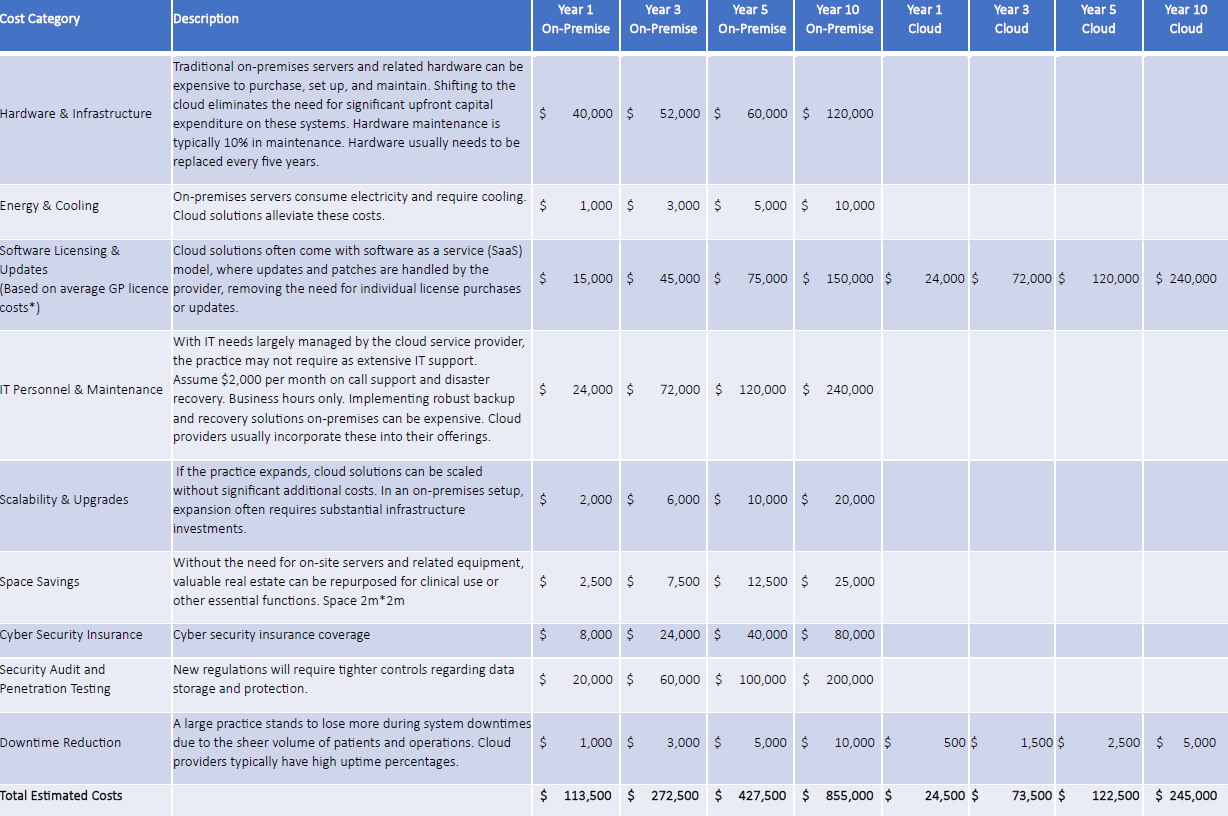
      4. Cost Analysis: Cloud vs. on-premise
      When it comes to the financial aspects of healthcare, cloud solutions offer undeniable benefits. Consider the following costs associated with cloud and on-premise solutions. 

      Click here to view the below table in a new window.

      5. Adapting to the casualised workforce trend
      The post-pandemic period has witnessed a shift towards a more casualised healthcare workforce. The burgeoning telemedicine sector, and changing economic circumstances, have resulted in more flexible work arrangements. Digital platforms are bolstering this change, fostering work-from-anywhere telecommuting and freelance opportunities. Cloud technology stands at the crux of these changing workforce trends, ensuring seamless transitions and facilitating innovative care models for healthcare providers and consumers.

      6. Meeting patient expectations in the post-Covid era
      The Covid-19 pandemic reshaped many sectors, and healthcare wasn’t exempt. Nowadays, patients anticipate digital solutions such as online appointment bookings, e-prescriptions, and quick access to telemedicine. Beyond the functional solutions, they also expect a personalised touch to their care, and more involvement in decision-making. Digital healthcare, powered by cloud technology, enables safety improvements, real-time access to information, and an enhanced patient experience.

      7. Environmental benefits
      According to research, cloud computing can decrease carbon emissions by approximately 60%-70%. This not only reflects more sustainable utilisation of resources like water, but also effective management of waste products when decommissioning hardware. As opposed to traditional data centers, cloud data centers are known to be significantly more energy efficient. [1,2] Transition to the cloud means reducing the carbon footprint of your health business.

      8. Virtual care: The way forward
      With virtual care rising in popularity, especially in Australia, integrated patient data systems are crucial. Cloud-based EHR solutions offer healthcare providers location-agnostic access to patient data, ensuring comprehensive care, whether provided remotely or in-clinic.

      In summary, the transition to cloud technology in the healthcare sector isn’t just a tech upgrade; it’s a holistic approach to meeting modern business challenges head-on. Furthermore, the estimated costs savings over a 10-year period for a 10-doctor practice is over $600,000, not to mention the environmental benefits and peace of mind that come with outsourcing operations to a trusted partner.

      Whether you’re a startup or an established player, it’s time to harness the power of the cloud.

      [1] https://sustainability.aboutamazon.com/products-services/the-cloud?energyType=true

      [2] https://aws.amazon.com/executive-insights/content/fighting-climate-change-with-the-cloud/

      This article was written by MediRecords CEO & Founder Matthew Galetto, and originally published by Health Services Daily and The Medical Republic.

      Looking to stay updated with the latest from MediRecords?

      Sign up to the newsletter

        A clinician’s MediRecords odyssey: unveiling efficient, mobile aged care medicine

        A clinician's MediRecords odyssey: unveiling efficient, mobile aged care medicine

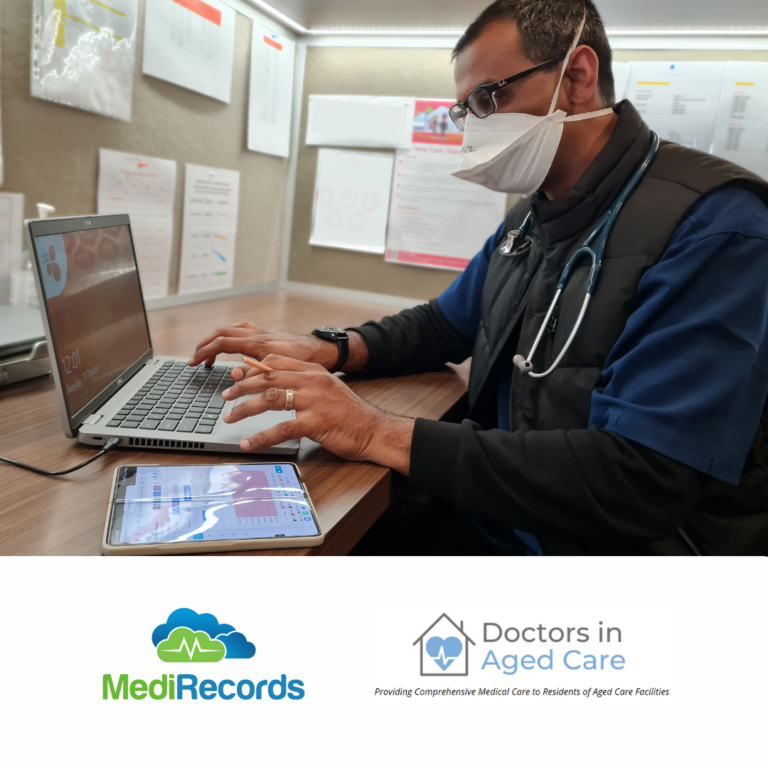
        Here’s the latest in our series on how people use MediRecords. In this Q & A, Dr Gaveen Jayarajan explains why he made the switch to the cloud and MediRecords to power his Doctors in Aged Care mobile medical practice.

        Tell us a bit about your practice.

        I operate the Doctors in Aged Care mobile GP service that visits residents at several Residential Aged Care Facilities (RACFs) throughout metropolitan Melbourne. Our service exclusively does RACF work and is fully mobile and virtual; we see residents in their homes every week. We are committed to excellence in medical care of the elderly using innovative, non-traditional/hybrid approaches to healthcare service delivery.

        Associated with our medical practice, I have built the Doctors in Aged Care (DiAC) Facebook group, which is a community of over 2300 doctors Australia-wide.

        Please contrast MediRecords with the system you used prior to using MediRecords.

        I had used all the common GP clinical and practice management systems working as a GP in medical centres for the previous eight years. Usually clinics would use two different programs, one for clinical use and one for practice management (i.e., appointments/billing/claiming/reporting). When I started working full-time in aged care, I used a popular GP clinical software system which was server-based. This worked okay in a medical centre but was not well suited to mobile work visiting RACFs.

        As a doctor working in a challenging and inefficient setting, I urgently needed a reliable and stable solution. Hence my move to a cloud-based alternative, MediRecords.

        My initial apprehension with using a cloud system was what happens if internet speed and connection were unreliable? To my surprise this was a non-issue. Using mobile broadband devices, which now give NBN-type speeds in some locations, internet speed was not an issue. I could also use my mobile phone as a Hotspot if needed.

        MediRecords is an all-in-one, integrated clinical and practice management system. So, from a single browser window I could access the clinical functions I needed as well as seamlessly view my appointment book, create new appointments, perform billings, view current Medicare claims in progress, and generate reports for total invoices/billings over any time period.

        The third change was no longer having to engage and deal with a third-party IT service provider. Now all of this was handled in the background automatically; updates are   installed remotely with no disruption or major technical issues.

        How does MediRecords enhance your efficiency?

        I use the MediRecords appointment book as a key tool to manage my workload, maximise efficiency and provide proactive rather than reactive care.

        Every time a phone, email or fax request is received to review a patient, the patient’s name is entered into the appointment book for the next weekly visit day (or on the day of request if urgent) with an appointment type depending on the nature of the issue. It could be a “Regular” appointment or classified as for example, “Urgent’’, “Vaccine”, “Wound Review”, “Post-fall Review”, “Health Assessment”, “Phone Consultation”, etc. MediRecords allows multiple appointment types and durations to be created. Every time a patient is seen, a follow-up appointment is also made at an appropriate interval. When done for every patient, I can see with reasonable accuracy what my workload will be like. Unplanned extra patients, or “walk-ins”, can be added to the daily schedule depending on demand that day.

        We further enhance our scheduled care by using the recalls or “Clinical Actions” function. For every new patient we have recalls for core things relating to Medicare item numbers and due dates, e.g., Health Assessments, Residential Medication Management Reviews and Care Plan Contributions.

        Also useful for efficiency is the Tagging feature. I use Tags, along with another existing MediRecords feature of doing multiple patient invoices at once, to reduce the time taken to process daily billings to under five minutes.

        Another recent improvement has come with my API integration of MediRecords with Snapforms. Using Snapforms I created a “New Patient Details Form”. Now when a RACF asks me to take on a new patient, I email them a cloud-based form with a URL link. They complete all new patient details, attach a recent patient health summary or hospital discharge summary and a current medication list. After they hit submit, something magical happens! A new patient file is created in MediRecords with the key demographic data already populated, and a PDF copy of the form and any uploaded health summary or discharge summary and medication lists stored in the Correspondence IN tab in the patient file.

        I use MediRecords on multiple devices including my Surface Laptop, Samsung Galaxy tablet and Samsung Z-Fold 5 mobile phone.

        How does MediRecords enhance patient care?

        MediRecords allows me to operate with the lowest and leanest cost base and make it financially viable and sustainable for the long-term. It enables me to maintain safe and high standards of care that are consistent, repeatable and maximise quality of life for patients.

        What are your tips for people considering changing to MediRecords?

        Have a clear idea and rationale for why you want to move to the cloud.

        It can’t just be about saving money on software subscription costs or on upgrading or buying a new server. Independent GPs working at your practice will not be interested in this. Show them a way forward with a big picture view of how moving to the cloud can change the way they deliver healthcare, creating benefits they are not currently experiencing. Avoid trying to replicate like-for-like every feature of server-based software.

        What are you looking forward to with MediRecords in the future?

        The efficiencies we have been able to achieve by using cloud-based software have been done with an intense focus on optimising processes and managing costs – and without Artificial Intelligence (AI). We look forward to incorporating AI to further drive efficiency and improve patient care standards by automating more administrative processes and providing advanced clinical decision support and insights.

        If you’d like to showcase innovative ways you use MediRecords in healthcare, please reach out to us via [email protected].

        Dr Gaveen Jayarajan is an investor and member of the MediRecords Medical Advisory Board.  

        Read more about Doctors in Aged Care on their website.  

        Looking to stay updated with the latest from MediRecords?

        Sign up to the newsletter

          What are the keys to embedding telehealth into your practice?

          What are the keys to embedding telehealth into your practice?

          A new US study has identified reasons that some primary-care practices were better able than others to adapt to the surge in the demand for telemedicine during the pandemic.

          We wanted to know if the Australian experience was the same, so we asked our telehealth partner, Coviu.

          The study of 87 US practices, in the Annals of Family Medicine, found key factors were:

          • Prior experience with virtual health, such as knowing the importance of grouping telehealth visits together; and
          • Triaging rules, that is, clearly or not clearly knowing which patients could be treated virtually and which required an in-person visit 

          Coviu observed during the pandemic that primary-care practices, boosted by the rapid introduction of universal Medicare reimbursements for phone and video telehealth, were quick to adopt phone for telehealth, but were more reluctant to adopt video telehealth, according to CEO Silvia Pfeiffer.

          “This has remained the major approach to telehealth in primary care,“ Dr Pfeiffer said.

          “This trend persists despite the government’s push for the adoption of video and compelling evidence suggesting that, for many visits, video results in better outcomes than phone calls.

          “But for many primary-care services, phone telehealth is completely adequate, and for many patients without connectivity, phone is the only telehealth option.”

          Coviu confirmed that practitioners throughout the Australian healthcare system demonstrated greater adaptability to telehealth when it was already integrated into their practice model, such as in rural settings, or when it was part of their pre-pandemic strategy.

          “The absence of clear and consistent triage guidelines, especially early in the pandemic, contributed to the challenges faced by healthcare providers,” Dr Pfeiffer said.

          “Triage guidelines help determine which patients should receive in-person care, telehealth consultations, or home care, and their absence can lead to uncertainty and increased workload for clinicians.”

          She said when initially adopting telehealth during the pandemic, primary-care practitioners faced significant challenges including “unmet basic requirements, such as the absence of webcams or sufficiently powerful computers for telehealth”.

          “In addition, many GPs lacked adequate training on what could be accomplished through video telehealth.”

          Today, obstacles to wider adoption of telehealth include, “the stigma associated with video consultations, particularly among practitioners accustomed to in-person care”, Dr Pfeiffer said.

          “Slow change management within healthcare organisations hinders progress, with a perception that video visits are inferior to in-person appointments, which does not apply in all instances. For example, mental health advice often leads to better outcomes when delivered via video in the comfort of a person’s own home.

          “Reimbursements are still a challenge as the rules continue to change, causing confusion.

          “Misinformation about privacy and security concerns as well as regulatory requirements also loom, impacting patient trust.

          “Furthermore, inadequate training, both in technical software use and determining the clinical appropriateness of remote consultations, remains a hurdle.”

          Factors Coviu says lead to successful telehealth adoption include:

          1. Digital knowledge within practices that already had digital communication mechanisms set up with their clients.
          2. Practices that strategically integrated telehealth into their workflows and adopted technology to make this seamless
          3. Practices that prepared their staff with training on their virtual-care workflow
          4.  Adoption of triaging rules by clinicians, as proposed by industry experts such as the RACGP, and other industry bodies and federations.

          MediRecords has partnered with Coviu to streamline booking of video consultations with practice clients. Once your Coviu account is connected to MediRecords, any consultation nominated as a telehealth appointment auto-generates a link to the Coviu virtual consultation and your client is sent an invitation via SMS or email.

          MediRecords and Coviu are both Australian developed cloud-hosted health technology companies.

          Read more about Coviu on their website

          Looking to stay updated with the latest from MediRecords?

          Sign up to the newsletter

            Untapped potential: Hybrid care benefits remain overlooked post-pandemic

            Untapped potential: Hybrid care benefits remain overlooked post-pandemic

            Hybrid care — that is the mixed delivery of in-person and telehealth consultations by a clinic — is decreasing in Australia, according to leading telehealth platform Coviu.

            “This compares to a continued increase in the use of self-paid telehealth consultations with online-only GP services,” Coviu CEO Silvia Pfeiffer said.

            “The recent introduction of GP telehealth services by Woolworths for a fixed $45 rate is a clear example demonstrating what consumers want, but what their own GPs may not be delivering.”

            “While hybrid care is deemed the future of healthcare, we seem to be going in a direction where we are facing a segmentation of the industry into technology-only service providers and technology-averse service providers.”

            For hybrid care to function successfully, new reimbursement models and new models of care are necessary, Dr Pfeiffer said.
            Currently, most practitioners favoured the in-person attendance of patients, and patients did not feel empowered to ask for telehealth consultations, she said.

            “In a situation of clinician shortage where brick-and-mortar clinics have sufficient in-person patient traffic, there is very little incentive for the adoption of telehealth.

            “This will unfortunately lead to a continued reluctance of the adoption of hybrid care [and] lead to patients turning their backs on their own local GPs, instead seeking telehealth services from online-only providers.

            “This cannot be a desirable future.”

            Coviu’s position is that today’s Medicare reimbursements for telehealth consultations, “certainly are not designed to encourage the use of telehealth”, requiring an in-person visit at least once a year before patients become eligible for telehealth consultations.

            “This creates extra administrative burden on the practice, even discouraging practice administrators from offering telehealth consultations to patients,” Dr Pfeiffer said.

            “Better training and better triage rules for healthcare professionals, practice managers, administration staff, and nurses would certainly help to empower the industry with better telehealth capabilities.

            “It would address the technical capabilities gap in healthcare, the reluctance to video telehealth adoption, and facilitate necessary changes in patient pathways.”

            MediRecords has partnered with Coviu to streamline booking of video consultations with practice clients. Once your Coviu account is connected to MediRecords, any consultation nominated as a telehealth appointment auto-generates a link to the Coviu virtual consultation and your client is sent an invitation via SMS or email.

            MediRecords and Coviu are both Australian developed cloud-hosted health technology companies.

            Read more about Coviu on their website

            Looking to stay updated with the latest from MediRecords?

            Sign up to the newsletter