Re-thinking general practice beyond the clinic walls

Re-thinking general practice beyond the clinic walls

by Dr Gaveen Jayarajan

This article was originally published by GPRA Futures, a dedicated showcase of future thinkers, provocateurs, and healthcare innovations from visionary start-ups to established developers.

Can you please give a brief overview of your career to date, including qualifications and career pathway?

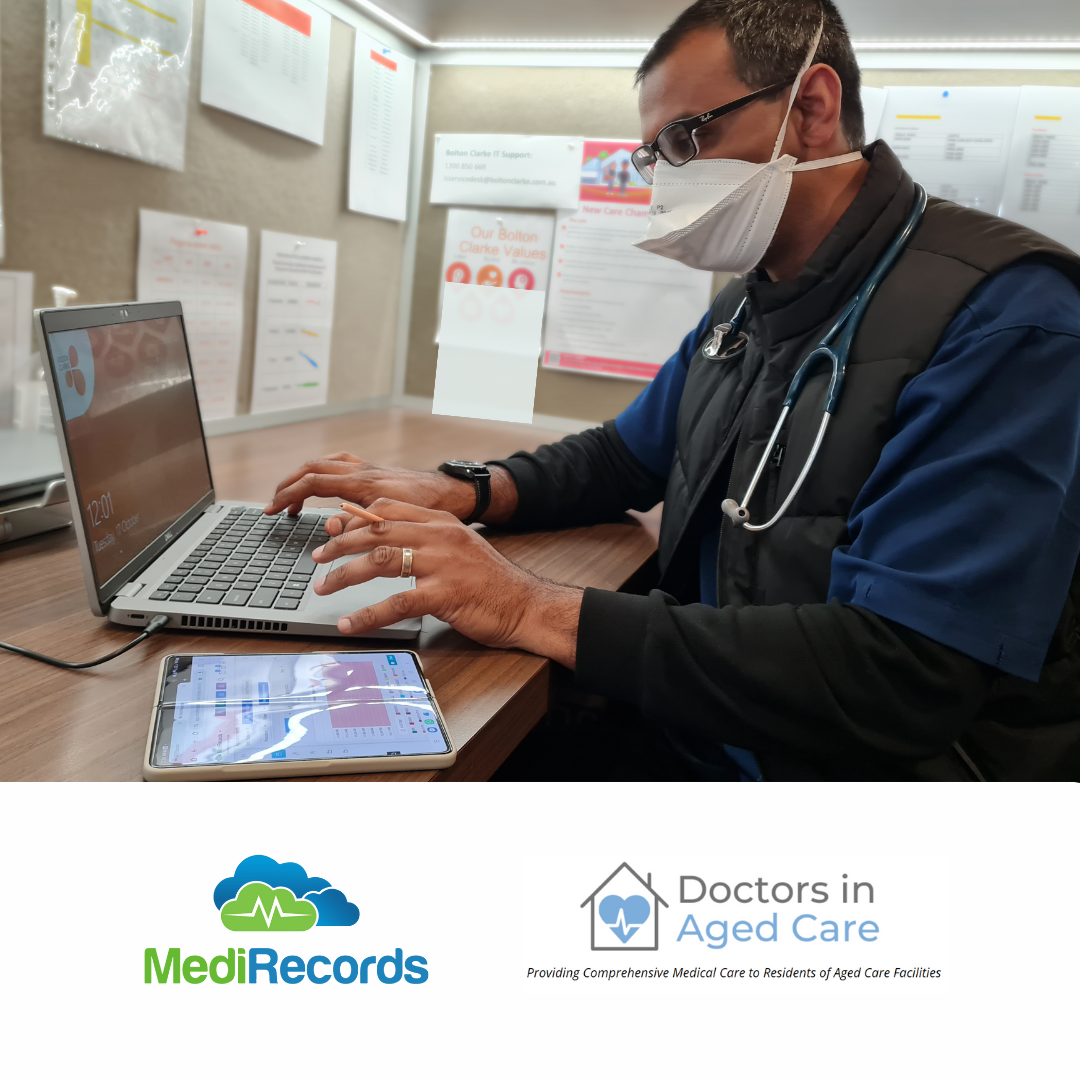
I graduated from The University of Melbourne in 2003 then worked in public and private hospitals as a resident and locum doctor for 4 years before starting my GP training, which I finished in 2010. I then worked full-time in several GP clinics till 2017, after which I moved to focus on full-time work in aged care, only visiting residential aged care facilities as part of a mobile GP practice. In 2022 I started my own solo mobile GP practice, Doctors in Aged Care, and continue this work today.

This year we became one of the first AGPAL-accredited mobile GP practices in Australia, accredited under the RACGP 5th Standards as a non-traditional practice without a physical premises/consulting rooms.

Doctors in Aged Care also has a dedicated Facebook Group with over 2700 doctor members where peer-to-peer learning and discussion occurs about all things related to aged care from administration, Medicare, clinical and organisational aspects.

What is the product you are using?

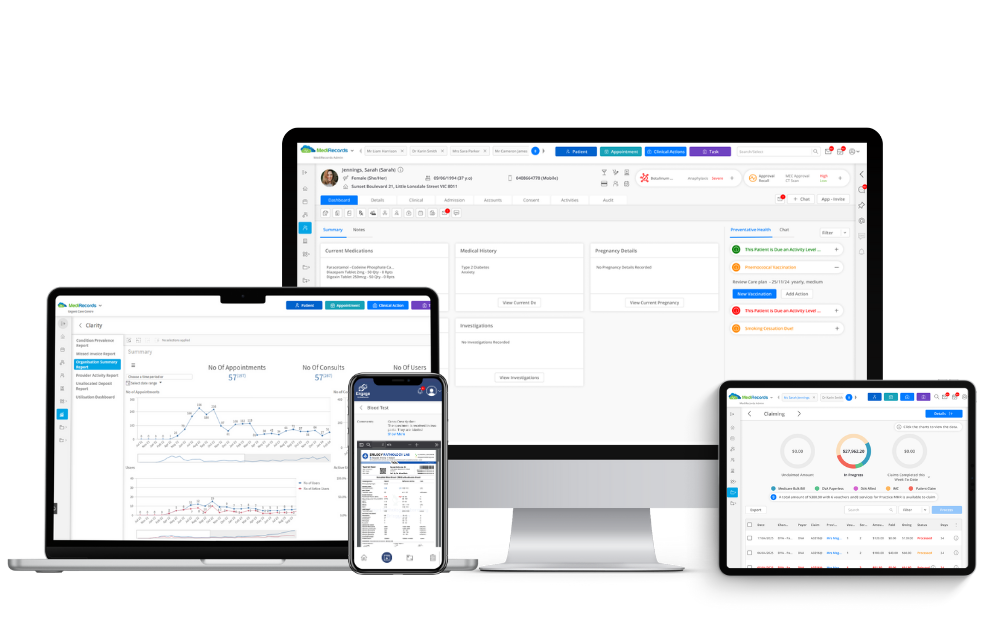
I use MediRecords as my clinical and practice management software as it gives me much greater reliability and speed working in mobile settings and without relying on remote access connections to access server-based software. It also provides much greater security along with automatic backups and ensures my IT costs are kept to a minimum by avoiding the need to pay for expensive third party IT service providers and maintaining hardware such as servers.

I also use Snapforms for various online forms that integrate directly into MediRecords and can auto-populate fields — for example, using an online new patient registration form that automatically creates a new patient file in MediRecords with certain demographic fields populated and a copy of the form automatically uploaded to the Correspondence tab.

I don’t use any AI software at present, but I do use a text shortcut software called Phrase Express to speed up my note-taking significantly.

What do you see as some of the enablers and barriers to health innovation in primary care in Australia?

Enablers include the current economic climate with rising costs across the board meaning we need to find new ways of doing things in order to be leaner, more efficient and thus more financially sustainable. I think there is openness to such innovation amongst the GP community.

Barriers include current operating models where GPs are operating their own independent medical practices within a common physical premises with the Practice Owner providing administrative and support services. Owners somehow need to cater to the needs of these individual GPs running their own practices and be able to customise their offering to each GP without increasing their costs too much.

A significant change — like a change of practice software — is harder to achieve in this situation as buy-in from many independent doctors is needed, who won’t necessarily see any direct financial benefit if their services fees remain the same and may be resistant to alterations to their usual workflows.

What do you think the future of general practice looks like?

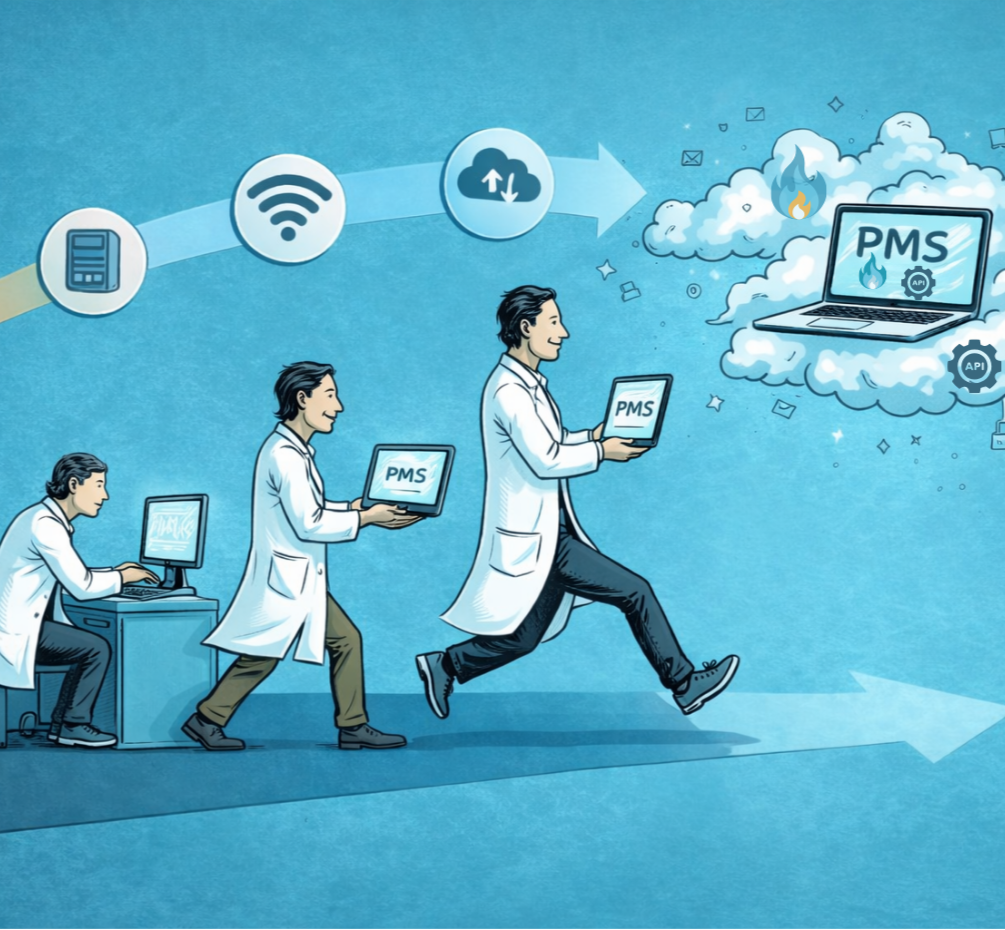
I think the future of general practice will need to move towards one that is underpinned by modern cloud-based software that is more secure, scalable and interoperable. One where face-to-face visits are complemented by phone and video consultations as well as asynchronous communications via cloud-based patient portals, where patients have more access and visibility over their own patient health records.

It will incorporate new operating models such as the use of more virtual or remote administrative and support staff to reduce operating costs and improve financial sustainability. GPs must expand their service offerings and become more accessible to counter the effects of the Telehealth/Online-only providers that are providing more convenience to patients, but without the continuity of care that patients should expect.

Why is it important GPs are involved in health innovation/new technology design?

GPs should be involved in the early stages so the products built are fit for purpose and designed with fewer iterations and ultimately lesser time and cost. Incorrectly designed software will get very little traction amongst GPs, who will not have the time to see patients and adjust to this with work-arounds.

What would you say to early career doctors about general practice/primary healthcare?

Early career doctors should ensure they get the broadest exposure to General Practice through the different medical centres they work in, and later on consider sub-specialisation into a niche area that suits their interests and abilities and meets their financial and lifestyle objectives and family needs.

Let the work fit into your life, not the other way round!

This article was originally published by GPRA Futures, a dedicated showcase of future thinkers, provocateurs, and healthcare innovations from visionary start-ups to established developers.

Opening a medical practice involves more than finding a location and hiring staff. From Medicare compliance to digital health registrations, there are many steps to get right. We’ve simplified the process into a practical checklist to help you launch a modern, compliant clinic with confidence.

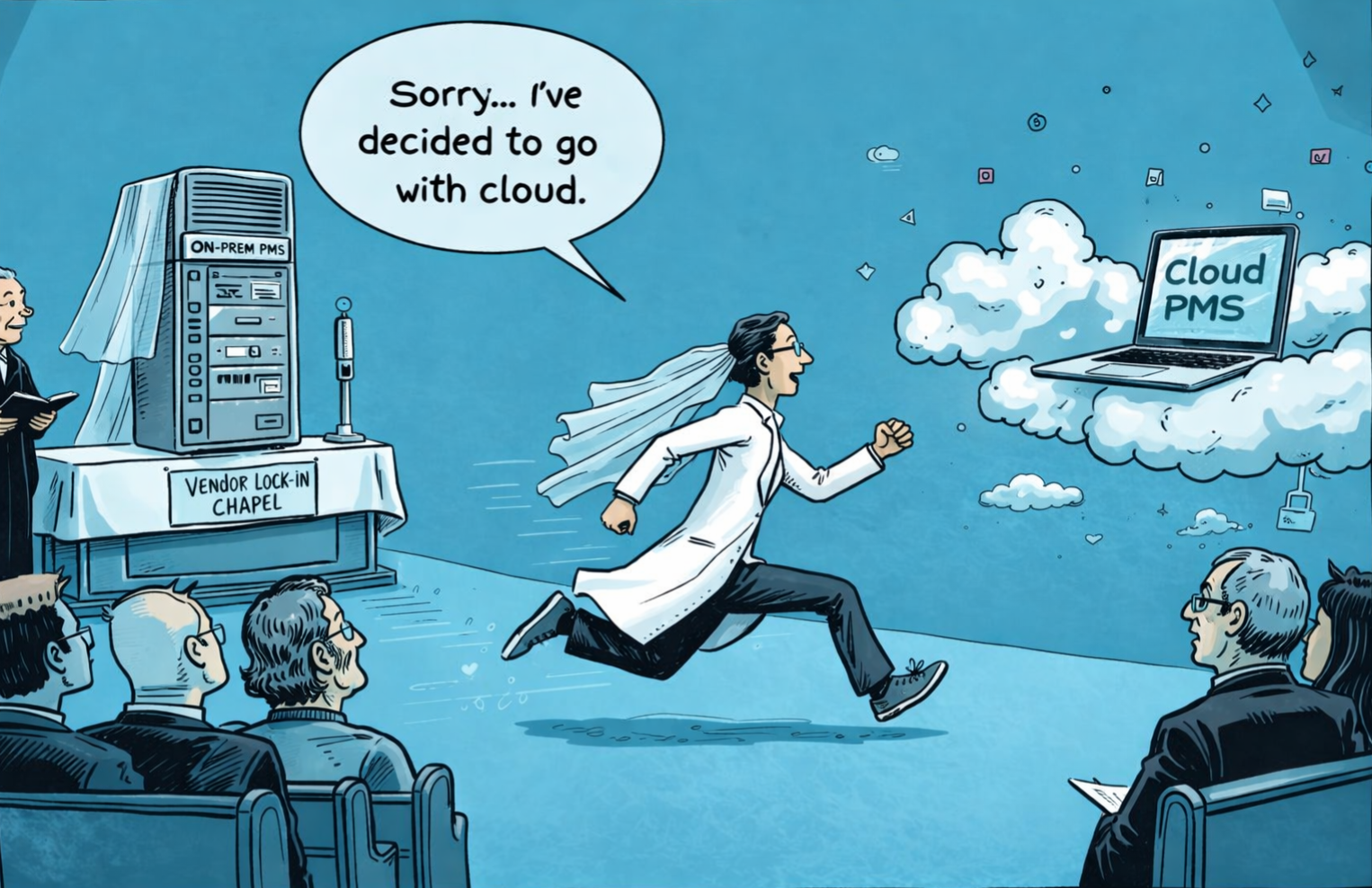
Why choosing a Practice Management System shouldn’t be a marriage for life

Why choosing a Practice Management System shouldn’t be a marriage for life - but neither should it be married at first sight

by Tim Pegler

Choosing a Practice Management System (PMS) is not a decision to take lightly.

Like a significant other, a PMS needs to be dependable, adaptable, and easy to spend time with. It should be open to growth, including making new connections. It should not be stuck in the past.

However, for time-poor clinicians their clinical software is all too often a set and forget decision. It’s the equivalent of ‘til death do us part’ (or the servers need replacing). Until then, inertia wins the day.

Fortunately, Australian healthcare is at a crossroads. There’s never been a better time to review technology partnerships, following Federal Government confirmation the future of healthcare is cloud-first and FHIR-enabled.

This doesn’t mean it’s time for a software swingers party or a married at first glance impulse buy. Migrating to a new Practice Management System can be complicated. Here are six things to consider carefully if you’re ready to reconsider your pairing:

1. Technology is evolving. Your PMS needs to keep pace

The Federal Government preference for cloud-hosted technology with FHIR (Fast Healthcare Interoperability Resources) connectivity is pragmatic and based on worldwide trends. There are rising expectations for data to be shared from Primary (e.g. GP) to Tertiary (e.g. hospital) care organisations in real time because communication silos create risk. Consumers increasingly expect access to their data – and their doctors – wherever they are. Your technology needs to support this with secure integration to government systems. Ask your vendors: 

  • What security certifications do they have? 
  • Are they conformant with government regulations for prescribing safely? 
  • How often do they release product updates and how easy are these to install? 
  • What’s on their roadmap?

2. Scalability inot negotiable

Growth looks different for every organisation. You might: 

  • Add multidisciplinary teams for holistic, shared care 
  • Expand to multiple sites 
  • Provide a combination of face to face and telehealth care 

A scalable PMS accommodates growth rather than impeding it. This is why cloud systems have become the modern standard; they scale effortlessly, securely, and cost effectively. 

3. Remote workforces are here to stay

The pandemic changed healthcare forever, resulting in workforce casualisation, proliferation of virtual care services, and teams working from anywhere with Internet access. Your preferred PMS needs to be limber enough to support: 

  • Telehealth consultations 
  • Distributed administrative teams 
  • After hours clinical care 
  • Offsite reporting, billing, and triage 
  • Multilocation collaboration 

If your workers are grinding away via legacy remote desktop systems, you’re likely to be losing time, money and team morale.  

4. API connectivity iessential 

API and FHIR interoperability enable innovation. Look for a PMS technology partner with open, well documented APIs ensuring secure connection with: 

  • AI-powered tools to enhance efficiency 
  • Digital front doors 
  • Patient engagement portals 
  • Medication dispensing and delivery systems 
  • And much more. 

A PMS that resists integrations is holding your organisation back. (To read about MediRecords’ connectivity, check out Connect by MediRecords – Connected Health Care.)

5. Look at the big picture on budget 

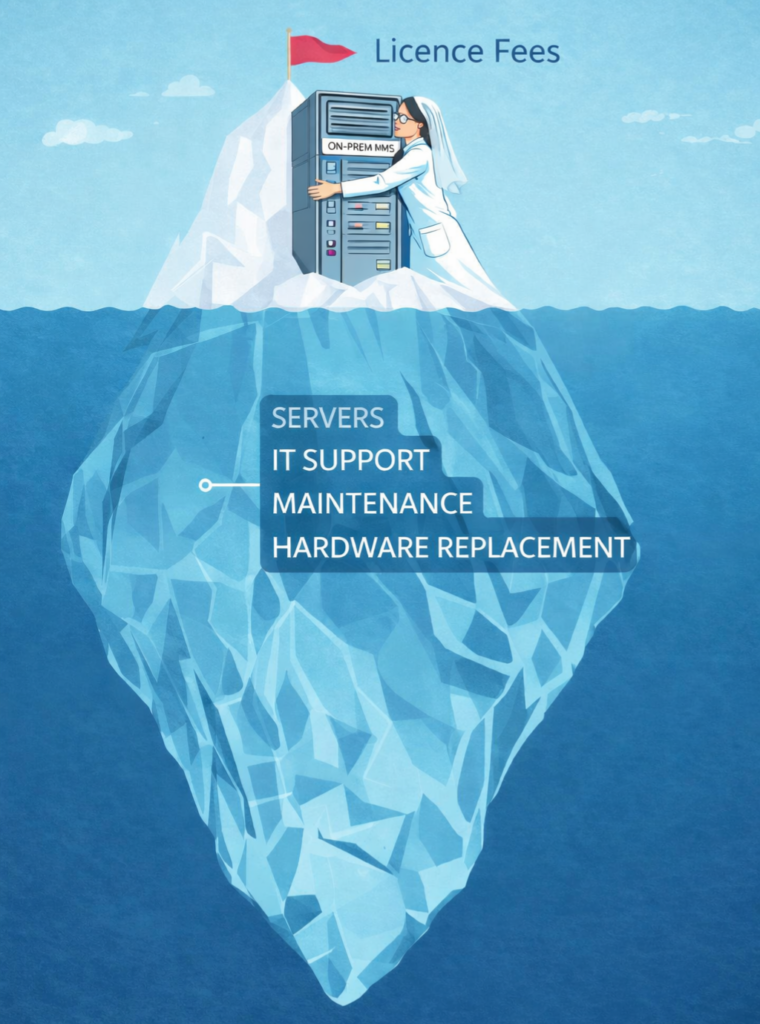
A wedding costs more than a dress, rings, catering and flowers. Factor in photography, suits, vehicle and venue hire, celebrants, music, and so much more. Licence fees for a server-based or hybrid PMS may be attractively low, but you need to budget for desktop downtime and IT support for managing your back-ups, software updates and security patches, not to mention the hardware, building and utilities expenses for owning, running and cooling servers. A server is a short-term investment; you’re committing to $40k or more, each time you replace the hardware. You also need to dispose of it securely and, ideally, sustainably. 

Cloud PMS systems mean you can ghost server issues, swipe left on IT contractors and let your technology partner automate software management for you. 

6. Where do you see yourself in a decade? 

People change. So does the healthcare sector. Hospital-, aged-, and palliative care will increasingly be delivered at home, to maximise patient comfort and convenience, and minimise costs. Can your nursing teams deliver patient care wherever they need? 

Actively seek PMS software with the flexibility to satiate new needs as they arise.  

If it’s not marriage for life, what is it?

Think of your PMS as a long-term partnership, built on performance, adaptability, and trust. You shouldn’t feel trapped by it. You shouldn’t choose it impulsively. You should feel confident it’s the right pairing for today and tomorrow. If it’s cloud-based, scalable, FHIR-enabled, and API-driventhat’s a lot of green flags. 

Moving forward

If you’re considering opening a new business, MediRecords’ Complete Medical Practice Startup Blueprint provides a comprehensive checklist on things to work through. 

If your existing business is looking for a new technology partner, please book a call via [email protected] so we can discuss your requirements. 

Opening a medical practice involves more than finding a location and hiring staff. From Medicare compliance to digital health registrations, there are many steps to get right. We’ve simplified the process into a practical checklist to help you launch a modern, compliant clinic with confidence.

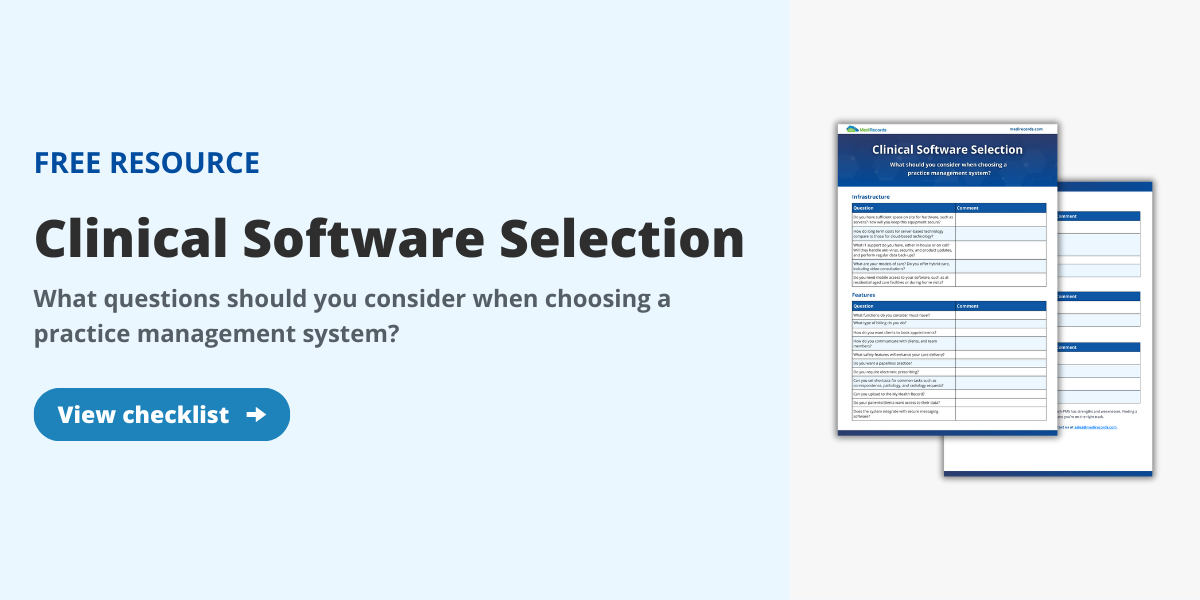
What to consider when selecting a practice management system?

What to consider when selecting a practice management system?

Looking for a new system to manage your practice, clinical notes, and patient records? What should you be looking for in a software solution?  

Delve into the following factors to consider when seeking a healthcare practice management system. These insights come from conversations with our customers, decades in digital health, and personal experience as healthcare consumers.

1. System architecture

When navigating PMS options, one of the first crucial decisions is whether to opt for a server-based or cloud-based system. Evaluate the long-term costs, encompassing initial setup, subscriptions, IT support, and maintenance. It’s important to tailor your choice to your practice’s model of care, whether it’s virtual care/telehealth, bricks-and-mortar, or a hybrid approach.

Read our article, “Eight Reasons to Embrace Cloud Technology in Healthcare” to learn how cloud technology can help in substantial cost savings, potentially saving your practice $600k in 10 years.

2. Feature requirements

To maximise the efficiency of your healthcare delivery, it’s essential to define specific feature requirements tailored to your practice. From appointment booking to electronic health records and billing, identify key elements such as ePrescribing, Medicare billing & claiming, online booking, My Health Record integration, secure messaging, patient portal functionality, investigation requests, and robust reporting capabilities.

3. Training and support

A successful integration of a PMS into your healthcare setting relies heavily on the training and support provided by the vendor. It’s important to enquire about the level of training and ongoing support offered by the PMS vendor, and to assess the available support mechanisms for addressing any day-to-day operational issues.

4. Evaluate other key aspects –

Other important factors to consider include the following:

  • Ease of use: Ensure the system is user-friendly, promoting an efficient workflow within your team.
  • Mobile accessibility: Verify if the PMS allows remote access, facilitating flexibility and on-the-go management.
  • Interoperability: Confirm the system seamlessly integrates with other healthcare systems, promoting efficient information exchange.
  • Security and compliance: Ensure the PMS adheres to necessary regulations to safeguard patient data, maintaining the highest standards of security.

The truth is every practice has slightly different needs and workflows so no practice/patient management system will be a perfect fit. Each will have strengths and weaknesses and potentially require compromise to accommodate your team’s unique requirements. Finding a flexible, robust system that can tick most of the boxes, now and tomorrow, suggests you’re on the right track.

Contact our Sales team today to discuss how MediRecords cloud-based software can help you. 
Looking to stay updated with the latest from MediRecords?

Sign up to the newsletter