What a difference the cloud makes – why GPs need to look up when seeking software

What a difference the cloud makes - why GPs need to look up when seeking software

This article was originally published by The Medical Republic and can be viewed in its original format here.


Matthew Galetto - Founder and CEO of MediRecords

 At the recent Wild Health Summit – Towards One Health System, MediRecords hosted a breakfast panel called, “What a Difference the Cloud Makes.” It was a chance to have a real conversation about where general practice IT is headed, and where it should be. 

One of our panellists, Peter O’Halloran, Chief Digital Officer at the Australian Digital Health Agency, was asked a simple question: 

“If you were setting up a general practice today, would you go cloud or on-premise?” 

His answer was unequivocal. Cloud technology is essential. 


The RACGP’s cloud guidance feels out of step 

That’s why it’s a bit jarring to read the RACGP’s own guidelines on cloud computing, which still lean heavily towards on-premise systems and paint the cloud as risky. 

From where we sit, as a healthcare cloud provider working with GPs every day, this doesn’t reflect reality. 

The idea that practices are better off managing their own servers, software, patches, backups, and security just doesn’t stack up in 2025. Most clinics don’t have dedicated IT staff, and even if they do, securing on-prem systems to the same standard as cloud platforms is near impossible. 

Cloud providers like MediRecords deliver: 

  • Continuous updates and security patches, 
  • Encryption by default (at rest and in transit), 
  • Secure, redundant backups, 
  • Access controls, audit logs, and role-based permissions, 
  • Always-on monitoring by specialised teams. 

These aren’t “nice-to-haves”. They’re standard and they’re built in. 

Cloud systems remove the need for older remote access tools like Citrix or RDP, making it easier for teams to connect and get work done. This simpler setup means faster performance, especially with tasks like printing, which are often slow or unreliable on Citrix and RDP due to delays and compatibility issues, with fewer security layers to manage. 


Meanwhile, the government Is Moving Full Steam Ahead on Cloud 

The disconnect is this: the Australian Government has made it clear that the future of digital health is cloud-first, secure, and interoperable. That’s not just a goal, it’s national policy. From the National Digital Health Strategy to ADHA’s recent messaging, it’s crystal clear. 

When asked about security, Mr O’Halloran said cloud technology companies are best equipped to provide these protections. 

Cyber-criminals are highly organised and sophisticated and well advanced of most Australian businesses, he said. 

“You’ve got no hope of trying to keep up to date and keep ahead of the bad guys,” he said. “Putting (your data) in the cloud, if you do it a safe way, it doesn’t guarantee you’re safe, but it gives you a heck of lot more chance.” 

He said the days of running server-based systems are over; “it’s simply not safe”. 

What about costs? 

Costs of switching to cloud technology can be largely offset by reductions in hardware and utility costs but Mr O’Halloran applied a different lens. “Quite frankly, in most cases, the cost of not (transitioning to the cloud) is far worse when something goes wrong.” 

Dated advice 

When we asked the RACGP to consider updating their guidance that cloud technology may introduce “increased potential for data breaches”, we were told they’re happy with the current version. That’s disappointing, not for us as a vendor, but for the GPs who rely on accurate, forward-looking advice from their peak body. 

Time to call it like it is 

The truth is, we’re well past the point where this should be up for debate. Cloud isn’t a risk, it’s the solution to the risks we’ve seen time and time again with outdated, localised infrastructure. 

It’s safer. It’s more scalable. It is more user friendly for your workforce and supports better patient outcomes. And it’s what the rest of the health system is already moving towards. 

We owe it to our clinicians, and our patients, to move the conversation forward. 


About the author: 

Matt Galetto is the founder and CEO of MediRecords, Australia’s first true cloud practice management system and electronic health record. Matt has extensive experience in data analytics, healthcare, banking and hospitality technology. 

 This article was written by MediRecords CEO & Founder Matthew Galetto, and originally published by The Medical Republic. The original article can be viewed here.

New Prescribing role for nurses: What you need to know
 

New prescribing role for nurses: What you need to know

More nurses will be able to prescribe pharmaceutical medicines from September in a move that aims to ease the pressure on GPs.

Not all registered nurses will be granted prescribing authority, and those who complete the required training and registration process are allowed to prescribe 2, 3, 4 and 8 medicines only within a “formal prescribing partnership” with an authorised prescriber, such as a doctor. 

The new Registration Standard, Endorsement for Scheduled Medicines – Designated Registered Nurse Prescriber, was approved by health ministers last December and is part of ongoing national health workforce reform aimed at:

  • Improving access to healthcare, particularly in rural and remote communities or other settings where there are doctor shortages.
  • Expanding the scope of practice for experienced registered nurses.
  • Reducing pressure on GPs and the broader healthcare system. 
 
“This is a landmark moment for Australian nursing,” said Nursing and Midwifery Board of Australia (NMBA) Chair Ajunct Professor Veronica Casey. “We’re inviting the entire health community to join us on this journey.”

The standard was published last month to give stakeholders time to prepare for the change. 

Help for nurses to understand and meet the endorsement requirements can be found in the NMBA’s fact sheet and guidelines.

Help for Customers:

As these changes come into effect, MediRecords is ready to support your team. If you have registered nurses who will be endorsed to prescribe, their licences will need to be upgraded to enable prescribing functionality. This ensures appropriate access and compliance within MediRecords.

Your Customer Success Manager can walk you through the upgrade process, including any associated costs, and help ensure everything is in place before implementation begins in September. We’re here to make the transition simple and seamless. 

Frequently asked questions

The Registration standard: Endorsement for scheduled medicines – designated registered nurse prescriber can be found here on the NMBA website. 

A nurse practitioner has a master’s degree and can work independently to diagnose, treat, and prescribe. A designated RN prescriber has extra training and can prescribe, but only in partnership with a doctor or authorised prescriber. 

An RN must meet all requirements outlined in the official Registration Standard, including, but not limited to,  

  • Completing an NMBA-approved prescribing course (or equivalent study); 
  • Have at least 5,000 hours of clinical experience within the past six years; and,  
  • Hold general registration with no relevant conditions or undertakings. 

After gaining endorsement, the RN must work within a formal prescribing partnership (e.g. with a doctor) and complete a six-month clinical mentorship when they begin practising as a prescriber. See also the Guidelines for registered nurses applying for and with the endorsement – designated registered nurse prescriber on the NMBA website. 

Schedule 2, 3, 4 and 8 medicines, but only within a formal prescribing partnership with a doctor or authorised prescriber. 

We can help upgrade your clinical licences to include prescribing capabilities and integrate nurse prescribers into your workflows. 

To ease pressure on GPs, improve access to care (especially in rural/remote areas), and expand the scope of experienced nurses. https://pricing.medirecords.com/

Sources

MediRecords in the fast lane for FHIR connectivity
 

MediRecords in the
fast lane for FHIR connectivity

MediRecords will be releasing new FHIR integration pathways for clients throughout 2023, as part of our commitment to a better connected Australian healthcare system. 


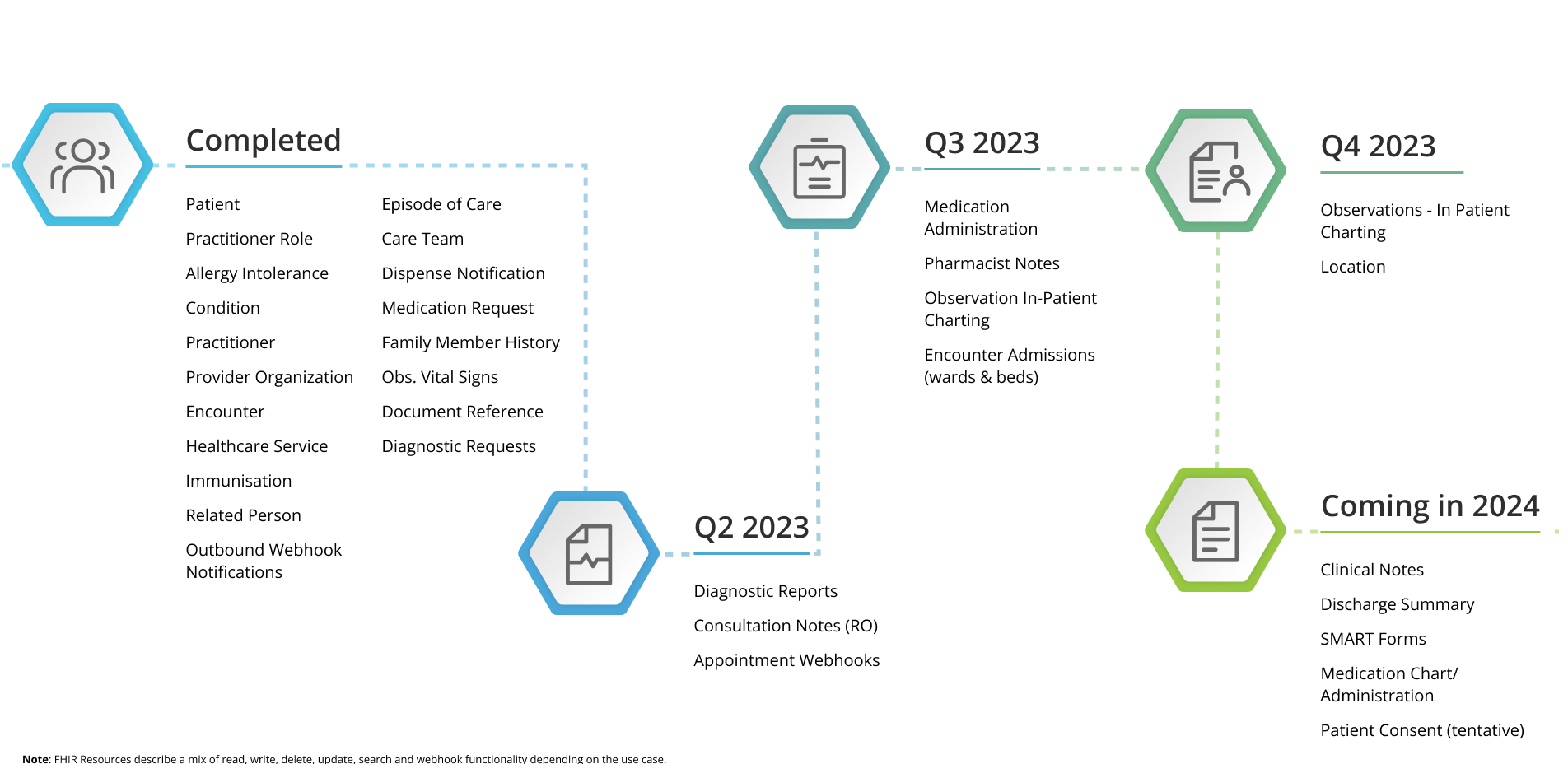
As can be seen from our FHIR Roadmap below, we not only have established and proven options for data sharing, but we’re investing in the expansion of our Connect platform which comprises of  FHIR (Fast Health Interoperability Resources) and Connect services.

We now have FHIR integrations with hospital systems for ePrescribing, and updating patient records. New resources in development for MediRecords 2.0 include allergies, diagnostic requests and reports, patient summaries, and inpatient charting.

MediRecords Chief Executive Officer Matthew Galetto said the Connect platform enabled health care providers and patients to access records quickly and securely, driving better and timelier health outcomes.

“We’re keen to see more software vendors hit the road and deliver on industry standards for interoperability, resulting in connected health care across Australia,” Mr Galetto said.

“Some vendors seem to be waiting for a reason to modernise when the motivation should be clear — the right care at the right time, wherever you are in Australia.”

MediRecords is part of a national consortium, led by Leidos Australia, developing a new Health Knowledge Management (HKM) system for the Australian Defence Force. This project will see MediRecords connect health records for GPs, allied health practitioners, specialists, patients, and hospitals.

MediRecords is also supporting the Victorian Virtual Emergency Department with an integrated ePrescribing system.

MediRecords Technical Product Lead Sanjeed Quaiyumi said 2023 would be an exciting year. “We’re working on consultation notes and can’t wait to hit other milestones on our roadmap.”

MediRecords FHIR Roadmap

MediRecords FHIR roadmap was last updated 01/11/23.

Looking to stay updated with the latest from MediRecords?

Sign up to the newsletter

    MediRecords partners with Clinivid to provide secure communications between multidisciplinary care teams.

    MediRecords partners with Clinivid to provide secure communications between multidisciplinary care teams.

    Matthew Galetto MediRecords banner

    Matthew Galetto

    MediRecords, the market leading cloud based clinical & practice management solution, and Clinivid a cloud-based clinical communication platform, have joined forces to provide a secure alternative for multidisciplinary care teams to communicate, share advice and files for improved holistic patient care.
    Matthew Galetto, CEO of MediRecords, says: “Our partnership with Clinivid allows health providers using MediRecords to easily share clinical information, including images, in a mobile environment and to include external members of a care team through easy and direct messaging. It supports our goal to give our users access to the best-in-market solutions, with the flexibility to choose the right tools to support their workflow. Most importantly, clinical information flows seamlessly back into MediRecords to complete the patient longitudinal record and clinical workflow. ”
    Dr Katja Beitat, CEO of Clinivid, adds ”This partnership highlights the power of cloud-based clinical solutions that make multidisciplinary care instant and easy. Patient information is secure at all times. With automatic creation of a medical record, everyone saves a lot of time.”
    MediRecords is expecting its users with high levels of mobility and multidisciplinary care to take up the joint solution. Clinivid secure messaging is applicable for care teams in hospitals, chronic disease management, mental health care and for virtual patient handovers.

    About MediRecords

    MediRecords is Australia’s leading cloud-based clinical and practice management solution used by Specialists, GP’s and Allied Health Professionals across Australia. MediRecords is transforming the delivery of healthcare servicing in Australia. Connecting health professionals and patients with a suite of integrated products, MediRecords improves patient care while reducing associated costs of outdated technology. Developed from the ground up to harness the power of the cloud, MediRecords is available as a SaaS solution for SMB’s or as a dedicated platform service for larger corporates and institutions.

    About Clinivid

    Clinivid is an Australian based company enabling safe and mobile clinical information sharing across the whole health care sector. Fitting seamlessly into existing workflows in practices and hospitals, we improve the way clinicians connect, communicate and collaborate to increase efficiency, minimise risks and help provide better patient care. Clinivid offers secure mobile messaging and clinical meetings.

    To learn more or get involved email [email protected] or call 1300 103 903.

    Media Contacts:

    Michael Alldrick
    Matthew Galetto MediRecords banner

    Matthew Galetto

    Looking to stay updated with the latest from MediRecords?

    Sign up to the newsletter