
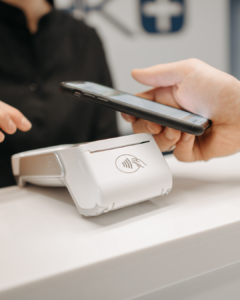



Innovations in Hospital Healthcare
 

Innovations in Hospital Healthcare

Exploring Virtual Hospitals, Hospital in the Home, and Hospitals Without Walls.

Advancements in technology have seen an explosion of new terms and concepts in healthcare.

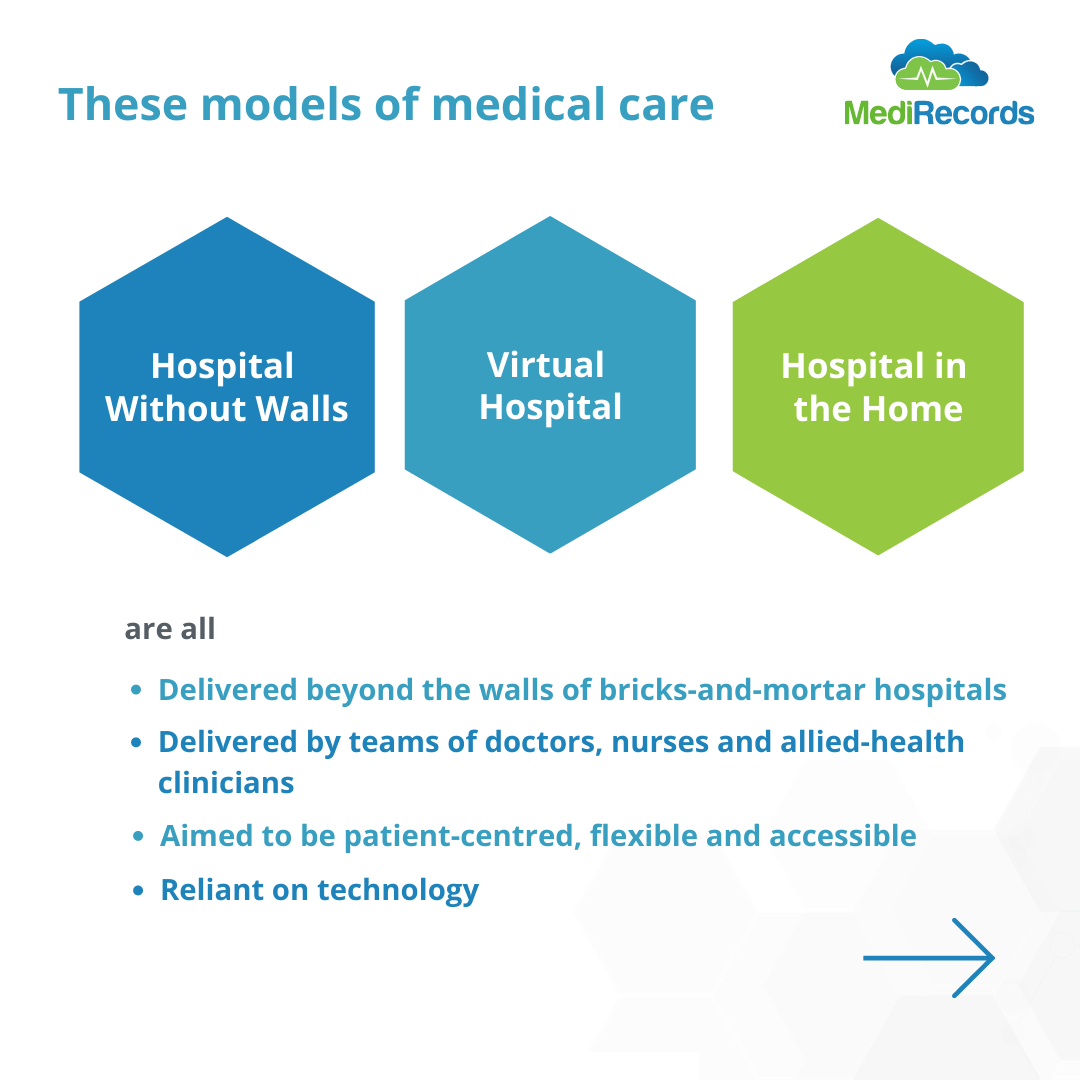
In this article, we aim to demystify three innovative approaches: Virtual Hospitals, Hospital in the Home, and Hospitals Without Walls.

All three challenge traditional notions of hospitals and have potential to revolutionise patient care as they reshape healthcare delivery.

Virtual Hospitals: Remote Care

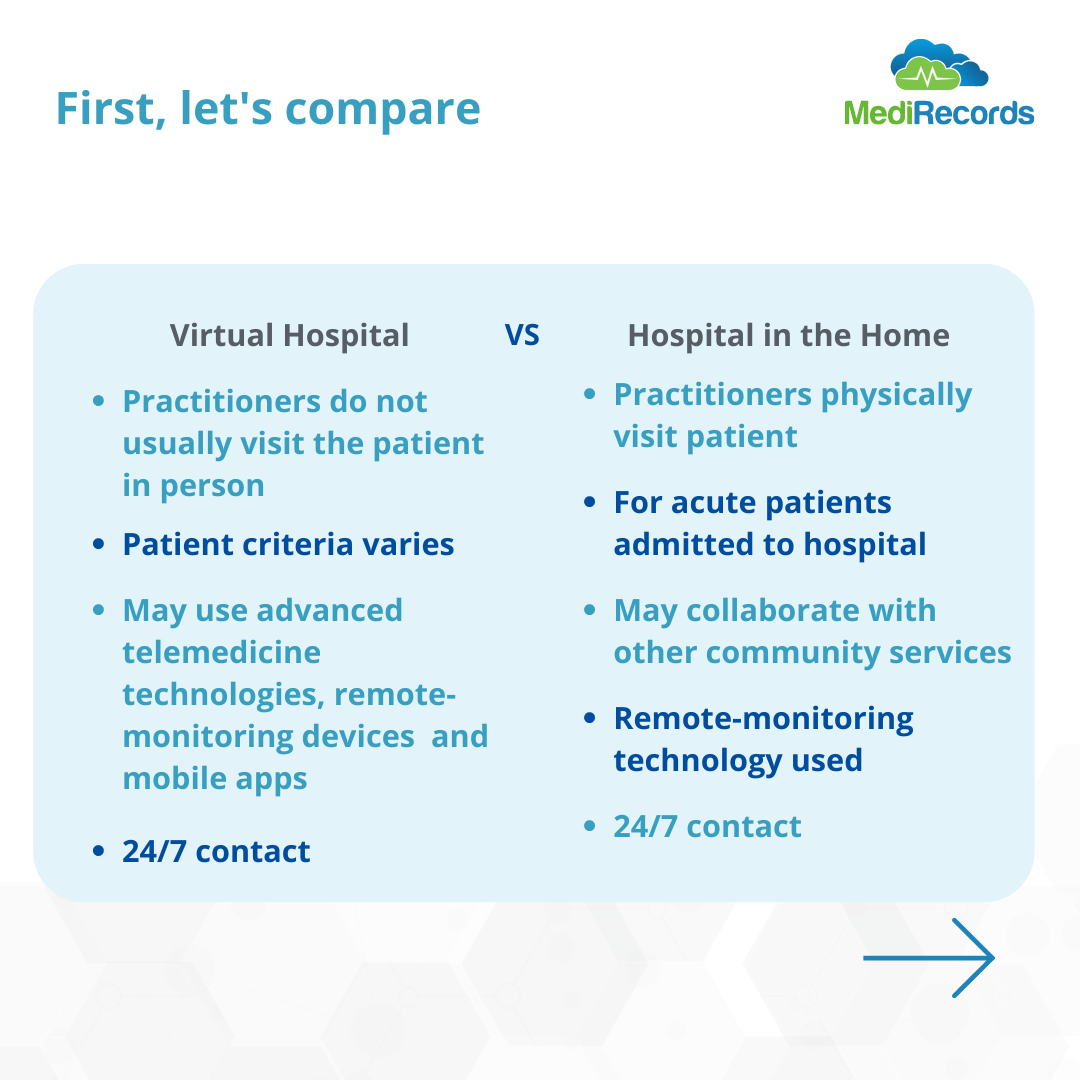
Virtual hospitals use telehealth and telemedicine technologies to bring medical care directly to patients’ homes. Through video conferencing, remote-monitoring devices, and electronic medical records, healthcare professionals can remotely diagnose, treat, and monitor patients.

Hospital in the Home (HITH): Care in Familiar Surroundings

HITH programs deliver acute-care services to patients within the comfort of their own residences. Healthcare professionals visit patients at home to directly assist with treatment but also use remote-monitoring devices and video conferencing.

Hospitals Without Walls: Care Beyond Traditional Boundaries

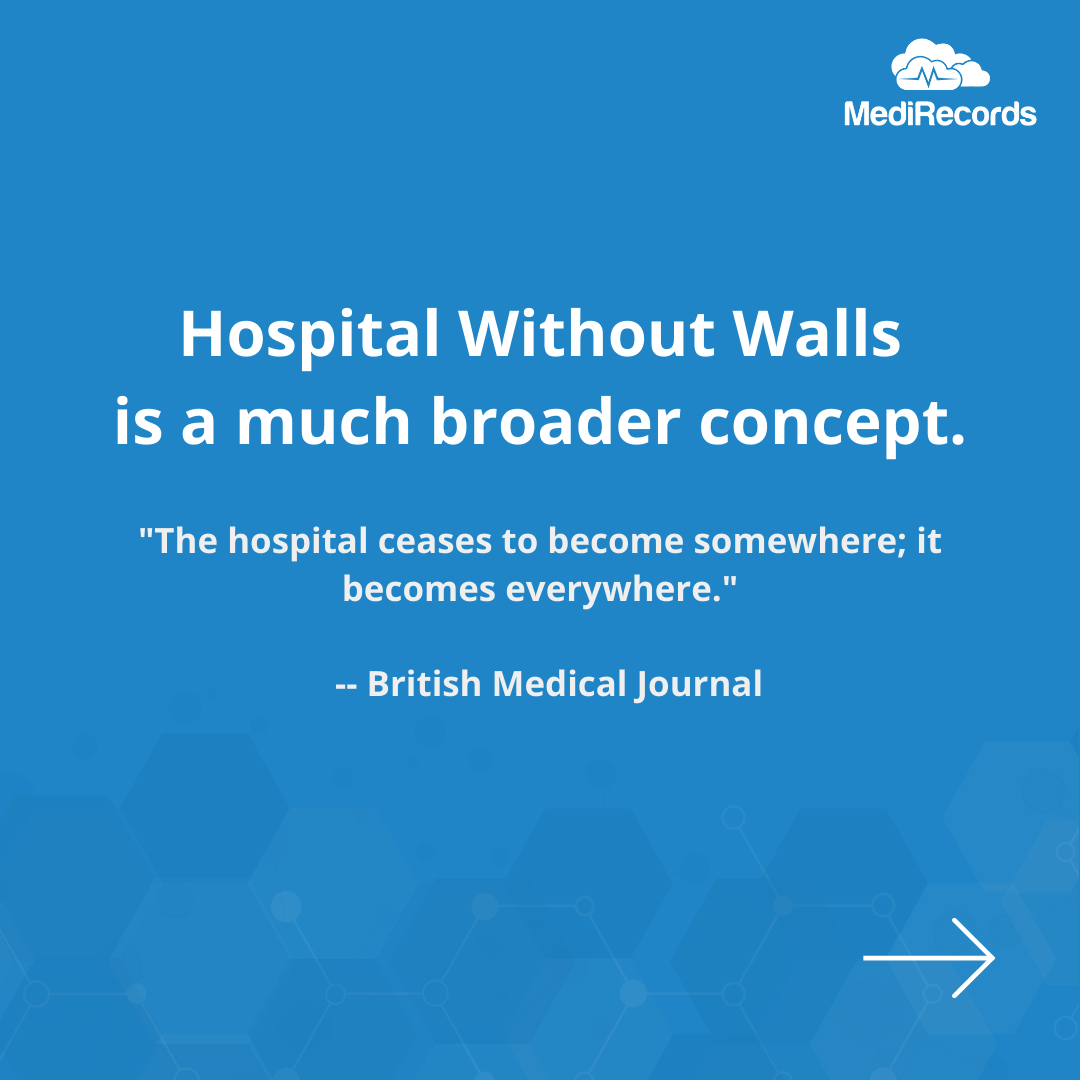
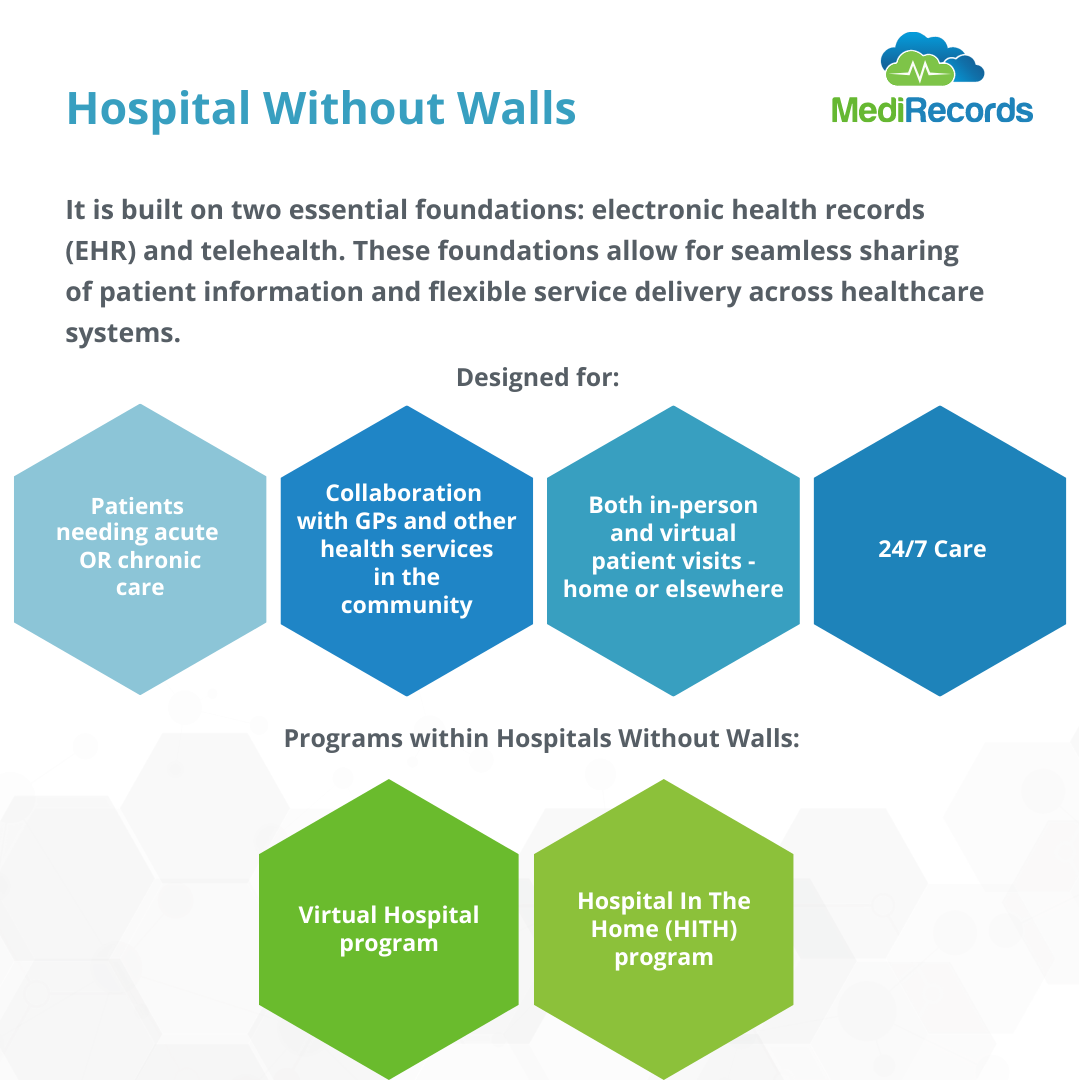
A hospital without walls provides healthcare services in non-traditional spaces such as community centres, nursing homes, or even workplaces. The goal is to bring medical care closer to where people live, work, and play, increasing accessibility and equity of healthcare. Multidisciplinary teams leverage technology and resources to provide more convenient and more cost-effective care.

All three models of care offer increased efficiency, accessibility and personalised care experiences. They use technology, patient-centred care, and interdisciplinary collaboration to bring healthcare closer to the individuals who need it — and can help reduce demand for beds in traditional bricks-and-mortar hospital wards.

MediRecords currently supports clients in hospital settings including:

  • My Emergency Doctor virtual teams providing Senior Emergency Physicians to Urgent Care Centres, hospitals and ambulance services across Australia
  • Victorian Virtual Emergency Department and Northern Health outpatient teams as an ePrescribing system
  • Queensland Health virtual emergency department team as an ePrescribing system
  • Queensland Health Hospital and Health Services as a billing and claiming system for outpatient clinics
  • Private hospital VMO (Visiting Medical Officer) consulting suites as an electronic health record (EHR) and patient management system.

As a flexible and scalable EHR platform with inpatient functionality in development, including medication charting, MediRecords is well placed to be the clinical system of record for models of care including HITH and Hospitals Without Walls. 

Book a demo with our Sales team to learn how we can assist you.

Looking to stay updated with the latest from MediRecords?

Sign up to the newsletter

    Big-spending Federal Budget tackles bulk billing crisis 
     

    Big-spending Federal Budget tackles
    bulk billing crisis
    Doctors and healthcare consumers are the winners in the 2023-2024 federal Budget.

    The Albanese Government’s first Budget emphasised the importance of secure, safe and efficient digital sharing of health information — albeit without mandating standards for achieving this.

    A total commitment of $101 billion in health spending will include an upgrade to My Health Record, and $3.5 billion in bulk billing incentives for common GP consultations, including telehealth and videoconference, making care more affordable.

    More than 300 common PBS medicines will be made more affordable, with Australians able to buy two months’ worth of medicine for the price of a single (one month) prescription.

    MyMedicare — a new voluntary scheme in which patients enrol with a MyMedicare general practice — will support longer GP telehealth consultations, with reduced administration for practices, at a cost of nearly $6million to the government. There’s also more than $200 million allocated under this same scheme to provide new funding packages for general practices to provide comprehensive care to patients who are frequent hospital users ($98.9m); and for Australians in residential aged care ($112.0m). 

    The key budget measures for healthcare include:
    • $3.5 billion in bulk billing incentives enabling more telehealth and video conference consultations, and free appointments for children aged under 11, pensioners and Commonwealth Concession Card holders.
    • $358.5 million for 8 additional Medicare Urgent Care Clinics to reduce pressure on hospital emergency departments
    • $98.2 million for larger Medicare rebates for long healthcare appointments, aimed at enhancing care for people with chronic diseases and mental illness.
    • $445.1 million to encourage general practices to hire multidisciplinary teams to provide team-based primary care.
    • $951.2 million to overhaul the My Health Record
    • $46.8 million for Medicare rebates for care provided by nurse practitioners, including prescriptions of PBS medications
    • $1.2 billion for community pharmacies to administer free vaccinations and support treatments for opioid addictions.
    Looking to stay updated with the latest from MediRecords?

    Sign up to the newsletter

      Collaboration ignites at HL7 AU FHIR Connectathon
       

      Collaboration ignites
      at HL7 AU FHIR Connectathon

      A spirit of collaboration even among competitors was the overwhelming experience of the MediRecords Technology & Product team this month at a key event for advancing the secure and seamless exchange of electronic healthcare data. 


      The HL7 AU FHIR (Fast Health Interoperability Resources) Connectathon at the Sydney Microsoft headquarter revealed the broad range of organisations using FHIR. 

      “This event was a great way to see what is on the horizon and to see how many organizations are using FHIR and are willing to work together towards a common objective,” said MediRecords Technical Product Owner Sanjeed Quaiyumi.

      “At MediRecords, we have already built a huge suite of FHIR resources. Events like Connectathon allow us to validate our new ideas and in-progress work.” 

      Sanjeed added that the team gained insights into the FHIR capabilities of organisations such as Australian Digital Health Agency, CSIRO, Telstra Health, Sonic HealthCare, and software developers Epic, and for what business purposes they are using FHIR.

      “It is an amazing community which brings people from different aspects of healthcare together, sharing a common objective of interoperability, he said. 

      MediRecords Software Developer/FHIR Analyst  Niel Sayo and FHIR Team Lead Jack Li agreed the friendly event was an opportunity to view the latest products, approaches and ideas in Australia. 

      “We can look at our competitors also as partners when it comes to collaborative interoperability concerns,” Niel said. 

      MediRecords Graduate Software Engineer Joshua Vazzoler also noted the collaborative nature of the event and appreciated the opportunity for practical experience in a hackathon-style setting. 

      “My initial observations of the event highlighted the expanding presence of FHIR within the Australian market, with a significant turnout of professionals,” Josh said. 

      “As a participant, I was eager to engage with like-minded FHIR professionals who share a passion for interoperability, and learn from esteemed industry experts.” 

      “The event instilled a sense of inspiration and motivation to contribute towards the advancement of FHIR-based solutions within the healthcare industry.” 

      Check out our latest FHIR update and roadmap

      Looking to stay updated with the latest from MediRecords?

      Sign up to the newsletter

        MediRecords in the fast lane for FHIR connectivity
         

        MediRecords in the
        fast lane for FHIR connectivity
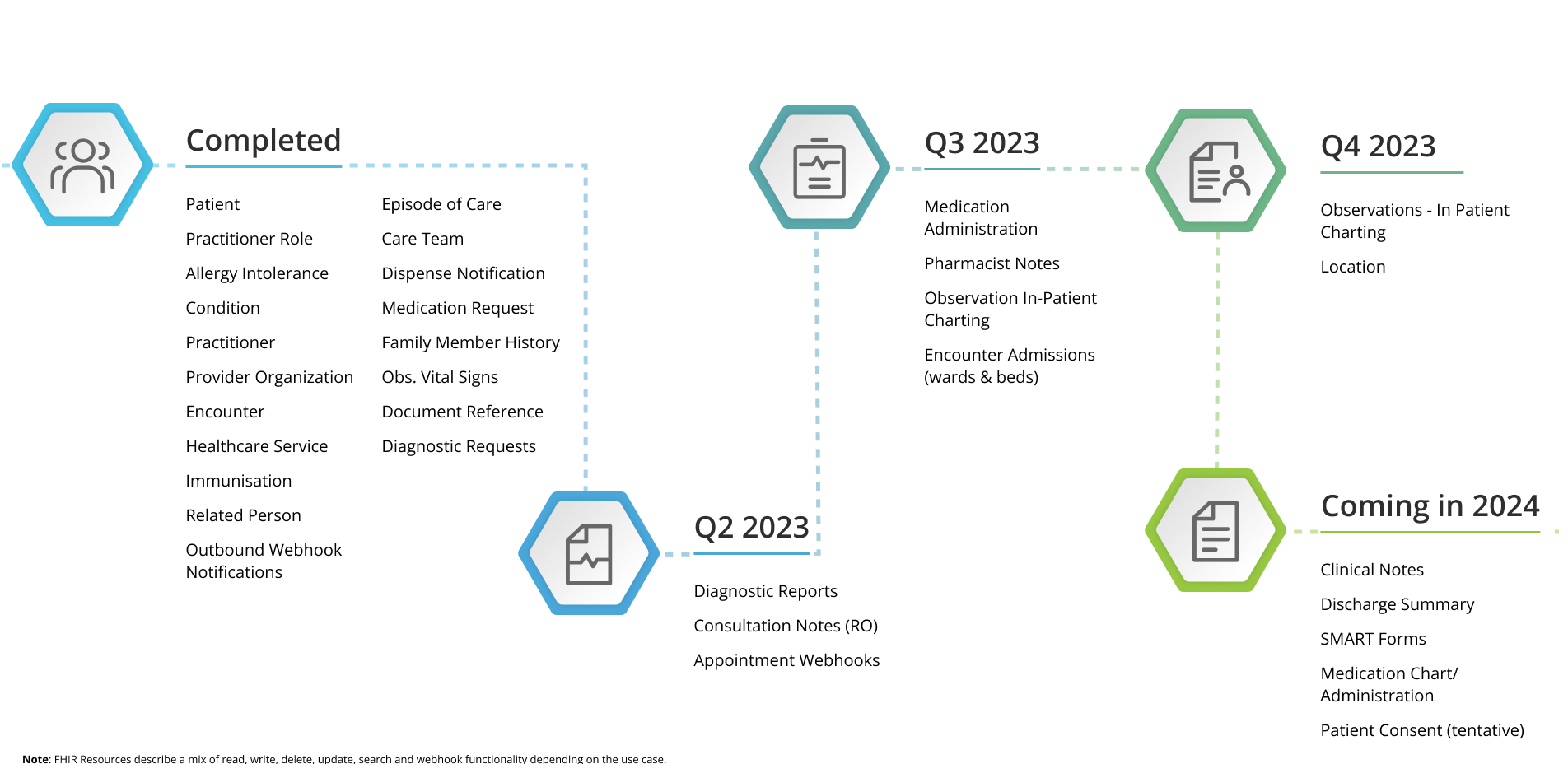
        MediRecords will be releasing new FHIR integration pathways for clients throughout 2023, as part of our commitment to a better connected Australian healthcare system. 


        As can be seen from our FHIR Roadmap below, we not only have established and proven options for data sharing, but we’re investing in the expansion of our Connect platform which comprises of  FHIR (Fast Health Interoperability Resources) and Connect services.

        We now have FHIR integrations with hospital systems for ePrescribing, and updating patient records. New resources in development for MediRecords 2.0 include allergies, diagnostic requests and reports, patient summaries, and inpatient charting.

        MediRecords Chief Executive Officer Matthew Galetto said the Connect platform enabled health care providers and patients to access records quickly and securely, driving better and timelier health outcomes.

        “We’re keen to see more software vendors hit the road and deliver on industry standards for interoperability, resulting in connected health care across Australia,” Mr Galetto said.

        “Some vendors seem to be waiting for a reason to modernise when the motivation should be clear — the right care at the right time, wherever you are in Australia.”

        MediRecords is part of a national consortium, led by Leidos Australia, developing a new Health Knowledge Management (HKM) system for the Australian Defence Force. This project will see MediRecords connect health records for GPs, allied health practitioners, specialists, patients, and hospitals.

        MediRecords is also supporting the Victorian Virtual Emergency Department with an integrated ePrescribing system.

        MediRecords Technical Product Lead Sanjeed Quaiyumi said 2023 would be an exciting year. “We’re working on consultation notes and can’t wait to hit other milestones on our roadmap.”

        MediRecords FHIR Roadmap

        MediRecords FHIR roadmap was last updated 01/11/23.

        Looking to stay updated with the latest from MediRecords?

        Sign up to the newsletter

          Communication the key to reducing hospital readmissions

          Communication the
          key to reducing
          hospital readmissions

          Can health tech help reduce hospital readmissions?


          According to a global research review, telehealth and virtual wards can certainly make a difference.

          The Deeble Institute — the research arm of the Australian Healthcare and Hospitals Association (AHHA) — reviewed international research on the role of primary care in reducing hospital readmissions.

          In its Evidence Brief no. 24, the Institute says telehealth can be used to boost general practice involvement in hospital discharges and subsequent multidisciplinary virtual care, resulting in fewer unplanned readmissions.

          Unplanned readmissions are associated with poorer health outcomes, dissatisfaction with healthcare, increased costs, and bed blockages.

          The report highlighted research that showed improved communication and coordination of care between GPs, hospitals and/or pharmacists is effective.

          “Effective interventions included … electronic tools to facilitate quick, clear, and structured (health) summary generation… use of electronic discharge notifications; and web-based access to discharge information for general practitioners,” reported the Netherland’s Hesselink and colleagues.

          Virtual wards are another way to reduce risk of hospital readmissions and improve outcomes during hospital-to-home transition, with research indicating these can be effective with specific disease cohorts but less so with non-specific, complex diseases.

          The Evidence Brief contrasted virtual wards with Hospital in the Home (HITH). HITH is a form of remote hospital inpatient care whereas virtual wards facilitate transition from hospital care to home care.

          “Compared to HITH, virtual wards typically have a higher degree of interdisciplinary care coordination and review, are simpler in design and implementation, and have a broader scope of activities,” The Deeble Institute reported.

          “Transitional care is similar to virtual wards, but usually implemented within existing systems. Virtual wards typically require a completely new care pathway and potentially new organisations to manage its implementation.”

          MediRecords Connect provides FHIR (Fast Health Interoperability Resources) and API options for connectivity with hospital systems, including patient administration systems (PAS). MediRecords is deployed as an ePrescribing system at two Australian virtual emergency departments and as an outpatient billing and claiming system for Queensland Health. New functionality enabling multidisciplinary case management and inpatient care will be released later this year.

          MediRecords is also integrated with the Coviu telehealth platform for streamlined virtual consultations.

          Top three Technologies that reduce hospital admissions:

          Further reading

          ‘A wonderful day’: telehealth to become permanent

          Improving Patient Handovers From Hospital to Primary Care

          Consumer adoption of digital health in 2022: Moving at the speed of trust

          PARR++ is dead: long live predictive modelling

          Impact of ‘Virtual Wards’ on hospital use: a research study using propensity matched controls and a cost analysis

          Applying the Integrated Practice Unit Concept to a Modified Virtual Ward Model of Care for Patients at Highest Risk of Readmission: A Randomized Controlled Trial

          Effect of post-discharge virtual wards on improving outcomes in heart failure and non-heart failure populations: A systematic review and meta-analysis

          Looking to stay updated with the latest from MediRecords?

          Sign up to the newsletter

            MediRecords 2.0: New ways to Care, Connect and Engage
             

            MediRecords 2.0: New ways to Care, Connect
            and Engage

            MediRecords 2.0 is the most comprehensive overhaul of our electronic patient record and clinic management system since we launched in Australia in 2016. While there have been many product updates over the years, MediRecords 2.0 is designed to use screen space better, streamline workflows, reduce administrative burn-out and support shared care.


            MediRecords Head of Product Jayne Thompson says, “Innovation is as important to us as it is to our customers”. The 2.0 product update reflects this philosophy, introducing best-in-class user experience design and other client-driven enhancements, while reinforcing the foundations for next generation digital health connectivity.  

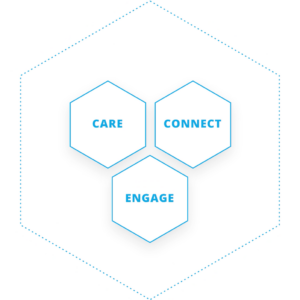
            Having grown beyond its origins as Australia’s pioneering, cloud-based practice management system, the MediRecords platform is now underpinned by three pillars: Care, Connect and Engage. Each of these will gain major new features during 2023.
             

            Care

            The MediRecords Care pillar contains core clinical features such as patient records, ePrescribing, appointment management, investigations, billing and claiming, correspondence, and assessments. New Care functionality will include: 

            • Case Management – Members of a designated Care Team can view and update client case notes. This is particularly valuable where care is shared between a multidisciplinary team working from separate locations or across different shifts. For example, mental health practitioners can collaborate with GPs and rehabilitation specialists as patients progress towards a safe return to work. 
            • Group appointments – Patients will be able to book and join group sessions or classes. This feature will enable group therapy, family consultations and community health programs, with providers able to message an entire group or individual group members. 
            • New mental health and readiness for work assessment templates are being added, including the Glasgow Coma Scale. 
            • Single provider view of appointments: Clinicians practising across multiple clinics won’t have to jump between them to view their appointments. Appointments across multiple sites will be consolidated in a single view. 
            • New communication capability: Real time chat with team members will be available throughout MediRecords, making it easier to message team members on the fly. Our new Comms bar will also provide shortcuts to SMS, email, alerts, and notifications. 
            • Inpatients – In a major new premium* feature, MediRecords will be able to support complex care, including inpatient admissions, detailed charting, clinical escalations, progress notes and Discharge Summaries. 
            • Our Letter writer tool is having a makeover and will be even easier to use, with highly requested new functionality, such as digital signatures. 
            • We’ve added industry-leading means of recording Consent (or denial of consent) and made it easier to add attachments to patient records. 
            • Custom fields and Tagging can be used in patient records, creating new and innovative ways to capture information, search records and report on data. 


            Connect 

            Many clients are familiar with our Connect site. MediRecords was an early adopter of FHIR (Fast Health Interoperability Resources) and API technology and new options for using these to share data are on the way. We have proven integrations with patient monitoring devices, patient-reported outcome and engagement measure systems (PROMs and PREMs), dictation technology and partner products. MediRecords is built on the SNOMED-CT-AU data coding system, which makes the data we share cleaner and primed for analytics. 

            • We now have FHIR integrations with enterprise products such as hospital patient administration systems (PAS) and scanned medical record software. This means a patient record created or updated in MediRecords can be pushed up into hospital systems, ensuring consistency of records and supporting better patient safety. Current options include allergies, medication requests and dispense notifications. 
            • New FHIR resources to be added throughout 2023 include referrals, diagnostic requests, diagnostic reports, and vital signs.  


            Engage 

            MediRecords has already connected over 60,000 patients to healthcare records via our patient mobile app. This enables consumers to book appointments, see medication information, receive reports and educational resources, and access and store personal health documents. We’re taking this to the next level in 2023 with an entirely new patient engagement platform. This will include new features such as:  

            • Real time surveys and forms 
            • Clinical assessment and observations data for remote monitoring 
            • In-appointment chat functionality 
            • Secure web access to personal health data. 

            Frequently asked questions

            MediRecords 2.0 is an overhaul of our current platform rather than a new product. All existing customers will transition to 2.0. Sticking with the old MediRecords format will not be an option.

            We will perform the update remotely. Users won’t have to download or do anything.

            We have done our utmost to preserve familiarity and usual behaviour within the MediRecords application, but the new layout may take some adjustment. To help with this, we have been providing Lunch and Learn sessions for clients. Please reach out to our training team if you have any further questions, [email protected].

            Development will finish in March. Rigorous testing will follow before pilot sites switch to 2.0 in late April. Once we have considered their feedback, we’ll finalise the date for general release and shout it from the rooftops to let you know. 

            If you are a current client, please contact your Account Manager if you would like to be a test pilot for these new features. Limited places are available.  

            MediRecords 2.0 is an upgrade of your existing system and will be covered by usual licence fees. However, some of the optional new features will be Premium products and require additional fees. Details will be published as soon as possible. 


            For other questions, please email [email protected].

            Looking to stay updated with the latest from MediRecords?

            Sign up to the newsletter

              Federal Government digital health upgrade grants on the way

              Federal Government digital health upgrade grants on the way

              Update: 24 April 2023

              New details are now available on the Strengthening Medicare General Practice Grants.

              Grants of $25,000, $35,000 or $50,000 are available depending on practice size. The grants will be administered by your local Primary Health Network (PHN) or the National Aboriginal Community Controlled Health Organisation (NACCHO). To take advantage of this funding, complete a grant application sourced via your PHN or NACCHO.


              MediRecords welcomes the news that Federal Government grants aimed at helping to enhance digital health capability for Medicare general practices and Aboriginal Community Controlled Health Services (ACCHS) will become available from April. 


              General practices and ACCHS will be eligible for one-off grants of up to $50,000 for innovation, training, equipment, and minor capital works under three categories:

              1. Enhance digital health capability – Accelerate moves to a more connected healthcare system that meets future standards;
              2. Upgrade infection prevention and control arrangements – Ensure infectious respiratory disease (e.g. COVID, influenza) patients can be safely seen face-to-face; and/or
              3. Maintain and/or achieve accreditation against the Royal Australian College of General Practitioners (RACGP) Standards for General Practice to promote quality and safety in health care.

              The grants were an election promise from then opposition leader Anthony Albanese in May 2022. The Strengthening Medicare – GP Grants Program was subsequently allocated $220 million in the October 2022 federal budget.

              Medicare general practice grants will be administered by local Primary Health Networks (PHNs) and ACCHS grants by the National Aboriginal Community Controlled Health Organisation (NACCHO). Practices and health services owned or operated by a state, territory or local government agency are ineligible.

              MediRecords Chief Executive Officer Matthew Galetto welcomed the move and said he hoped it signalled a shift to better data connectivity between GPs and the broader health care system.

              “We would like to see incentives for general practices to switch to the cloud, given the environmental, security and interoperability benefits that flow from leaving behind legacy software and hardware systems.”

              Mr Galetto said the grants program was an opportunity for the Federal Government and PHNs to drive industry-wide reform and boost adoption of new technology platforms.

              “Just as PIP (Practice Incentives Program) grants helped shift GPs from paper-based systems to electronic, this grant funding should seek to do the same for next generation interoperable technology.”

              “This is bigger than improving the My Health Record. There is an opportunity to follow the United States example and provide genuine connectivity of digital health records for patients, from primary to tertiary care.”

              MediRecords is a true cloud electronic health record system featuring global standards-based interoperability and SNOMED-CT-AU clinical coding. MediRecords pioneered cloud practice management software in Australia and is now used by general practitioners, specialists, multidisciplinary clinics, hospitals, and government departments.

              Practices considering using their grant to upgrade to cloud clinical software are welcome to reach out to MediRecords. We provide onboarding services including training, data migration and configuration of electronic prescribing, telehealth integration, Medicare claiming and more.


              Looking to stay updated with the latest from MediRecords?

              Sign up to the newsletter

                Health care reform: No gain without pain
                 

                A fundamental failing of our health system

                November 24, 2022

                Health care reform:
                No gain without pain

                A shift to value-based care in Australia may be inevitable but is unlikely to be painless. This post is the first in a series looking at healthcare industry issues.

                Australia has a unique set of problems to overcome, said David Rowlands, a member of the Roster of Digital Health Experts at the World Health Organization (WHO).

                He told the October Wild Health Summit: “What we are seeing are symptoms of a fundamental failing of our health system.”

                “Our health system was designed 50 years ago for problems of 50 years ago. (It) was not designed to deliver integrated, value-based care. It was designed to deliver episodic care.”

                Episodic care is provided to patients who need treatment for an “episode” of care with a foreseeable “endpoint”. Examples include cases treated in hospital Emergency Departments.

                The focus in Australia’s health care system, Mr Rowlands said, is on outputs, not outcomes.

                Value-based care uses a model where providers, including hospitals and physicians, are paid based on patient health outcomes. Under value-based care agreements, practitioners are rewarded for helping patients improve their health, reduce the effects and incidence of chronic disease, and live healthier lives.

                The “value” in value-based healthcare is paid after measuring health outcomes against the cost of delivering them.

                In contrast, episodic care is paid on an activity-based or fee-for-service model measuring the amount of healthcare services delivered.

                Mr Rowlands said tinkering with the system will fail. “After 50 years, it’s time for a review.” He said the Australian system needed independent, external experts to determine the way forward. He cited Lumos, a new partnership between the NSW PHNs and the NSW Ministry of Health, as an example of doing things differently.

                Lumos generates insights into patients’ journeys across the health system and shares de-identified data from general practices with other health services to provide a comprehensive view of patient pathways.
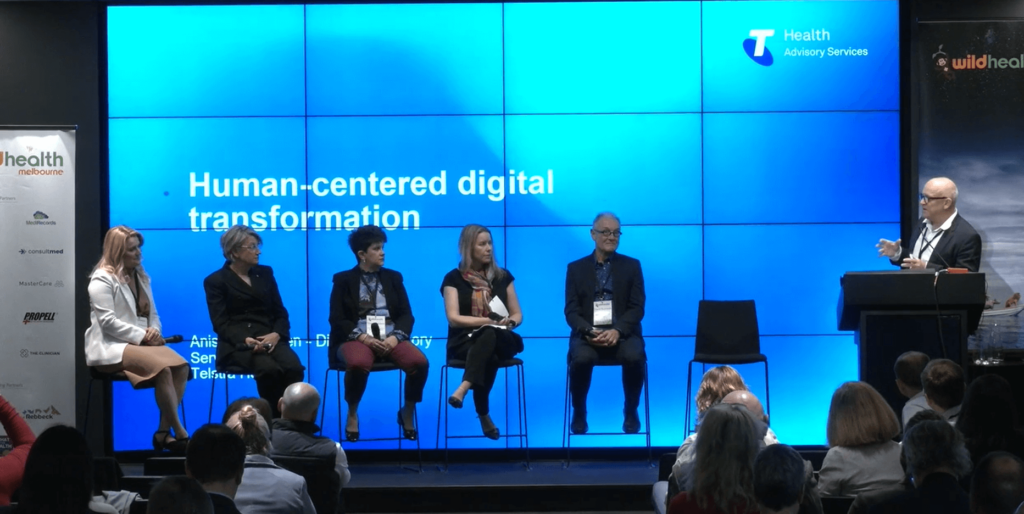
                Elisabeth Koff, the managing director at Telstra Health and immediate past secretary at NSW Health, said she had helped negotiate health agreements and most came down to money rather than a strategic approach to healthcare.

                She said reform agreements focusing on outcomes had been negotiated but, “then we forget about them, and they sit on the shelf”.

                While there had been progress in New South Wales around collaborative communities, Ms Koff said change would be slow as governments are focused on the short term and, “health care reform is hard… no pain, no gain”.

                Tracey Johnson, the CEO and company secretary at Inala Primary Care, said Australia’s health system is run by “mini-empires”, each seeking individual advancement.

                “We don’t have a healthcare system,” she said. “We have a profile-for-profit system.”

                Inala reinvests any practice profits into patient care, but it was becoming difficult to provide affordable care when reliant on a $39 bulk-billing item.

                Ms Johnson said General Practice should be considered a specialist form of medical care, given the knowledge and training required. This could provide access to a wider range of Medicare-funded billing items.

                Ms Johnson pointed to the role GPs play in taking pressure off overcrowded hospitals. “Data shows where patients visit their GPs more, there were fewer hospital admissions… Comprehensive care works.” 

                MediRecords is used by general practitioners, specialists, multidisciplinary clinics and hospitals across Australia. The MediRecords electronic health records platform features embedded SNOMED CT-AU coding and is designed for interoperability using FHIR and APIs. MediRecords is currently developing additional functionality to support team case management and value-based care.

                Article originally published by Wild Health and written by Dr Leon Gettler on behalf of MediRecords.

                If you are interested in learning more about MediRecords’ functionality to support team case management and value-based care, book a demo below. 

                Looking to stay updated with the latest from MediRecords?

                Sign up to the newsletter

                  FHIRing up the Australian Defence Force
                   

                  FHIRing up the Australian Defence Force

                  Hear how FHIR is connecting the entire Defence health ecosystem with OntoServer at its heart!

                   
                  At the recent Inaugural Australasian CXO Healthcare Cloud Summit in Sydney, MediRecords CEO and Founder, Matthew Galetto, presented a case study on how FHIR is connecting the entire Defence health ecosystem. 
                   
                  View the video below! 
                   
                  Looking to stay updated with the latest from MediRecords?

                  Sign up to the newsletter

                    Taking the pulse on digital health
                     

                    Taking the pulse on
                    digital health

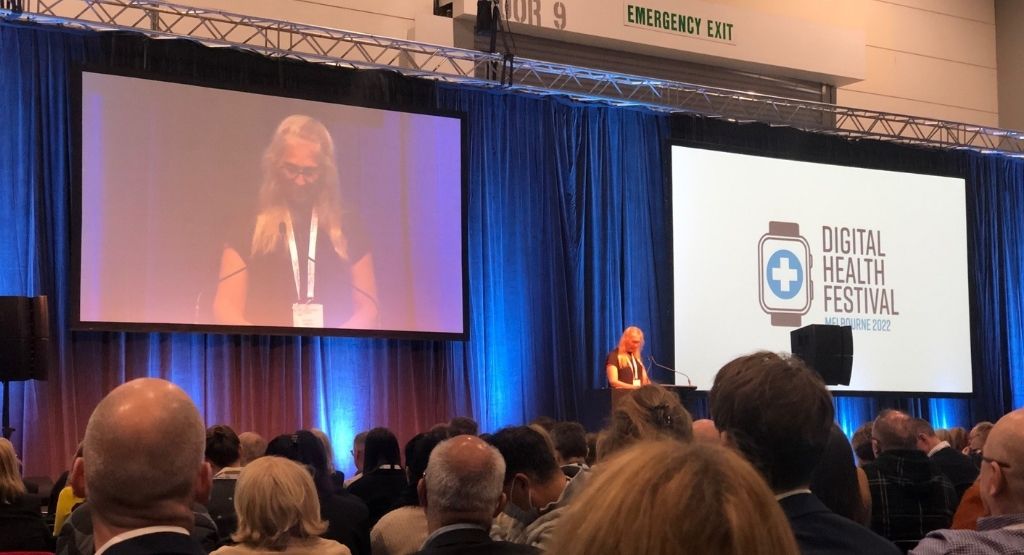
                    MediRecords attended a packed Digital Health Festival in an icy Melbourne on 31 May and 1 June. The conference was the largest face-to-face event since the pandemic and attracted international speakers and delegates from across Australia.


                    A recurrent theme was that telehealth has been normalised during the pandemic and is now an everyday tool for doctors and specialists. But while digital and virtual care technology is widely used, too many systems still don’t share information and healthcare professionals are fed up with having to use multiple, disconnected products.

                    Here are some snapshots from the festival:

                    Australian Digital Health Agency CEO Amanda Cattermole said the agency remains committed to a connected healthcare system through which data passes, “seamlessly, safely and securely”. Ms Cattermole said a new National Digital Health Strategy is imminent and that the ADHA has three key roles:

                    1. Creating a collaborative environment that accelerates adoption of digital technology, including stewarding and supporting state government initiatives.
                    2. Building and providing ‘infrastructure glue’ that is FHIR enabled, web-based and includes a new health API gateway to national digital health systems, due by the end of 2022.
                    3. Co-designing a governance framework, or the ‘guardrails’ for a national healthcare interoperability plan.

                    ADHA projects under way also include:

                    • a national digital children’s health record, replacing state-based systems
                    • a framework for sharing population health data ethically and securely
                    • a national digital imaging platform for diagnostic medical imaging, and
                    • a My Health Record mobile app.
                    Dr Paresh Dawda, Director and Principal at Prestantia Health and Next Practice in Canberra, illustrated the importance of user experience design and interoperable health data systems by talking about a typical work day. Dr Dawda spends an estimated eight minutes every morning logging into 16 different clinical systems. Cumulatively that’s more than 30 hours per year that he can’t spend on patient care and the cost to his business could be $9800 per clinician per year. While digital technology, “is often held up as the solution to clinician burnout, it can also be part of the problem”, he said. True interoperability would mean clinicians could use fewer systems to access the same amount of data, freeing time to dedicate to patient care.
                     

                    My Emergency Doctor founder and Medical Director Justin Bowra explained how virtual ED doctors help improve patient flow and reduce clinical risks at hospitals and urgent care centres. Dr Bowra said MED clinicians conduct case conferences via video calls, including reviewing the status of patients waiting in ambulances. The case conferences enable patient flow decisions that reduce ED wait times, such as advising that patients can go direct to theatre. The service also provides clinical decision support and mentoring to on-site doctors and an auditable recording of all interactions.

                    Caligo Health Managing Director Dr Amandeep Hansra said the COVID-19 pandemic had catapulted digital health innovation forward by at least a decade, creating created consumers who are actively engaged in their care and demand access to and control of personal data. The pandemic had also created a mountain of data — 30% of global data comes from health — that could be the foundation for scalable analytics and AI-driven businesses. 

                    e-Health Queensland Health Deputy Director General Damian Green walked festival goers through the Sunshine State’s digital strategy, emphasising the importance of human-centered design and delivering equitable healthcare access for First Nations peoples and diverse communities. Mr Green said clinicians were required to work with too many products and ‘system sustainability’ would necessitate fewer systems with the requisite data for better decision making. He said safety was at the heart of all digital investment decisions and told vendors, “if you can show you are going to improve outcomes, then talk to us.”

                    Victorian Department of Health Chief Digital Officer Neville Board placed patient safety as the destination for the Garden State’s digital health roadmap. Mr Board said reducing risks to patients caused by paper-based processes was a major priority and showed how e-prescribing significantly reduces risks of medication errors. Victoria has also committed to a Health Information Exchange that enables interchange of information between all hospitals.
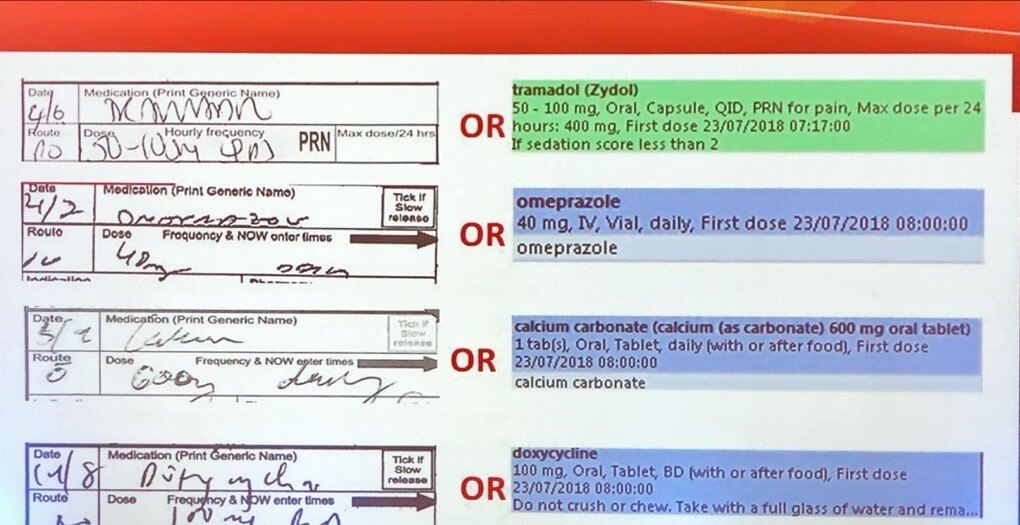
                    Neville Board placed patient safety as the destination for the Garden State’s digital health roadmap. Mr Board said reducing risks to patients caused by paper-based processes was a major priority and showed how e-prescribing significantly reduces risks of medication errors. Victoria has also committed to a Health Information Exchange that enables interchange of information between all hospitals.

                    Victorian Chief Digital Officer Neville Board highlights the risks of handwritten medication notes.

                    Alcidion CEO Kate Quirke said procurement processes in Australia were a deterrent to innovation and that many Proof of Concept projects did not proceed to implementation because contractual requirements were too onerous.

                    Former Deputy Chief Medical Officer Dr Nick Coatsworth said healthcare start-ups need to be thoroughbreds capable of going the distance, rather than flashy unicorns. And the secret to designing an enduring product? Make sure you’re solving problems for patients and their families.

                    Dr Emma Rees, Founder and CEO of women’s healthcare platform Femma, said health care should not cease when a patient leaves the room and be suspended until a follow-up appointment. Dr Rees said “the future of healthcare is a hybrid model” where patients have clinically curated, individual management plans and on-demand access to education materials and nutritional, exercise, mindfulness and yoga programs.

                    Image courtesy of ResApp

                    Australian start-up ResApp has developed a digital diagnostic app for respiratory illnesses, available on mobile devices. The ResApp tool listens to a patient cough five times and then sends a report direct to a GP. ResApp CEO Dr Tony Keating said trials in India and the US had shown a high level of accuracy in diagnosing COVID-19. Using the app for initial diagnosis could make up to 80% of RAT and PCR testing unnecessary, bringing immediate benefits for patients, cost savings for governments and environmental benefits. 

                    The Global Healthcare Lead for Zoom, Ron Emerson, said research by a leading US healthcare provider had shown that 70 per cent of patients attending at urgent care facilities could be safely seen by a virtual health care clinician, helping to relieve pressures on overcrowded hospitals. Zoom is now being used by prestigious US healthcare organisations, including the Mayo Clinic, Johns Hopkins and New York Presbyterian hospitals.

                    More from the Blog

                    Looking to stay updated with the latest from MediRecords?

                    Sign up to the newsletter