Federal Government digital health upgrade grants on the way

Federal Government digital health upgrade grants on the way

Update: 24 April 2023

New details are now available on the Strengthening Medicare General Practice Grants.

Grants of $25,000, $35,000 or $50,000 are available depending on practice size. The grants will be administered by your local Primary Health Network (PHN) or the National Aboriginal Community Controlled Health Organisation (NACCHO). To take advantage of this funding, complete a grant application sourced via your PHN or NACCHO.


MediRecords welcomes the news that Federal Government grants aimed at helping to enhance digital health capability for Medicare general practices and Aboriginal Community Controlled Health Services (ACCHS) will become available from April. 


General practices and ACCHS will be eligible for one-off grants of up to $50,000 for innovation, training, equipment, and minor capital works under three categories:

  1. Enhance digital health capability – Accelerate moves to a more connected healthcare system that meets future standards;
  2. Upgrade infection prevention and control arrangements – Ensure infectious respiratory disease (e.g. COVID, influenza) patients can be safely seen face-to-face; and/or
  3. Maintain and/or achieve accreditation against the Royal Australian College of General Practitioners (RACGP) Standards for General Practice to promote quality and safety in health care.

The grants were an election promise from then opposition leader Anthony Albanese in May 2022. The Strengthening Medicare – GP Grants Program was subsequently allocated $220 million in the October 2022 federal budget.

Medicare general practice grants will be administered by local Primary Health Networks (PHNs) and ACCHS grants by the National Aboriginal Community Controlled Health Organisation (NACCHO). Practices and health services owned or operated by a state, territory or local government agency are ineligible.

MediRecords Chief Executive Officer Matthew Galetto welcomed the move and said he hoped it signalled a shift to better data connectivity between GPs and the broader health care system.

“We would like to see incentives for general practices to switch to the cloud, given the environmental, security and interoperability benefits that flow from leaving behind legacy software and hardware systems.”

Mr Galetto said the grants program was an opportunity for the Federal Government and PHNs to drive industry-wide reform and boost adoption of new technology platforms.

“Just as PIP (Practice Incentives Program) grants helped shift GPs from paper-based systems to electronic, this grant funding should seek to do the same for next generation interoperable technology.”

“This is bigger than improving the My Health Record. There is an opportunity to follow the United States example and provide genuine connectivity of digital health records for patients, from primary to tertiary care.”

MediRecords is a true cloud electronic health record system featuring global standards-based interoperability and SNOMED-CT-AU clinical coding. MediRecords pioneered cloud practice management software in Australia and is now used by general practitioners, specialists, multidisciplinary clinics, hospitals, and government departments.

Practices considering using their grant to upgrade to cloud clinical software are welcome to reach out to MediRecords. We provide onboarding services including training, data migration and configuration of electronic prescribing, telehealth integration, Medicare claiming and more.


Looking to stay updated with the latest from MediRecords?

Sign up to the newsletter

    MediRecords on FHIR at Northern Health
     

    MediRecords on FHIR
    at Northern Health

    Mental Health teams at Northern Health now have access to the MediRecords e-Prescribing platform, following successful integrations with the hospital’s patient administration system (PAS) and Clinical Patient Folder (CPF) software.


    The pioneering FHIR (Fast Health Interoperability Resources) connections mean doctors don’t have to search a second database for patient records and can generate electronic prescriptions quickly, informed by current clinical information, including allergies and medication histories. Prescription records are then sent to CPF in real time, and no longer have to be posted to patients or manually scanned and uploaded to hospital digital records.

    The FHIR go-live signals Phase 2 of MediRecords’ implementation at Northern Health, following an initial launch as a stand-alone system for Victorian Virtual Emergency Department (VVED) doctors in July 2022. Wider use of the e-Prescribing system is being adopted, with Northern’s Outpatient clinics and mental health included in a staggered roll out from 31st January 2023. This implementation was the first FHIR implementation performed at Northern Health.

    MediRecords Chief Executive Officer Matthew Galetto said Northern Health had demonstrated the benefits of using industry-leading FHIR technology to streamline data interoperability and support efficient patient care in a hospital setting.

    “It is important for healthcare organisations investing in new digital health projects to future proof their investments by adopting the latest standards. Implementing FHIR will help organisations stay ahead of the curve and meet near future regulatory requirements,” Mr Galetto said.

    Mr Galetto said MediRecords would be releasing additional FHIR integration pathways for clients throughout 2023, as part of the Connect pillar underpinning the MediRecords platform.

    “We are fortunate to be at the forefront of FHIR development in Australia, thanks to our role in the Leidos-led consortium delivering a new Health Knowledge Management (HKM) system for the Australian Defence Force,” Mr Galetto said.

    “Data sharing for the HKM project has applicability throughout Australian healthcare and means we will be able to connect health care records in primary care all the way up to hospital, or tertiary care. This will help provide patients and clinicians with access to the right data at the right time, with significant safety benefits.”

    Mr Galetto thanked Northern Health for being an early adopter of the technology, the first time MediRecords has been deployed in a hospital setting supporting virtual care.

    “The Northern Health team are pioneers in virtual care and are now leading the way in connecting patient information systems.”

    Northern Health’s Mental Health Division provides hospital-based, community and specialist mental health services to youth, adults and aged people across northern and western Melbourne. The introduction of ePrescribing means prescriptions can be sent instantly and electronically to patients or carers, with a QR code to be scanned at pharmacies for dispensing. This provides significantly faster access to new and repeat medications for mental health clients.

    Media inquiries

    For further information, please email Matthew Galetto on [email protected] or Tim Pegler at [email protected]

    Looking to stay updated with the latest from MediRecords?

    Sign up to the newsletter

      8 health-tech trends to watch in 2023
       

      8 health-tech trends to watch in 2023

      Tim Pegler

      Tim Pegler - MediRecords Senior Business Development Manager

      The pandemic years have been actioned-packed for health-tech. What have we learned and what can we expect from 2023?

      1. The cloud is (still) coming 

      Based on conversations with customers, the market is increasingly aware of the security and infrastructure benefits of shifting to cloud. So why is the transition so slow? Partly because the healthcare industry is often understaffed, time poor and therefore change averse. The good news is that those who embrace fresh and more flexible technology rarely look back.

      Speaking of shiny and new…

      2. Robots are here to help 

      Staff shortages due to illness, burnout and pandemic-related workforce changes necessitate doing more with less. We can expect automation to play a bigger role in repetitive tasks, and robots to play support and even investigative roles.

      Exhibit A: Robot dietitian RMC adds robot dietician (thetandd.com)

      Exhibit B: Robot meds Mayo Clinic picks up stake in startup making pill-sized robot (beckershospitalreview.com)

      Exhibit C: AI bed management NUHS’s AI platform predicts bed state 2 weeks in advance | Healthcare IT News

      Exhibit D: Robot cleaning crews Cameron employs robots to super clean facilities | Heraldrepublican | kpcnews.com

      The automation trend also means…

      3. Lock in telehealth

      Virtual and remote care are generally cheaper than hospital beds (How to implement a virtual ED in 10 weeks – Wild Health Summits : Connectivity) and more consumer friendly than queuing for in-person care (see The cost and carbon savings of telehealth, quantified (beckershospitalreview.com)). Virtual mental health care, in particular, appears to be cementing its role. However, digital literacy and equitable access to technology, including Internet coverage, can be barriers to care.  Successful virtual care hinges on having accurate information, tools and help whenever needed so…

      4. Maybe it’s time to make new friends

      Difficulty accessing developers and tight tech budgets mean partnering can be the faster (and cheaper) path to product enhancement, in contrast to D-I-Y builds. Which means…

      5. Interoperability is king

      Products designed for integration have a strategic advantage over those that have not committed to interoperability at their core. Speaking the same language helps and Fast Health Interoperability Resources (FHIR) (Welcome to the HL7 FHIR Foundation) are the way to future-proof your health tech. Another interoperability truth is…

      6. Clean data counts

      Making sense out of a hotchpotch of data dropped into a free-text box is time consuming and painful for data analysis. Storing information in a logical, consistent and correctly coded format (MediRecords uses SNOMED CT AU SNOMED CT-AU and Australian Medicines Terminology June 2022 Release | Australian Digital Health Agency) helps the data wranglers do their thing. Quality, clean, actionable data has value and needs to be kept safe because…

      7. Cyber attacks are on the rise

      US data shows ransomware attacks more than doubled from 2016 to 2021 (JAMA Health Forum – Health Policy, Health Care Reform, Health Affairs | JAMA Health Forum | JAMA Network). The UK and Australia are also under siege. Minimising risk is mandatory and, while no system is risk-free, cloud technology allows you to outsource security management and those never-ending software updates so you can concentrate on core business.  This is important because…

      8. Change is gonna come

      Australian governments are still exploring how to introduce systemic change following royal commissions into aged care and mental health services (Victoria). Royal commissions are ongoing into disability, and defence and veteran suicide. The Australian Digital Health Agency is promoting collaboration and reform. NSW is working on a Single Digital Patient Record (SDPR). Victoria is moving toward a health-information exchange system, connected to a statewide Mental Health Client Management System. Queensland is pursuing better health information connectivity and remote monitoring options. Tasmania has a digital transformation strategy underway. There are versions of virtual emergency departments emerging across Australia…

      Buckle up. 2023 could be a wild ride.

      About MediRecords

      MediRecords is a FHIR-enabled, true cloud clinical platform with ePrescribing and telehealth integrations. MediRecords supports GP, multidisciplinary and specialist clinics across Australia and is working with Queensland Health, the Victorian Virtual Emergency Department and the Australian Defence Force on innovative models of care delivery. Please book a demo if you’d like to discuss solutions for your business.

      Want to dive deeper? Further reading below:

      2023 predictions: Health tech suppliers give their verdict (digitalhealth.net)

      What health tech trends CIOs are focused on in 2023 (beckershospitalreview.com)

      Virtual everything, asynchronous care, sustainability: Healthcare innovation predictions for ’23 (beckershospitalreview.com)

      CMIOs on what to project for 2023 (beckershospitalreview.com)

      Digital Health Review of the Year 2022

      MR.R4.CORE\Home – FHIR v4.0.1 (medirecords.com)

      Report: Telehealth accounts for about 10% of outpatient visits | MobiHealthNews

      The King’s Fund interoperability report highlights relationships and tech (digitalhealth.net)

      Russian hacking group ‘KillNet’ targets US healthcare (beckershospitalreview.com)

      2023 forecast: 7 big-picture goals for hospital leaders (fiercehealthcare.com)

      Top 10 hospital and payer trends to watch in 2023 | Healthcare Finance News

      National Digital Health Strategy and Framework for Action | Australian Digital Health Agency

      Digital Health Transformation – Improving Patient Outcomes 2022-2032 | Tasmanian Department of Health

      DOH-Strategic-Plan-Nov-2022-update.pdf (health.qld.gov.au)

      victorias-digital-health-roadmap.pdf

      Single digital patient record set to deliver vastly improved patient experience | eHealth NSW

      Looking to stay updated with the latest from MediRecords?

      Sign up to the newsletter

        MediRecords Product Update: Consent Module
         

        Product update:
        Consent Module

        MediRecords is excited to announce another product update, the Consent Module.

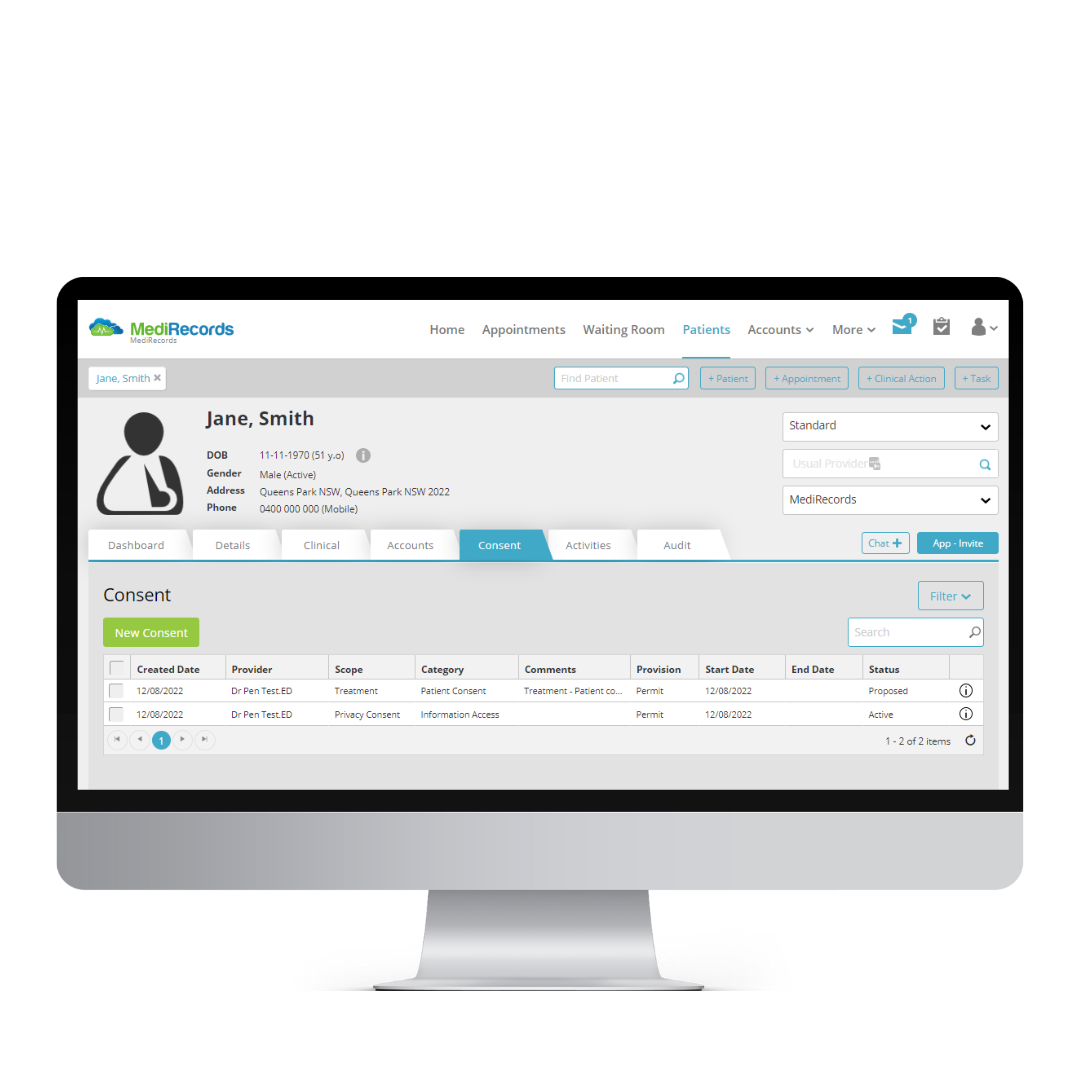
        The Consent Module addresses a critical need in healthcare – the need to capture and store electronic consent forms (and help make clipboards and paper-based questionnaires a thing of the past). 

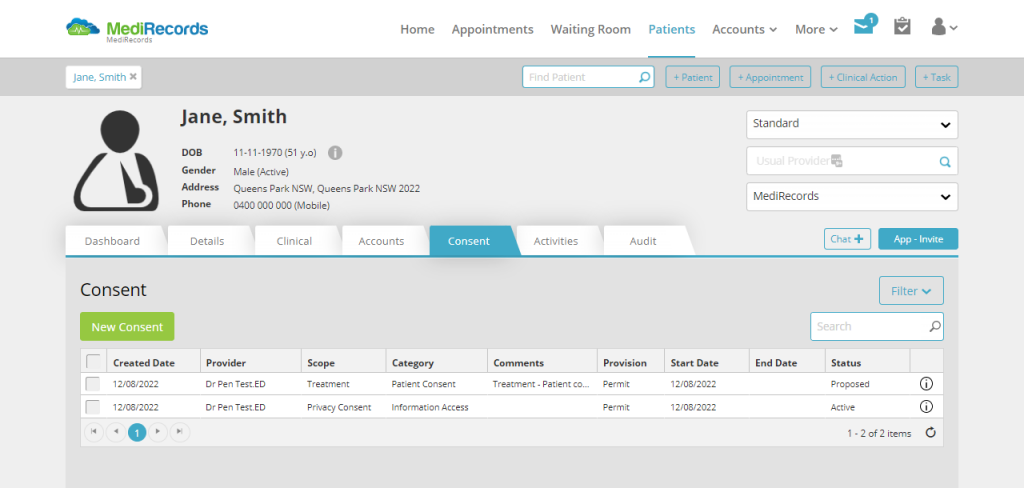
        MediRecords’ Consent Module has the flexibility to record consent for various procedure types or investigations. The Consent module is per-patient and used to capture and store the Consent type, scope, and associated documentation required (coming soon). 

        It shows exactly what the patient has provided consent for or rejected. This includes concepts such as Advanced Care Directives, information disclosure to third parties, acceptance of privacy policies and more. 

        You can open this new feature via a new tab at the top of the patient record, for quick viewing access. Potential ways to use the Consent Module include: 
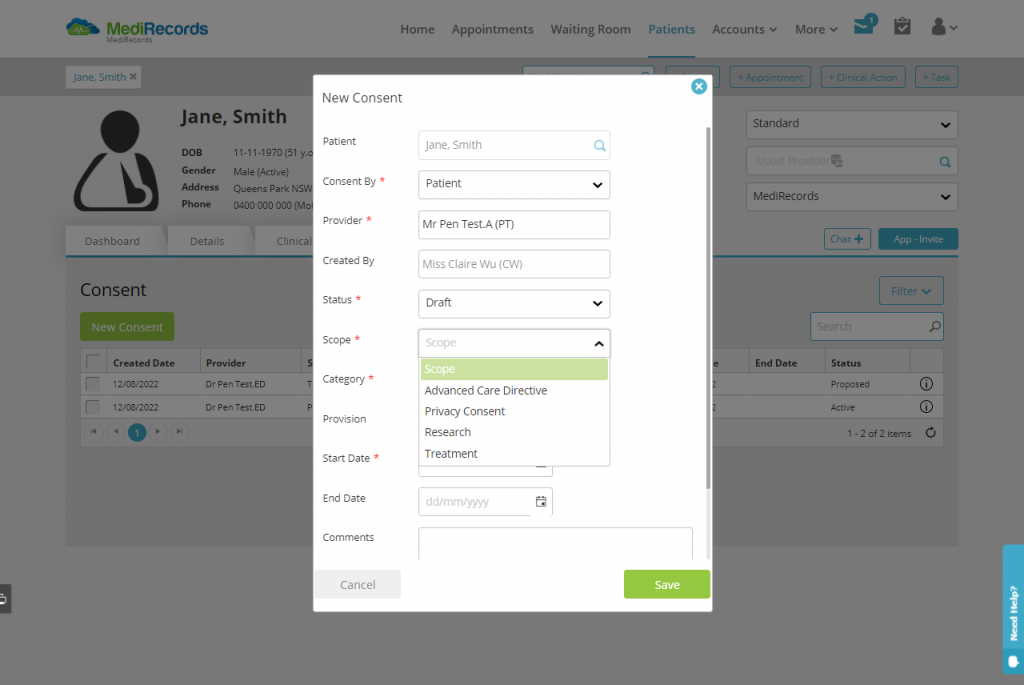
        1. New Patient Registration form – patients can sign consent for a practice to begin collecting their medical information 
        2. Advanced Care Directive – patient provides consent for their care if they become unable to make these decisions themselves 
        3. Procedural consent – Useful in pre-admission workflows – consent for upcoming procedures or treatment 
        4. Do Not Resuscitate – orders given by the patient not to resuscitate if they fall unconscious

        Future enhancements are imminent for this feature. In future releases you will be able to upload a Consent document directly to the Consent record, so that you can store paper consent forms along with electronic records.  

        To learn more about the Consent Module and how you can implement it for your business, please follow the link to our Knowledge Base articles below or contact our friendly Support team. 

        If you have feedback on our new feature, please reach out to your account manager. We would love to hear from you!  

        Consent Module Support Knowledge Base article 

         All new customers are welcome to book a demonstration to learn how MediRecords can support your organisation today

        Looking to stay updated with the latest from MediRecords?

        Sign up to the newsletter